On this page

THE BIG IDEAS
- The Big Dipper is an asterism in Ursa Major.
- It is not continuously visible from every northern location.
- Its outer bowl stars can guide you toward Polaris.
An asterism inside a constellation
The Big Dipper is a familiar seven-star pattern within the larger constellation Ursa Major. A recognisable pattern that is not itself an entire official constellation is called an asterism. The four-star bowl and three-star handle are useful shapes even if you have never seen a drawing of the Great Bear.
The same stars have names and stories in many cultures. For practical identification, concentrate first on the shape and relative brightness. Cultural interpretation and an astronomical map serve different purposes.
Check whether the whole pattern is up
Many northern guides describe the Big Dipper as always visible, but that does not apply everywhere. From low northern latitudes such as coastal Karnataka, parts of the pattern can set below the horizon. A high-latitude photograph can therefore be misleading.
Use a planetarium with your date, time and location. Inspect the northern horizon and choose a time when the bowl and handle are clearly above it. Do not assume that a familiar seasonal label guarantees an unobstructed view from your site.
Find the bowl before following pointers
Identify the two stars forming the bowl’s outer edge, opposite the handle. A line through these stars extends toward Polaris in one direction. Compare the direction with a chart and continue to the relatively modest star near the end of the Little Dipper’s handle.
Polaris is not dramatically brighter than everything around it. The pointer method depends on pattern recognition. If your chosen line leads to a brilliant low object on the wrong side of the sky, revisit the bowl identification.
Explore a second detail
The bend in the handle contains Mizar. Under suitable conditions, a nearby point called Alcor can be noticed beside it. Binoculars make the pair easier to separate. Treat this as a viewing comparison rather than an eyesight competition: light pollution, focus and individual vision all affect the result.
Draw the handle and mark which points you see before looking at a detailed chart. The exercise helps separate direct observation from information supplied afterwards.
Watch the signpost turn
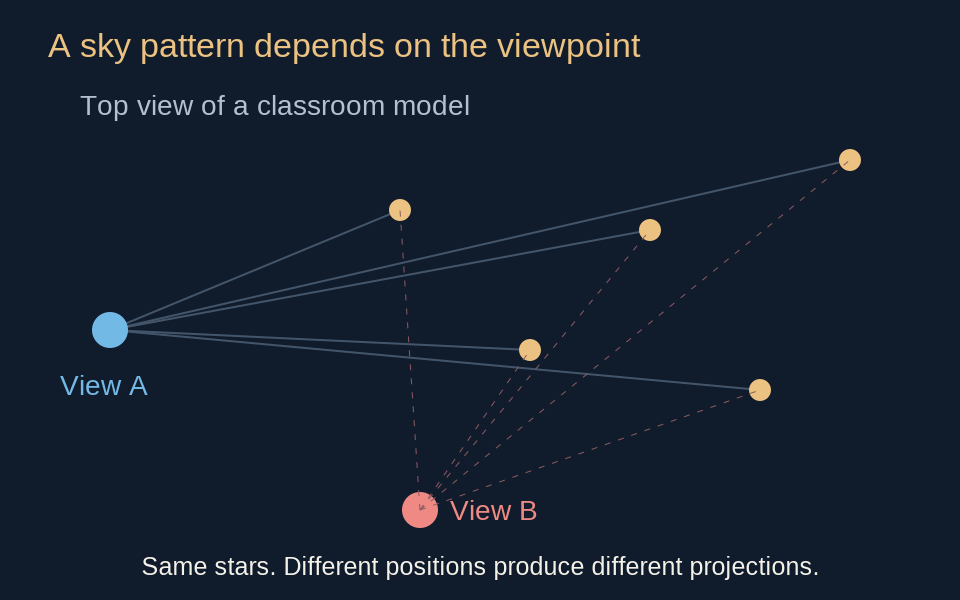
Sketch the bowl and handle relative to the horizon, then compare on another date at the same clock time. The pattern’s orientation changes because the nighttime view shifts through the year as Earth travels around the Sun. During a single night, Earth’s rotation also carries it around the celestial pole. Keep these two timescales separate in your notes and avoid interpreting either apparent motion as the stars physically circling Earth.
PAUSE AND THINK
Why should a Karnataka observer check a chart even if a northern guide calls the Big Dipper circumpolar?
Explore the answer
Whether a star stays above the horizon depends on latitude; a pattern that remains visible farther north can partly set at a lower latitude.