TRY IT YOURSELF
Approximate true field of view
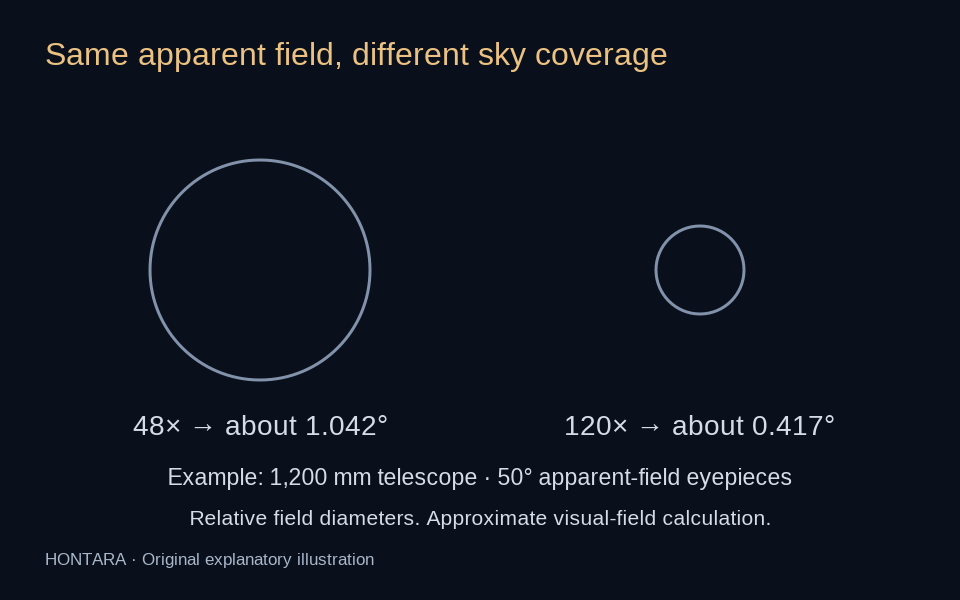
50° ÷ 48 = about 1.042°
On this page
THE BIG IDEAS
- True field is estimated from apparent field and magnification.
- All focal lengths must use matching units.
- This is a visual-eyepiece estimate rather than a camera field calculation.
Read the specifications before entering numbers
Enter the eyepiece’s apparent field in degrees, the telescope focal length in millimetres and the eyepiece focal length in millimetres. Use the optical focal length rather than the tube’s physical length. The Barlow factor is 1 when none is fitted.
The calculation first finds magnification, then divides apparent field by that magnification. The answer is an approximate true angular field in degrees. It describes a width of sky rather than a physical diameter in kilometres.
Check a worked example
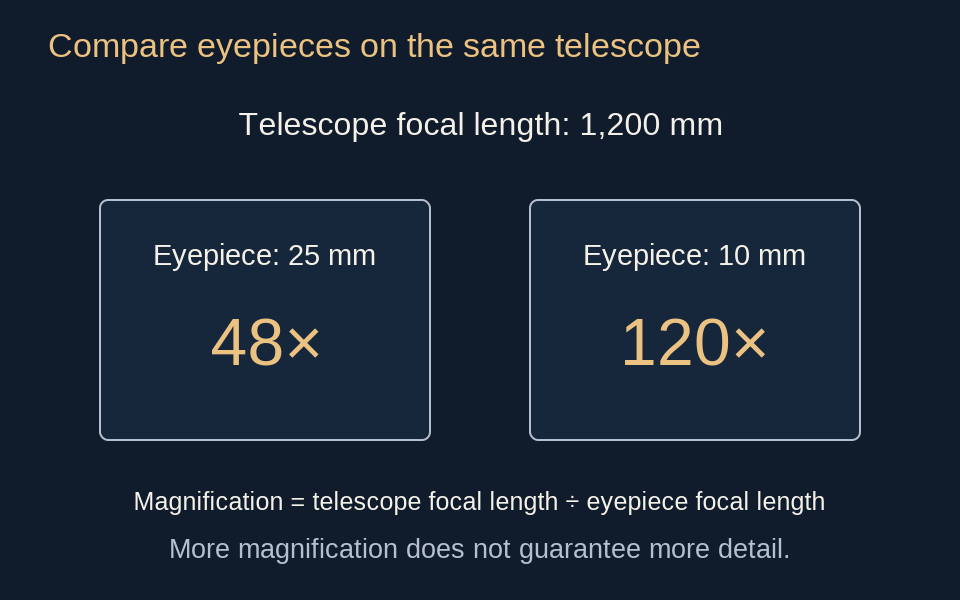
With a 1,200 mm telescope and 25 mm eyepiece, magnification is 1,200 ÷ 25 = 48×. A specified apparent field of 50 degrees gives 50 ÷ 48 = 1.0417 degrees, displayed here as about 1.042 degrees.
Keep the telescope and apparent field fixed, then enter a 10 mm eyepiece. Magnification becomes 120× and the estimated field is about 0.417 degrees. Adding a nominal 2× Barlow to that combination produces about 0.208 degrees. These changes follow from the example inputs; they do not measure a particular eyepiece.
Use the estimate for a decision
Write the target’s approximate angular size beside the result. If the target is wider than the field, begin with another combination or plan to inspect separate parts. Leave room for recognising surrounding stars rather than aiming for an exact edge-to-edge fit.
A large cluster can require a wider field than a small bright planet. This is a question about framing as well as magnification. Try two combinations on a known night target and sketch the field boundary. A numerical fit does not establish that a faint target will be detectable.
Know the limits of the shortcut
The apparent-field division is an approximation. The eyepiece field stop and optical distortion influence the actual field. Published specifications and nominal Barlow factors also have limits. Use a field-stop method or a properly designed measured test if a more accurate field is needed.
This calculator is for visual eyepiece combinations. A camera sensor’s field needs different inputs, including sensor dimensions and the optical arrangement. Do not use the displayed result as a camera framing prediction or as a promise of visible detail.
PAUSE AND THINK
A 60-degree eyepiece is used at 100×. What field does this shortcut predict?
Explore the answer
About 0.6 degrees. At 200× with the same apparent field, the estimate is about 0.3 degrees.