On this page
THE BIG IDEAS
- Magnification and aperture describe different properties.
- Correct eye spacing and focus prevent a frustrating view.
- Support can improve a binocular observation substantially.
Read the two numbers
A binocular marked 8×42 has eight times magnification and front lenses approximately 42 millimetres across. The first number describes image scale; the second describes aperture. Larger numbers do not automatically mean a better beginner experience because weight, steadiness and field of view also matter.
Use an available pair before deciding whether anything else is needed. A comfortable instrument that you can hold steadily is more useful than a heavier one that makes every star shake across the field.
Adjust before observing
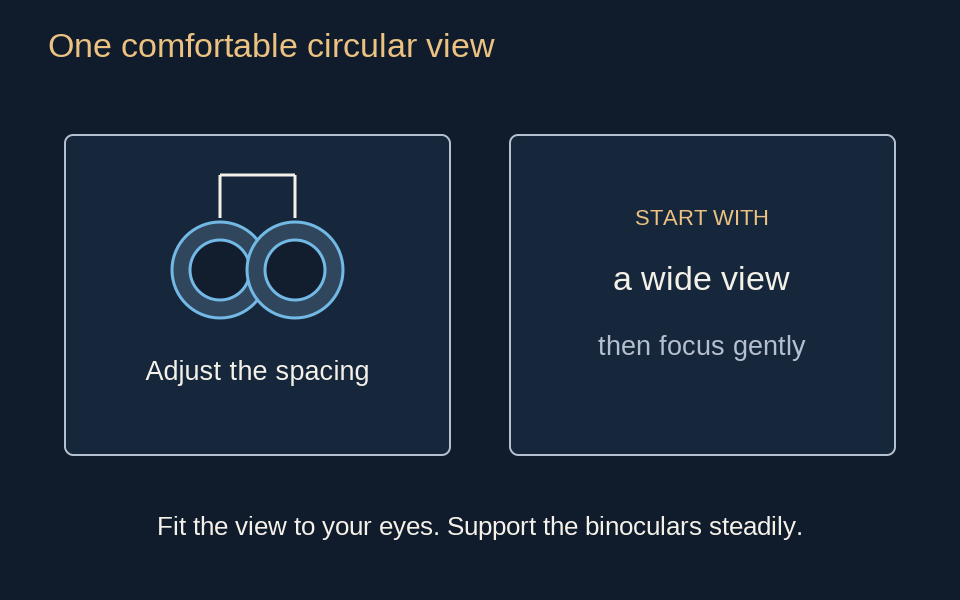
Move the barrels closer together or farther apart until you see one circular field instead of two overlapping circles. If the binocular has a separate adjustment for one eye, follow its instructions to match your eyes. Use a distant terrestrial target well away from the Sun to practise in daylight.
Never use binoculars to search near the Sun. They concentrate sunlight and can cause permanent injury. For the first sky session, choose nighttime Moon or star targets rather than a planet close to sunrise or sunset.
Support the view
Sit with your back supported and rest your elbows when practical. Do not balance on a wall or stand near an unprotected edge to gain a few degrees of sky. Some binoculars accept a suitable tripod adapter, but a mount must be stable and compatible with the instrument.
When switching targets, lower the binoculars and locate the broad region with your eyes first. Raise them without changing your gaze. This is often easier than sweeping randomly through an unfamiliar field.
Choose wide targets
The Moon, the Pleiades and rich star fields are useful starting points when visible. Binoculars reveal more stars and some lunar texture while keeping a broad context. Saturn’s rings and fine planetary surface details are not dependable handheld binocular targets.
Expect faint nebulae and galaxies to look like subtle patches rather than colourful photographs. A dark sky and steady view often help more than trying to magnify an object that already occupies much of the field.
Run a steadiness experiment
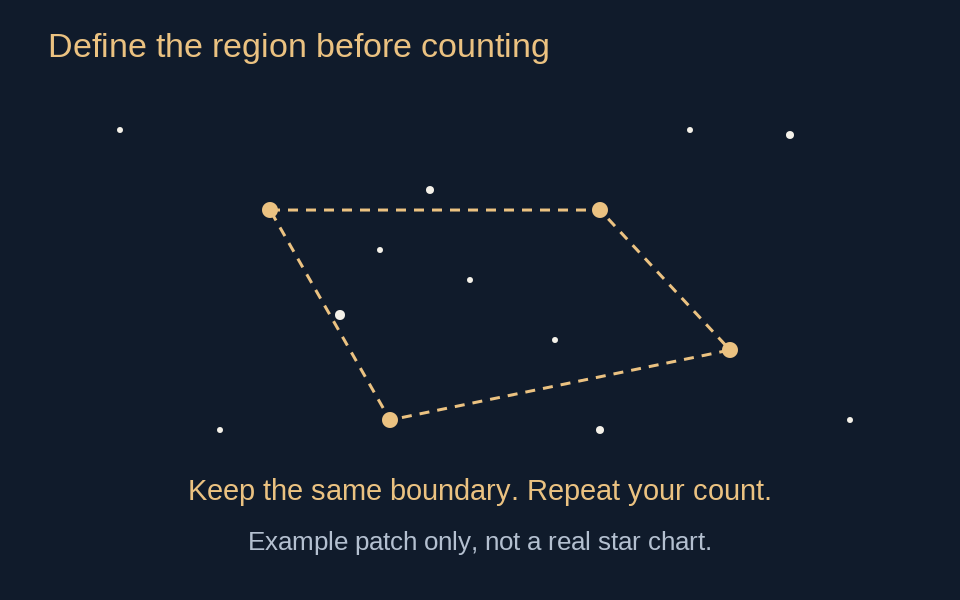
Observe the same small star group while standing freely and then while seated with your elbows supported. Count only points you can distinguish confidently and sketch the arrangement both times. Record whether the support made faint stars easier to notice. Keep your eyes relaxed and stop if the view produces strain or double images. The comparison demonstrates that useful detail depends on stable light reaching your eyes, not just the numbers printed on the instrument.
PAUSE AND THINK
Why can a lower-power binocular show more usable detail than a higher-power one held unsteadily?
Explore the answer
Reduced shaking lets you distinguish features consistently even though their image scale is smaller.