On this page
Start with what you want to see
If you want to find constellations, scan the Milky Way or take in a broad cluster in one view, start with binoculars you can hold steadily. If you mainly want to see Saturn’s rings separated from the planet or to follow the shadows along a lunar crater, start with a telescope on a stable mount.
| Target | With binoculars | With a telescope |
|---|---|---|
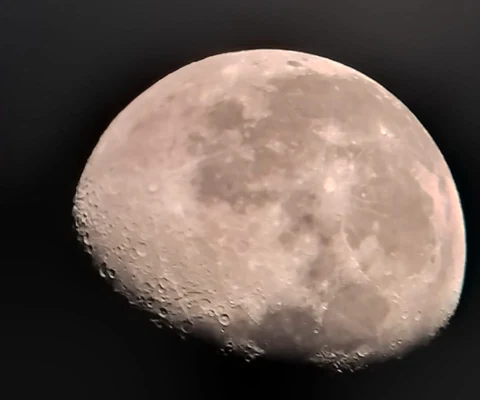
| Crescent or half Moon | See the whole shape and some large dark regions. | Follow small craters and shadows along the day-night boundary. |
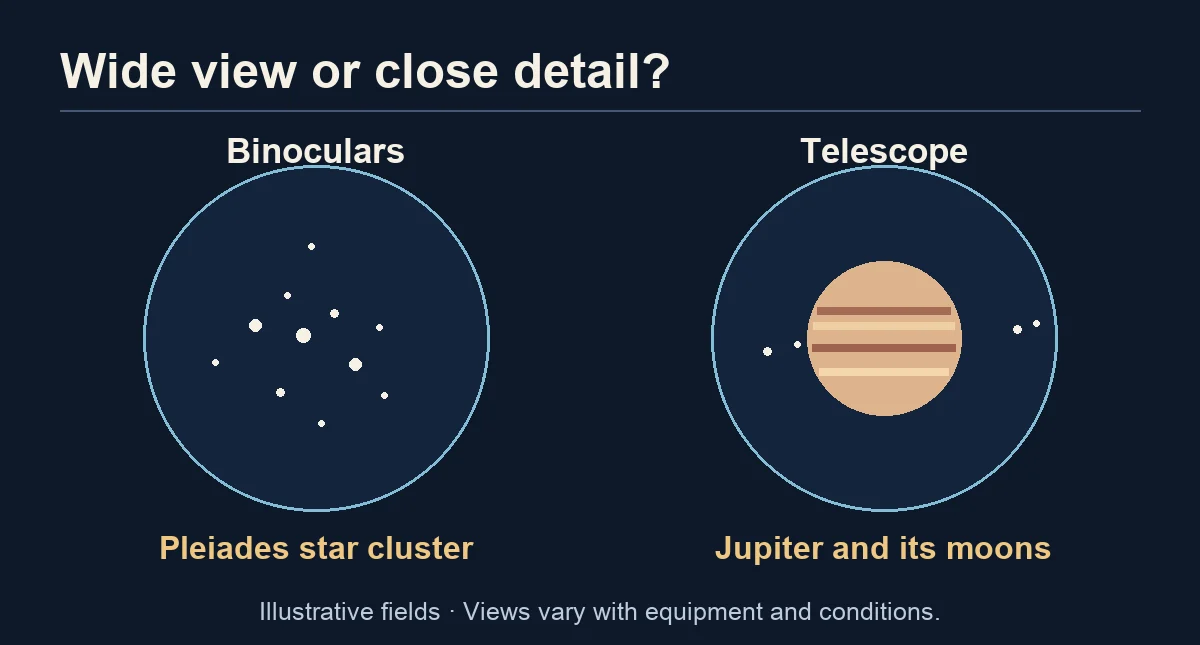
| Pleiades | See the group and surrounding stars together. | Use a low-power eyepiece for a wide enough field. |
| Jupiter | Spot the four bright moons when separated from the planet. | Look for cloud belts alongside the moving points of the moons. |
| Saturn | See a bright point or slightly elongated shape with suitable power and support. | See the rings on nights when they are sufficiently tilted and the air is steady. |
When simpler equipment shows you more
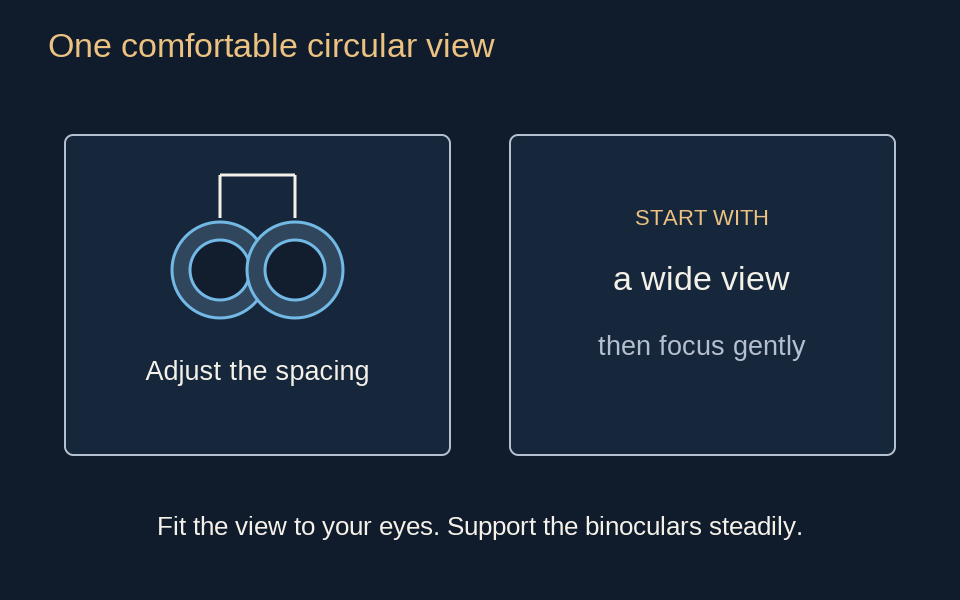
A label such as 7×50 means 7 times magnification with 50 mm objective lenses. Extra magnification also enlarges the shake from your hands. Rest your elbows, sit down or mount the binoculars. A view you can keep steady usually reveals more than a shaky view at higher power.
A telescope gives you different views by swapping eyepieces. Start low so the target is easy to find and centre. Increase power if the air stays steady and the mount can follow the target without wobbling.
Try both on the same evening
Pick one wide target and one compact target. If the Pleiades and Jupiter are both up, start with the Pleiades in binoculars and then try the lowest-power telescope eyepiece. Move to Jupiter and increase power while noting which additional detail becomes visible. If neither target is up, try a wide star field and the Moon.
For a group, binoculars give several people something to do while others take turns at a telescope. Pick targets everyone can find again after looking away.