On this page
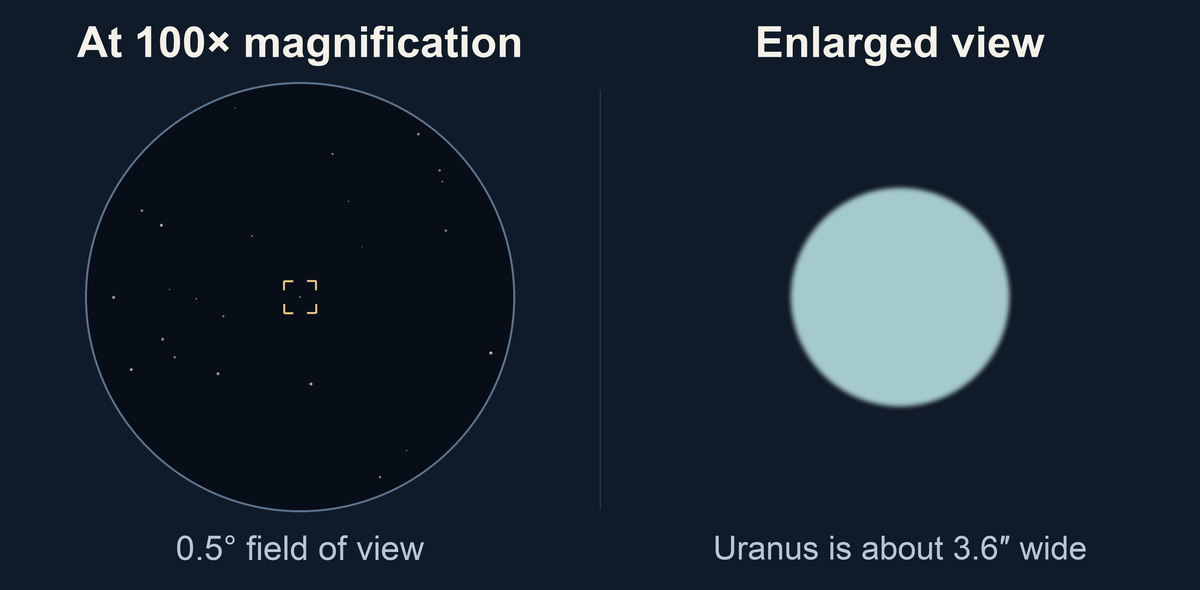
What you can see at the eyepiece
Uranus is only about 3.6 arcseconds across from Earth, though its apparent size varies with distance. In the illustrated 0.5° field, its disc spans about one five-hundredth of the width. The faint colour comes from methane in the atmosphere, which absorbs red light.
Find Uranus on a chart for your night
- Open Stellarium Web and set your observing location. Choose the date and local time you plan to go out.
- Search for Uranus and check that it will be above your horizon after dark. Give yourself a clear view in that direction.
- Zoom in until you can see the stars around it. Start at a bright star you can recognise and use your finder or lowest-power eyepiece to follow the chart to the planet.
How to tell Uranus from a star
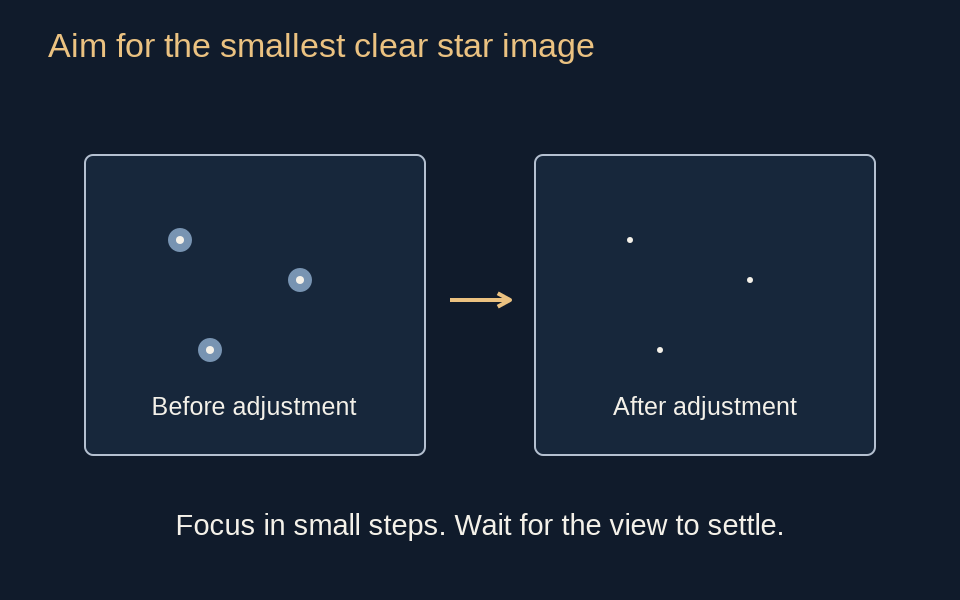
Match a triangle or pair of nearby stars to your chart first. Your telescope may rotate or mirror the view. Once you’ve matched the field, increase magnification and bring a nearby star to its sharpest focus. Uranus may still show a small disc while the star looks like a point.
If you can’t resolve the disc, sketch the object and a few nearby stars. Compare your sketch with a fresh chart a few nights later. Uranus moves against the background stars as Earth and Uranus orbit the Sun.
Can you see Uranus’s rings?
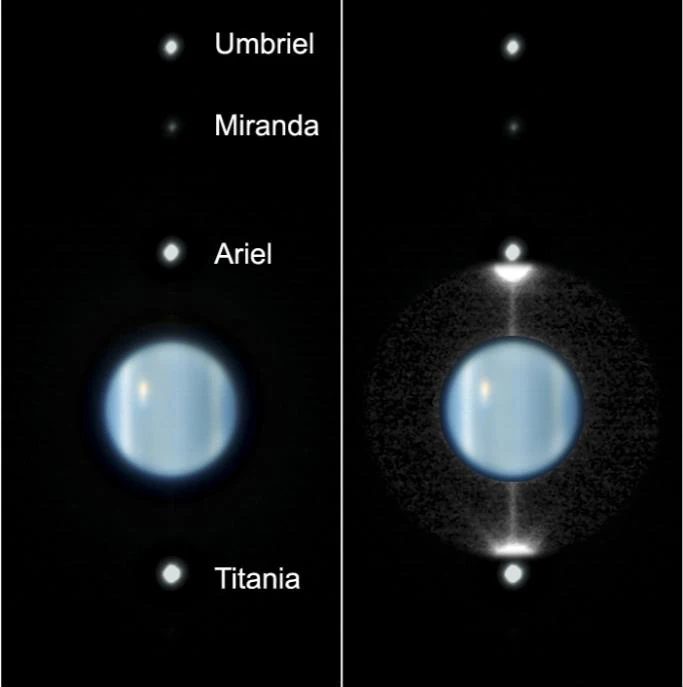
Uranus’s rings are dark and very hard to see through a small telescope. The European Southern Observatory photographed them with an infrared camera on its Very Large Telescope. The team combined images from different wavelengths and enhanced the region around the planet to reveal the rings.