On this page
THE BIG IDEAS
- Neptune requires optical equipment and a current chart.
- Several matching field stars provide stronger evidence than colour.
- Use predicted relative motion for a later confirmation.
Treat this as an identification task
Neptune is too faint for unaided-eye viewing. Binoculars or a telescope may reveal it as a small point, but finding a faint point is different from proving it is the planet. Begin with a current planetarium set to the observing location, date and time rather than an old screenshot.
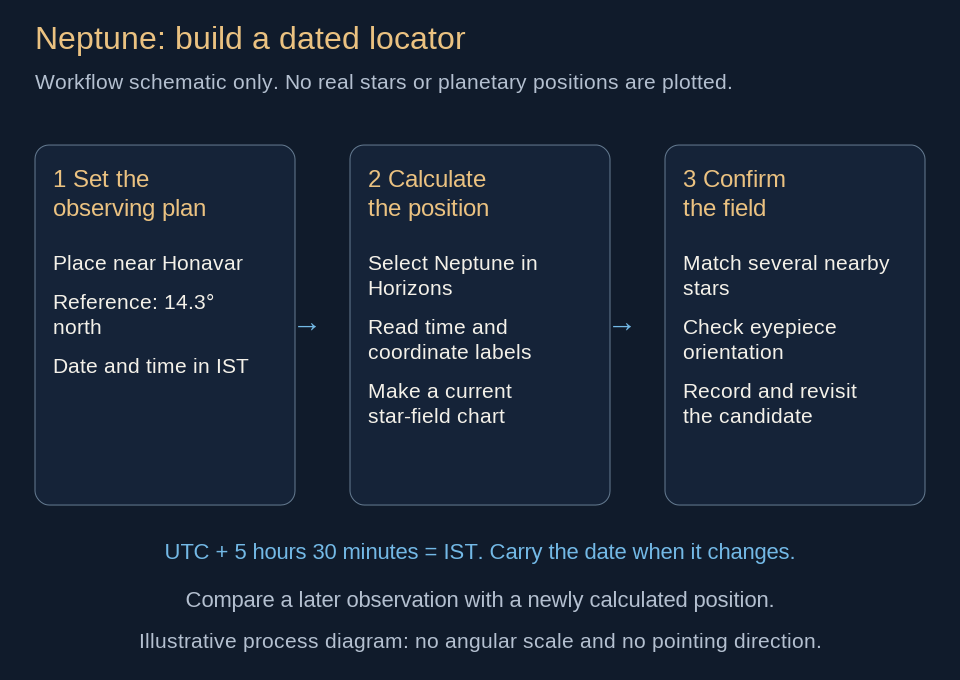
Near Honavar at roughly 14.3° north, its useful altitude depends on its current declination and the hour. Check that the planned field is well clear of buildings and trees after full darkness. Choose an accessible observing position before setting up equipment and postpone a search compromised by thick haze.
Build a dated pair of charts
Use JPL Horizons to check Neptune's observer ephemeris for the intended place and time. Record the output time standard, coordinate system and the target selected. IST is UTC plus 5 hours 30 minutes, including a date change when needed. A correct coordinate with the wrong date label can still produce a poor plan.
Prepare a broad chart that links a bright anchor to Neptune's region and a detailed chart that matches the instrument's true field. Include stars faint enough to distinguish the immediate pattern. The diagram here is an explanatory locator schematic. Its illustrative points and arrows must never be used as a pointing chart.
Reach the correct field slowly
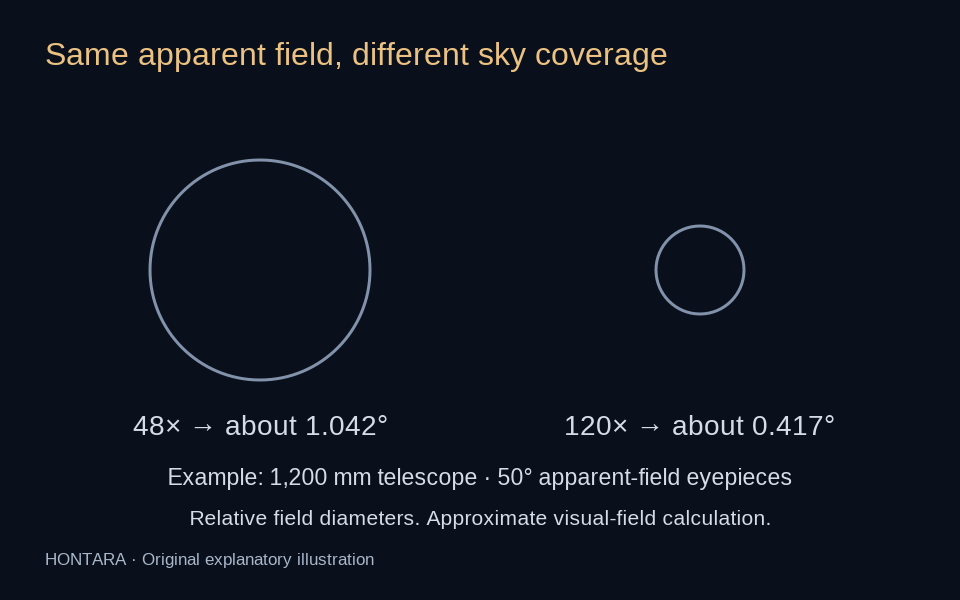
With an aligned finder and a low-power eyepiece, work from one confirmed star pattern to the next. Rotate the chart to match the view and check whether the optical system mirrors it. Count separations in known fields rather than guessing how far a hand movement has shifted the telescope.
At each step ask whether several surrounding points match, not simply whether a star exists where expected. A faint star near the predicted position can be an especially convincing false identification. If the field does not agree, return to the last confirmed anchor before continuing the search.
Keep the visual expectation modest
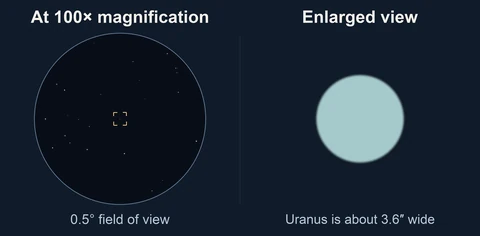
NASA identifies Neptune as an ice giant whose atmosphere contains hydrogen, helium and methane. Its apparent disc is tiny, commonly only a few arcseconds across. A small telescope may leave it looking nearly stellar. Steady air and suitable magnification help, but there is no universal power that guarantees a clear disc.
Do not expect a saturated blue ball with spacecraft cloud detail. Colour photographs depend on instruments, wavelengths and processing as well as the planet. Compare the candidate with neighbouring stars at the same focus. A possible tint is a supporting impression rather than the basis of the identification.
Check movement and preserve uncertainty
Sketch the candidate with several nearby stars and record the date, time, equipment and chart source. A later observation can test its displacement against a newly calculated position. Choose an interval for which the predicted motion is measurable in your field; consecutive nights do not always produce an obvious visual change.
If Neptune remains unconfirmed, keep the sketch and label the candidate honestly. Recheck time settings, chart orientation and field scale indoors. This careful method transfers to other faint targets even when weather prevents a second visit. The result is a reproducible search, not an invented successful sighting.
PAUSE AND THINK
Why is a blue-looking point insufficient to confirm Neptune?
Explore the answer
Colour impressions are uncertain and other stars can occupy the field. The dated position and surrounding star pattern must also agree.