On this page
Plan a view near Honavar
- Height
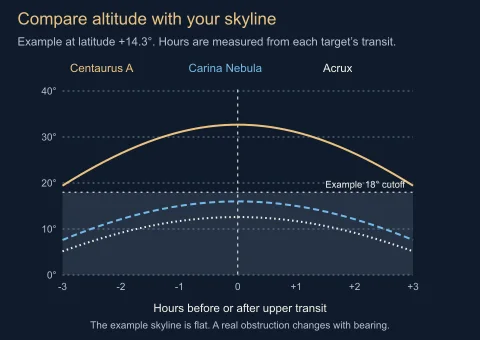
- The lowest of the four main stars, Acrux, peaks at about 13° due south.
- When to try
- Try April or May. On 10 May 2027 the stars are close to their highest around 10 pm IST.
- First look
- Use your unaided eyes. Match the four-star pattern and confirm it with the two Southern Pointers.
Set your location and time in Stellarium Web, then search for Acrux. Check the Moon and your actual skyline. Record whether you could identify the target and what affected the view.
Start with the short cross
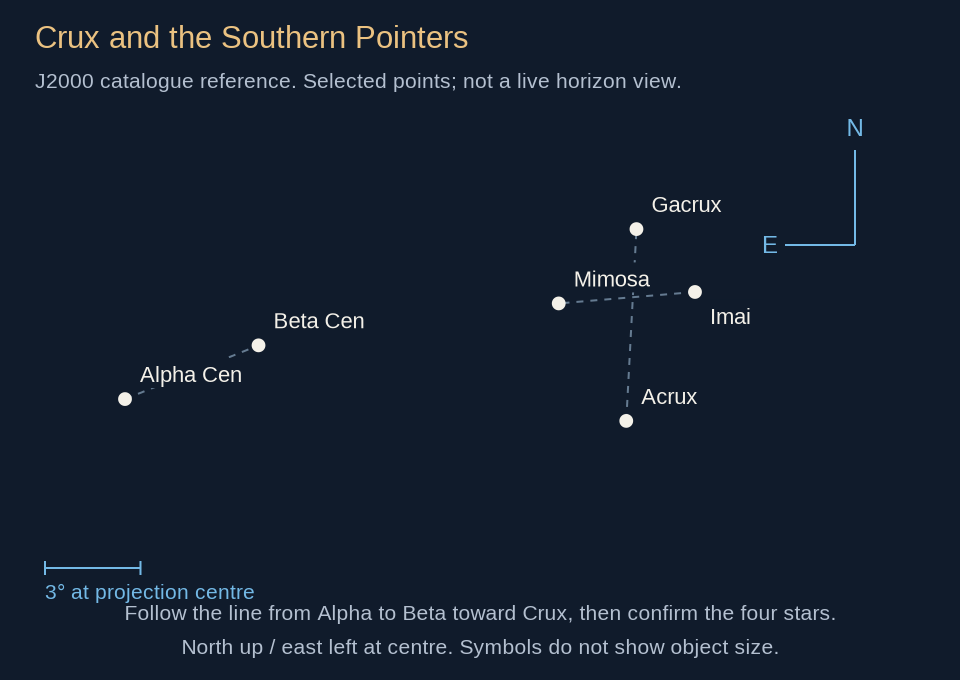
The Southern Cross is the familiar pattern in the constellation Crux. Acrux and Gacrux form its long arm. Mimosa and Imai make the shorter arm. The constellation is a designated region of sky, so its boundary includes more than the four stars in the pattern. Try to recognise the arm lengths and the position of their intersection before using a name.
The chart has celestial north at the top and east at the left. From Honavar, Crux sits low and rotates relative to the skyline through the night. Rotate the chart to match two recognised points and check the other two before treating the pattern as identified.

Confirm the pattern with the Pointers
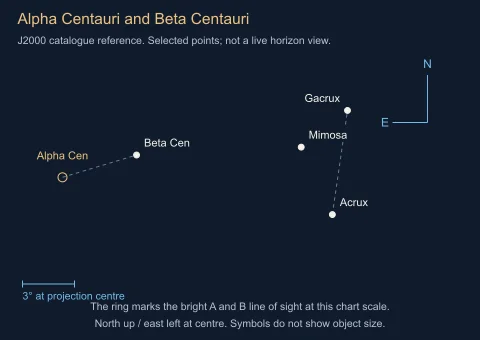
Look in a wider part of the sky for Alpha and Beta Centauri. These two bright stars lie outside Crux. The direction from Alpha through Beta brings you toward the cross. Treat the line as a guide to the neighbourhood, then identify each star using the smaller pattern. Another cross-like pattern elsewhere in the southern sky is easy to mistake for Crux if you stop at the shape alone.
When facing south near transit, look for the pointers toward the east side of Crux. Start without binoculars so you can take in the whole field. An instrument’s field can be too small to keep the cross and both pointers in view at once.
Check the lowest star first
At Honavar’s latitude of about 14.3° north, Acrux tops out at roughly 13° above a geometrically level horizon. Gacrux can reach roughly 19°. A roof or hill that blocks the lower 14° of the southern sky can therefore hide Acrux even as the upper part of the cross appears. Read the altitude of each star for your date if the horizon is tight.
Try a clear evening in April or May and use a local sky chart to choose a time close to the pattern’s crossing of the southern meridian. Set the time zone to IST. Compare the geometry with what you see at the actual site. Haze can remove the lowest stars before a skyline does.
Record a partial view
Sketch the visible stars and the local skyline separately. Mark a predicted star as missing if you had enough reference points to know where it should be. A blank spot near the horizon gives a useful result when it is paired with a time and direction. Repeat from a more open location or closer to transit and see whether the missing part of the cross returns.
The long arm is often used to estimate the direction toward the south celestial pole. From northern latitudes the pole itself is below the ideal horizon. For this session, use Crux as a recognition target and use a map to find true south on the ground.
PAUSE AND THINK
Why might Gacrux be visible while Acrux is hidden near transit?
Explore the answer
Gacrux reaches a higher altitude from Honavar, so a southern obstruction or haze may hide Acrux first.