On this page
Plan a view near Honavar
- Height
- The cluster reaches about 15° above due south at its highest.
- When to try
- Try April or May. An example near the highest point is 10 May 2027 at 10:15 pm IST.
- First look
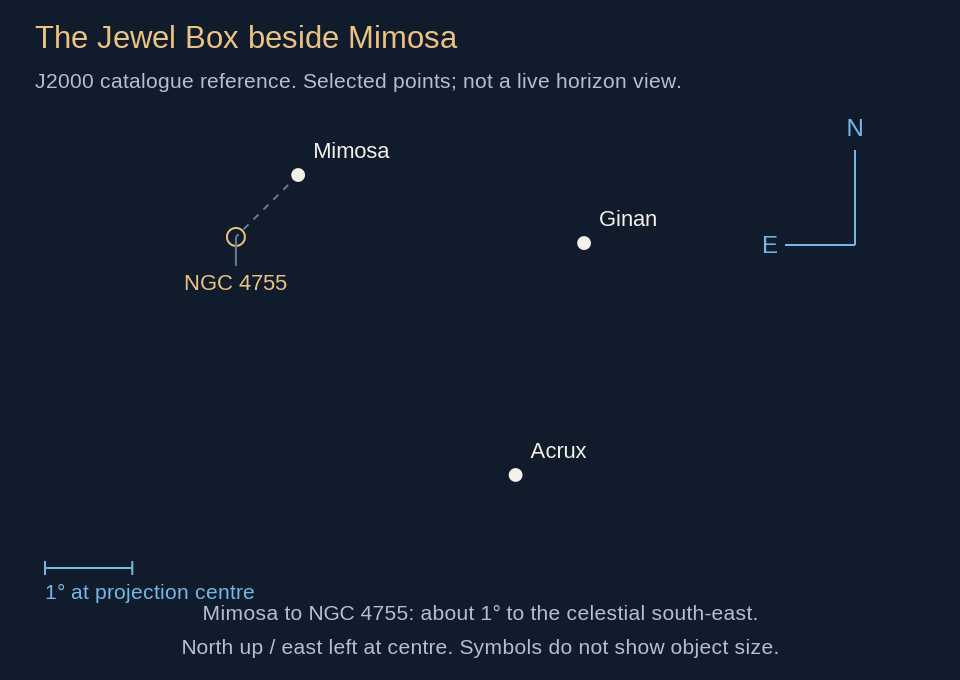
- Start with binoculars. Find Mimosa in Crux then look about 1° to its celestial south-east.
Set your location and time in Stellarium Web, then search for NGC 4755. Check the Moon and your actual skyline. Record whether you could identify the target and what affected the view.
Use one star as the starting point
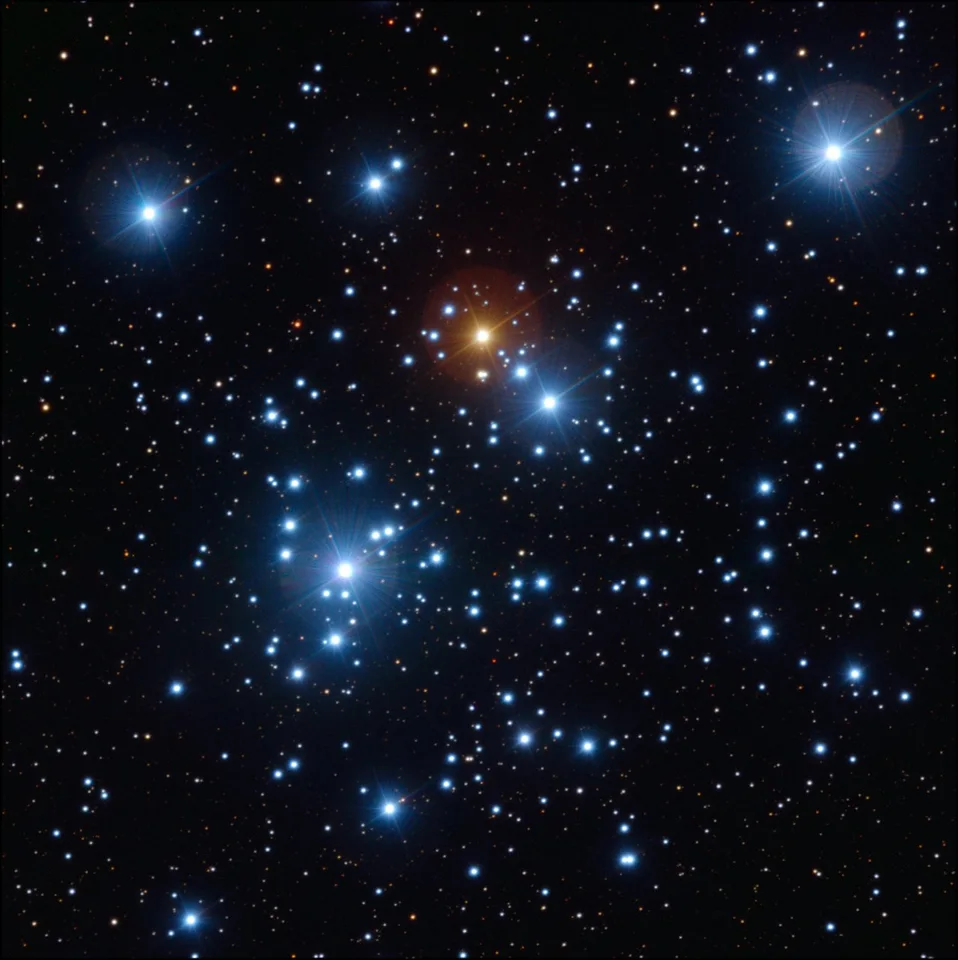
The Jewel Box is the young open cluster NGC 4755 in Crux. Start from Mimosa, also called Beta Crucis, on the short arm of the Southern Cross. In the chart the cluster lies roughly 1° to its southeast. As you orient the field, recognise the surrounding cross stars first. Then move to the yellow target ring, which marks the cluster’s centre.
If the field is wide enough, keep Mimosa at one side of the view and check for a small knot of light nearby. A bright point elsewhere in the field can mimic an unresolved cluster. Confirm the offset before adding magnification.
Choose a time when both objects are above the skyline
The cluster and Mimosa each peak around 15° to 16° high near Honavar. A low southern tree line that leaves Gacrux visible can still hide them. Pick a transparent night in April or May. Look up the cluster for your actual date and choose a time near its highest point after dark. If the start star looks unsteady, record the condition before deciding whether to try a telescope.
Compare wide and magnified views
NASA’s Caldwell guide describes the cluster as small and bright enough to look star-like without magnification under a good sky. A steady binocular view may show a small concentration. A telescope may resolve more stars. Start with a low power and record how many distinct points you see before trying higher power.
The published photographs have more colour and depth than you should expect at the eyepiece. Use the ESO survey image to identify the larger field around Mimosa. Treat any colours you notice in the cluster as your own observation and mark doubtful colour impressions separately from positions.
Let different observations answer different questions
Draw three fields side by side for unaided eyes, binoculars and a telescope, where those options are available. Use only the stars you can place with confidence. Record the equipment and altitude conditions next to each drawing. Changes between the views can show resolution and contrast limits. They do not show that cluster members appeared or disappeared physically.
PAUSE AND THINK
Why can an open cluster look like one star without magnification?
Explore the answer
Light from a compact group can fall into one unresolved patch. More angular resolution and a steadier view may separate several points.