On this page
Plan a view near Honavar
- Height
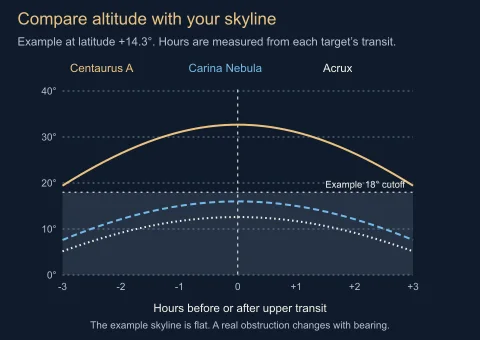
- The bright A and B pairing reaches about 15° due south at its highest.
- When to try
- Try May or early June. An example near the highest point is 3 June 2027 at 10:25 pm IST.
- First look
- Use your unaided eyes. Find both Southern Pointers and identify Alpha as the star farther from Crux.
Set your location and time in Stellarium Web, then search for Alpha Centauri. Check the Moon and your actual skyline. Record whether you could identify the target and what affected the view.
Find the bright pair south of the familiar sky
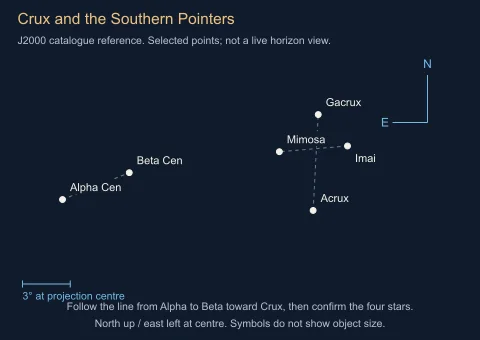
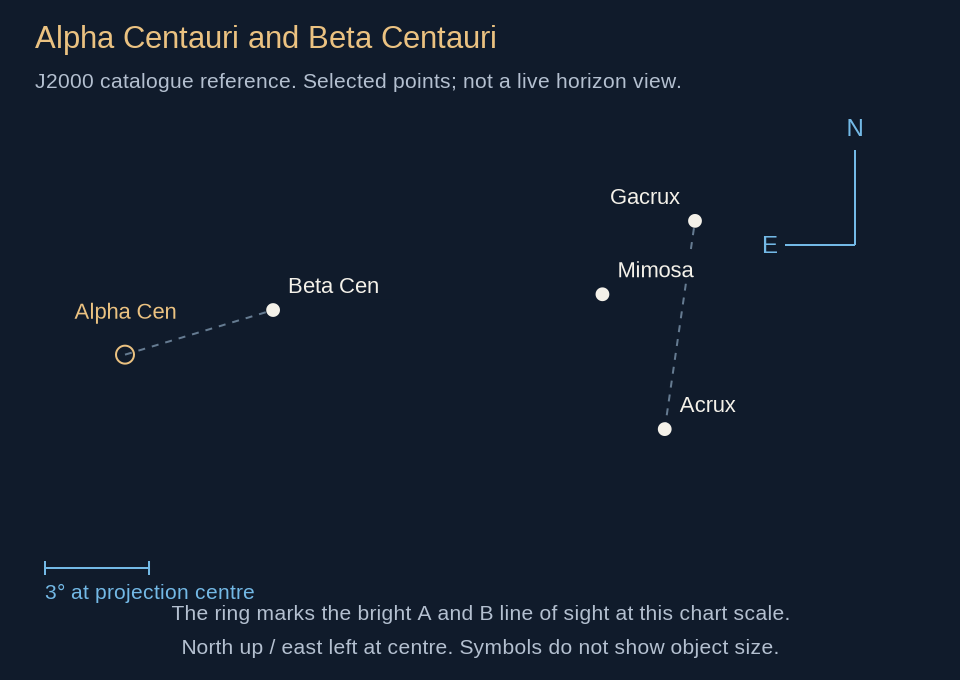
Alpha Centauri and Beta Centauri form the Southern Pointers near Crux. Confirm both together because bright stars close to the skyline can look surprisingly similar. On the chart the pair is east of Crux, with Beta Centauri nearer to the cross. Follow the line toward Crux, then reverse your route to verify that you have landed on Alpha.
The system reaches a maximum altitude of roughly 15° at Honavar. Try May or June evenings when a local chart shows the pointers near the south meridian after dark. Use an open southern sector with no tall trees or light sources. Even the bright pair may disappear into dense haze.
Separate two meanings of pair
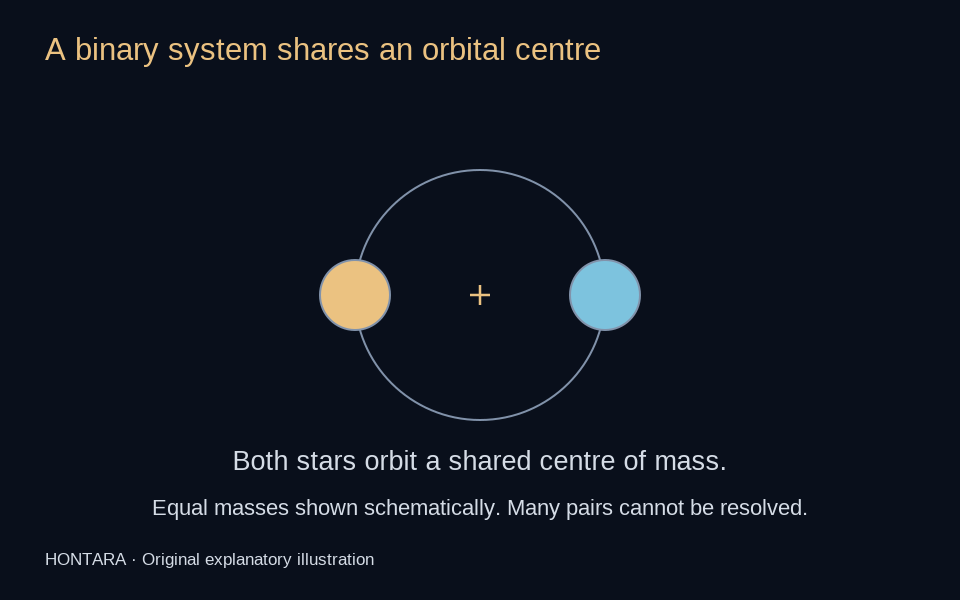
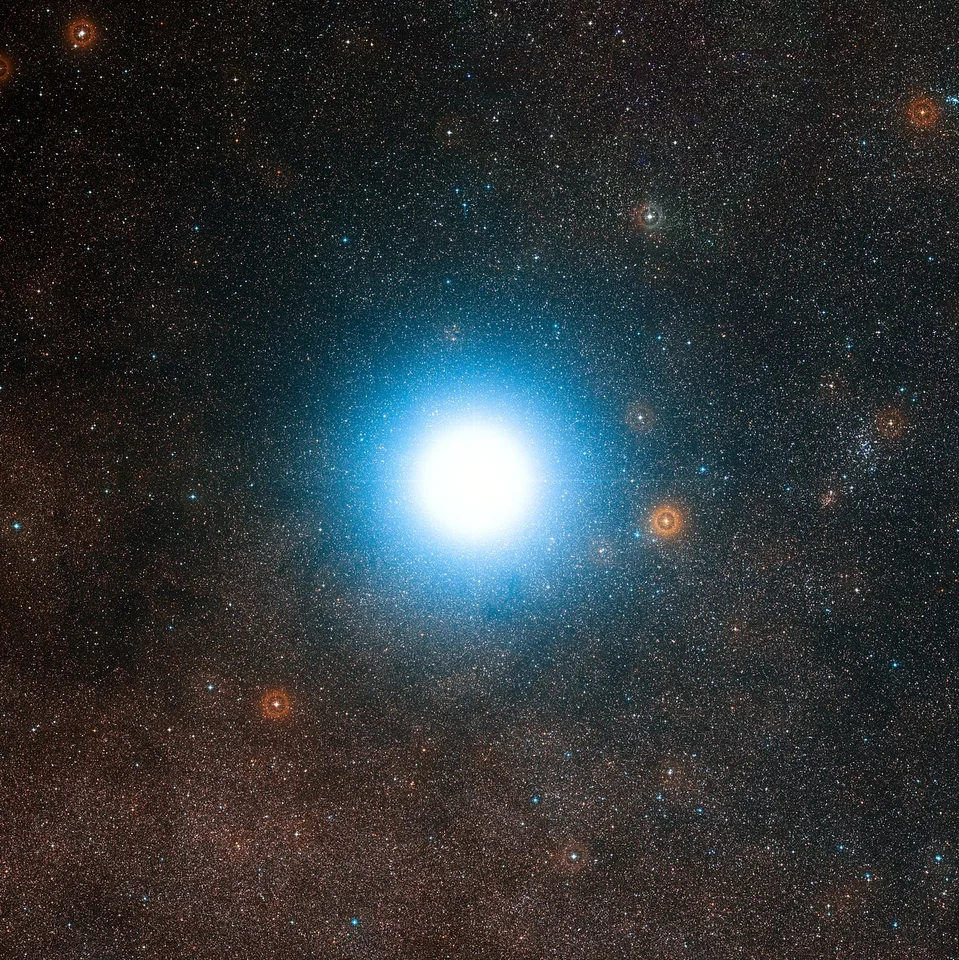
Alpha and Beta Centauri make a pair in an observing pattern. The two bright stars that orbit each other within Alpha Centauri are Alpha Centauri A and B. In an unaided view A and B combine into one bright point. Proxima Centauri belongs to the same system and is the nearest star beyond the Sun, at about 4.25 light-years.
A and B have an orbital period of about 80 years. Their apparent separation changes as the orbit progresses. If you want to split them with a telescope, look up a date-dependent separation first. Low-altitude turbulence can merge points that a telescope could otherwise resolve. The first goal is a correct system identification.
Keep Proxima as a separate observing project
The bright point that guides you to Crux is the combined light of A and B. Proxima is a faint red dwarf and is outside a close view centred on the bright pair. A reliable Proxima identification would require a deeper dated chart and repeated comparison against field stars. You can learn the structure of the system from the NASA references after your naked-eye observation.
To record this session, draw the two pointers and place Crux beside them. Label the bright point Alpha Centauri A+B. Add a second drawing showing the three related stars without using the wide sky pattern as an orbital diagram.
Use the observation to test a claim
Compare the statement “the closest star is the brightest point in the pair” with what the page’s sources identify. Distance alone does not set apparent brightness. A nearby low-luminosity star can be much harder to see than its neighbours. Use the distinction between individual stars and combined light when explaining what you observed.
PAUSE AND THINK
Does the bright point you see show Proxima Centauri?
Explore the answer
The point is dominated by Alpha Centauri A and B. Proxima is a faint separate field object that requires a deeper finder chart.