On this page
THE BIG IDEAS
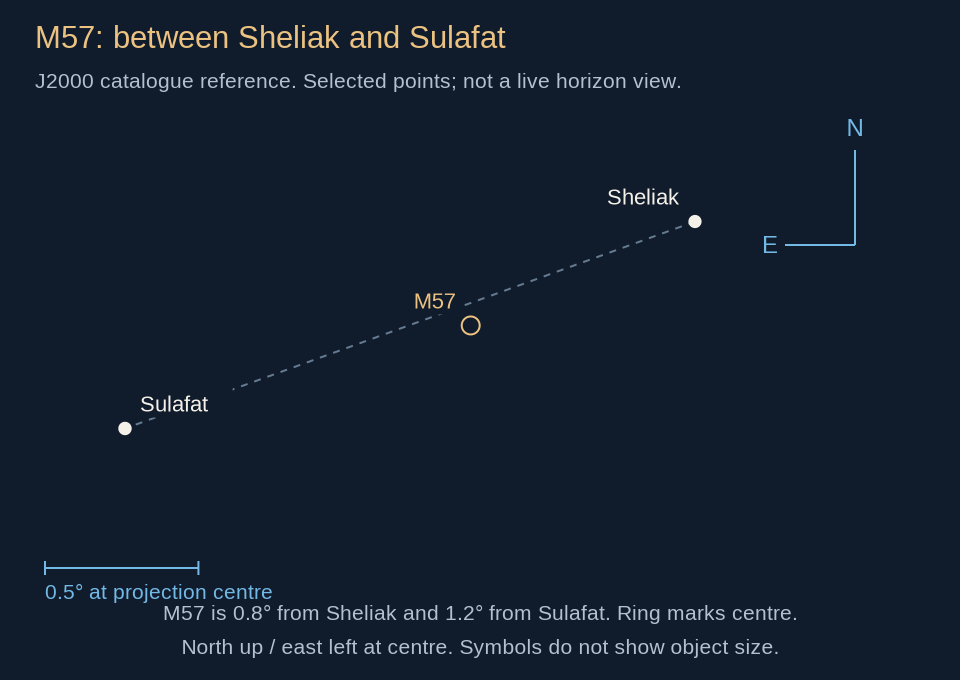
- M57 lies between Sheliak and Sulafat, closer to Sheliak.
- The target is much smaller than its chart symbol.
- Detecting a nebula and seeing its ring are separate claims.
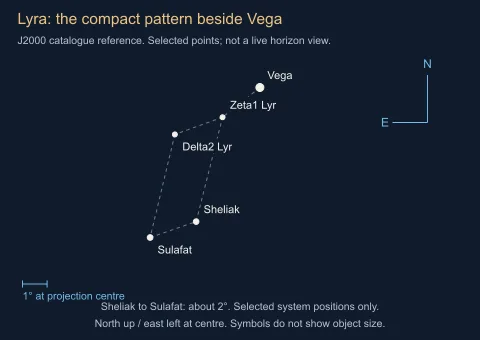
Start with Lyra's bright framework
Identify Vega first, then locate the compact Lyra pattern beside it. Sheliak and Sulafat form the useful baseline for M57. They are about 2° apart. The nebula lies between them, a little closer to Sheliak, so the pair provides a much better starting point than a blind sweep around Vega.
The finder is a focused catalogue reference centred on this pair and M57. Its target symbol is enlarged for clarity. It does not simulate the nebula's angular diameter or supply all the faint field stars a detailed telescope atlas would show. Confirm both bright anchors before attempting the small target.
Choose a high clear view
M57's declination is about +33°. From latitude 14.3° north it can reach about 71° geometric altitude at upper transit. Evenings roughly June through November often offer useful opportunities, depending on the hour. Set a current local chart to the actual observing time and check whether Lyra clears nearby obstructions.
A higher altitude helps reduce atmospheric interference, but moonlight and local lamps can still wash out faint diffuse light. Give your eyes time away from bright screens. Choose a comfortable eyepiece position so repeated looks remain practical rather than rushing through one uncertain glimpse.
Match the field before increasing power
Start at low power with an aligned finder. Follow the baseline approximately 40 percent of the way from Sheliak toward Sulafat. Catalogue positions place M57 about 0.8° from Sheliak and about 1.2° from Sulafat. It is a small displacement off a perfectly straight connecting line.
The reference has north up and east left at the tangent centre. A diagonal eyepiece view can rotate or mirror it. Establish your optical orientation and field width before translating the hop into telescope movement. If the view fails to match, return to a known anchor and repeat slowly.
Understand a planetary nebula's appearance
M57 is a planetary nebula, glowing gas shed by an evolving star rather than a planet. NASA lists integrated magnitude around 8.8 and notes that resolving its ring-like detail requires a suitable telescope. At low power it may resemble a tiny fuzzy point rather than an obvious smoke ring.
Once the field is secure, try a moderate increase in magnification and compare the candidate with nearby focused stars. Ask whether it stays extended and whether any central dimming is repeatable. Hubble's bright coloured structure is scientific imaging, not a promise of colour or intricate detail through a small eyepiece.
Record detection and shape separately
Draw the two anchor stars and mark the candidate's location. Then note whether you detected an extended object, a ring-like outline or a darker centre. Those are progressively more specific claims. If only the position and diffuse appearance are secure, leave the interior undescribed.
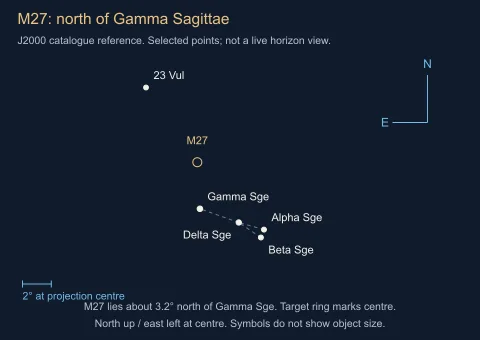
Compare with M27 on another suitable night. Both are planetary nebulae, but their apparent sizes and surface-brightness patterns differ. Use the same equipment where possible and note changing conditions. This comparison makes the word planetary a historical classification to investigate rather than a prediction of one universal visual shape.
PAUSE AND THINK
Why should magnification follow field confirmation?
Explore the answer
M57 is tiny and a narrow high-power field makes navigation harder. Establishing the correct neighbourhood first reduces mistaken identification.