On this page
THE BIG IDEAS
- Vega anchors a much fainter compact pattern.
- From 14.3° north Vega peaks about 66° high.
- The Ring Nebula needs a separate telescope search.
Find the bright star before the small shape
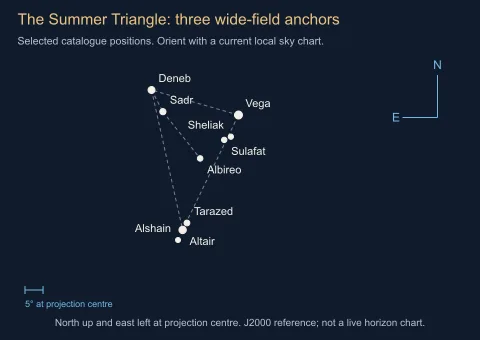
Vega is Lyra's bright anchor and a corner of the Summer Triangle. Use a current sky chart to distinguish it from Deneb and Altair, then look beside it for the much fainter stars of Lyra. The compact pattern is easier to learn after its conspicuous neighbour is secure.
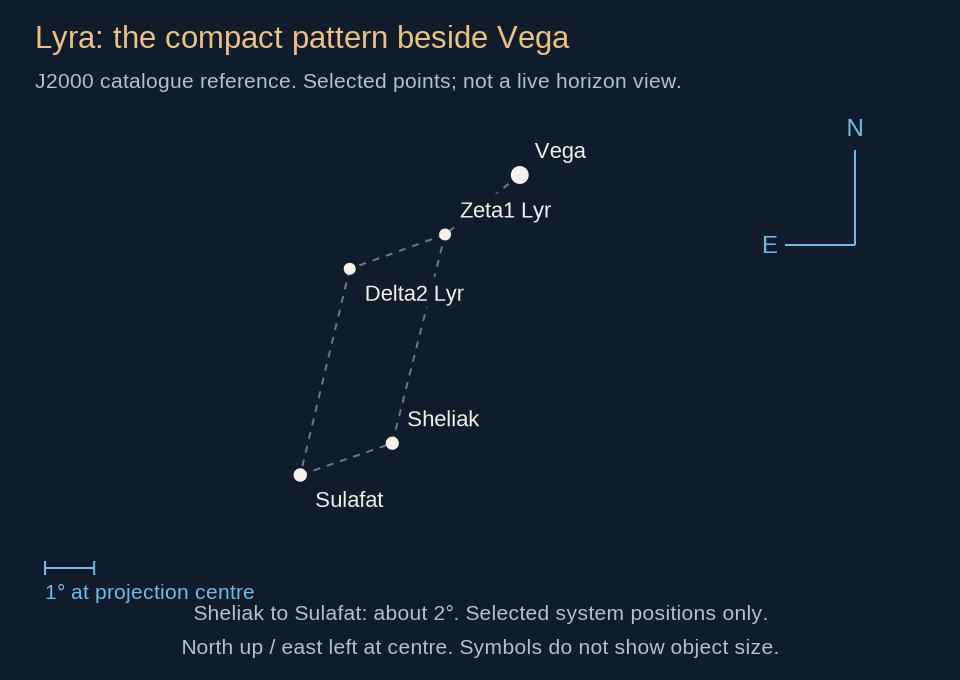
The chart marks Zeta1 Lyrae, Delta2 Lyrae, Sheliak and Sulafat as a four-sided reference. These selected catalogue entries represent a practical pattern, not every point visible in binoculars. Some named stellar systems contain multiple components, so an enlarged instrument view can show more detail than this broad chart.
Check height without assuming overhead
Vega's declination is about +38.8°. From a rounded Honavar reference latitude of 14.3° north, its highest geometric altitude is therefore about 66°. It never passes directly overhead from this latitude. Sheliak and Sulafat culminate somewhat higher, near 71° and 72°, at their own transit times.
Evenings roughly June through November can provide useful opportunities, with the actual hour changing across those months. A north-up celestial chart does not tell you where the local roofline or horizon will cut the pattern. Check your location and time before deciding where to set up.
Use two different scales of navigation
Vega is about 6° from Sheliak and 8° from Sulafat. A broad binocular field may connect parts of the pattern, but a telescope usually covers only a small fraction at once. Match the expected field width before attempting a hop. The scale bar is an angular reference at the projection centre.
Sheliak and Sulafat lie about 2° apart and form a useful baseline. Confirm which is which by matching the full pattern. Telescope rotation can make an instruction based on the bottom of a drawing misleading. Celestial north and east remain defined even when an eyepiece turns the image around.
Keep the Ring Nebula as a second task
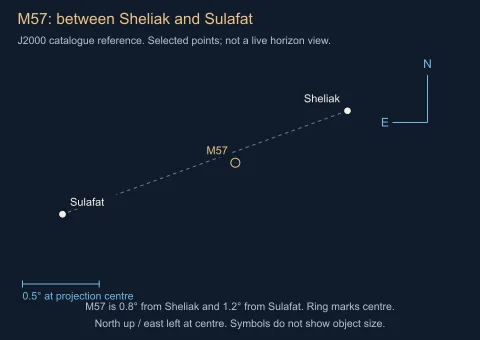
The Ring Nebula, M57, lies approximately between Sheliak and Sulafat and requires a separate detailed search. Finding Lyra does not mean the nebula will appear in ordinary naked-eye viewing. Its tiny diffuse appearance is easily missed when sweeping too rapidly or using a chart at the wrong scale.
The broad Lyra chart deliberately prioritises the bright framework. Use the linked M57 finder for the smaller field and realistic telescope expectations. Different targets in one constellation can require quite different equipment and sky conditions. There is no need to complete every possible Lyra target during one short outing.
Make a brightness-and-pattern record
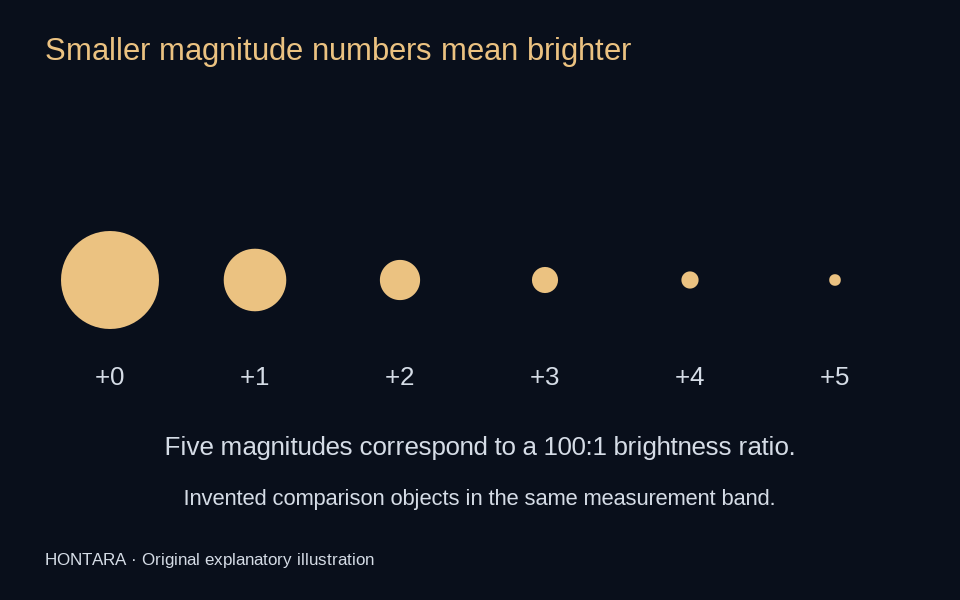
Draw Vega first and use a smaller symbol for each confirmed pattern star. Record whether your eyes alone or binoculars were needed to distinguish them. Keep apparent brightness separate from distance or intrinsic luminosity: a prominent point can owe its appearance to several different physical factors.
Return under a different Moon phase and compare how much of the compact pattern remains accessible. Note haze and nearby lighting too, because the Moon is only one contributor to sky brightness. This simple comparison turns Vega from a familiar name into a dependable reference for more careful navigation.
PAUSE AND THINK
Why is Vega easy to find while the rest of Lyra may be difficult?
Explore the answer
Vega is much brighter than the pattern stars. Sky brightness can hide the fainter framework while the anchor remains obvious.