On this page
THE BIG IDEAS
- Omega Centauri peaks only about 28° high locally.
- Use a clear southern sector near upper transit.
- A low target can lose detail despite high integrated brightness.
Let the southern view decide the plan
Omega Centauri is a large bright globular cluster in Centaurus, but from a rounded Honavar reference latitude of 14.3° north it remains a low southern target. Its declination near −47.5° gives a maximum geometric altitude of only about 28°. That limit matters more than a dramatic photograph when planning a first attempt.
Choose an accessible site with a clear southern sector and aim for a time near upper transit. Buildings, trees and low haze can conceal it. The calculation uses a level astronomical horizon without refraction or terrain. A prediction of 28° does not guarantee an unobstructed or transparent line of sight.
Learn the reference stars in advance
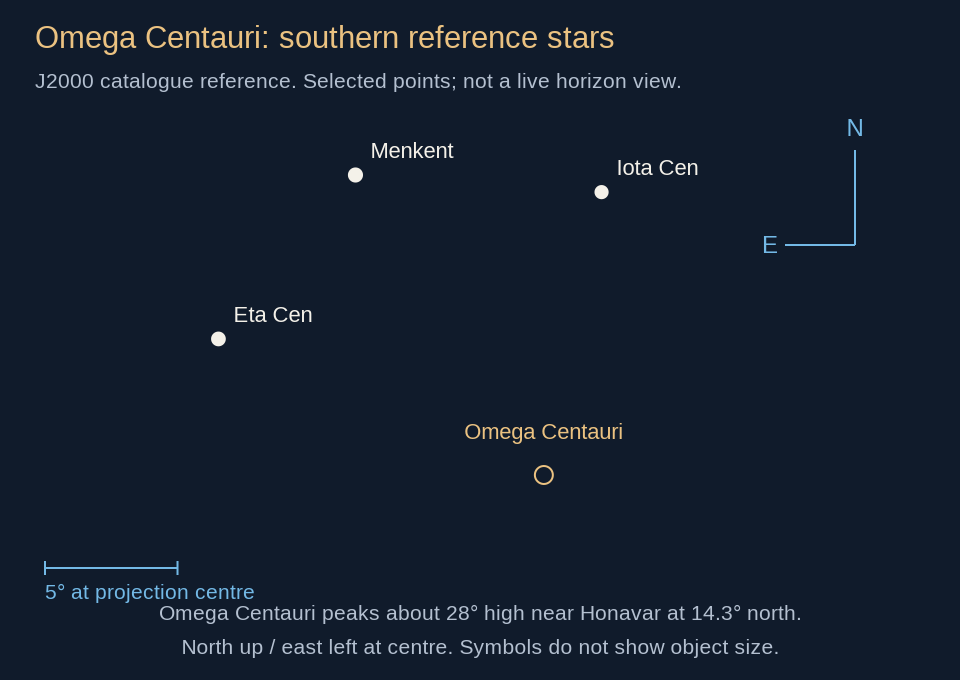
The chart places the cluster with Iota Centauri, Menkent and Eta Centauri. First match those stars using a current local map because a north-up reference does not show how the region tilts above your horizon. Iota Centauri lies about 11° north of the cluster and provides a useful regional anchor.
The whole reference pattern spans many telescope fields. It is a regional route rather than a complete eyepiece star atlas. Use a more detailed field chart for the final approach if necessary. The symbolic ring identifies the catalogue centre and does not show the cluster's actual apparent diameter.
Choose season and conditions together
Evenings roughly March through June offer a useful seasonal opportunity, with the exact transit time changing through the period. Check a date-based chart at your planned hour. A clear late dry-season evening may offer a more useful attempt than a nominally ideal month dominated by cloud or haze.
Low altitude means looking through more atmosphere than for a high northern cluster. Extinction dims light and turbulence can spoil the fine stellar texture. Compare a known higher star field to the southern reference stars, then decide whether conditions justify continuing. Postponement is a valid observing decision.
Expect a cluster rather than a spacecraft portrait
ESO describes Omega Centauri as an exceptionally massive Milky Way globular cluster with a complex stellar population. For a first visual task, try to establish a broad concentrated glow with binoculars or a low-power telescope. A bright catalogue magnitude does not ensure easy resolution through a hazy southern sightline.
Its many stars can produce a rich telescopic view in favourable conditions, but that is an expectation to test. Do not infer a black hole, multiple stellar generations or an exact age from a visual impression. Those scientific conclusions require specialised measurements beyond a beginner eyepiece sketch.
Keep the altitude in the record
Sketch the surrounding field and describe central concentration, visible extent and any confidently separated points. Record the time, equipment, Moon conditions and southern obstruction. Note whether the cluster was near transit so a later comparison does not confuse poor altitude with a change in the target.
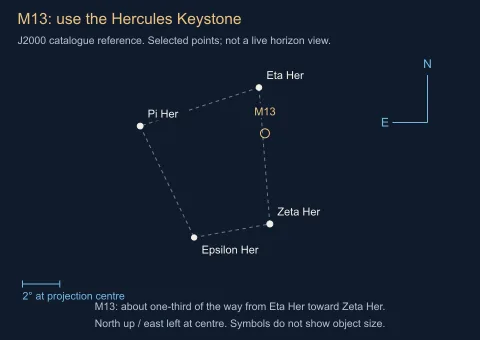
M13 makes a valuable contrast because it can reach about 68° from this latitude. Compare them as different observing situations as well as different clusters. The goal is a documented attempt with realistic limits. An honest non-detection with recorded conditions remains useful for planning another attempt.
PAUSE AND THINK
Why does a clear southern horizon matter even though the cluster rises above it?
Explore the answer
Its low maximum altitude leaves little margin for obstruction and makes it vulnerable to haze and atmospheric extinction throughout the useful observing interval.