On this page
THE BIG IDEAS
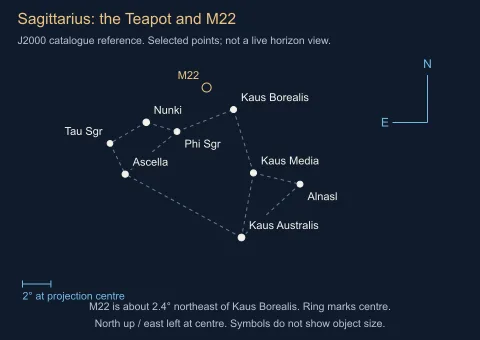
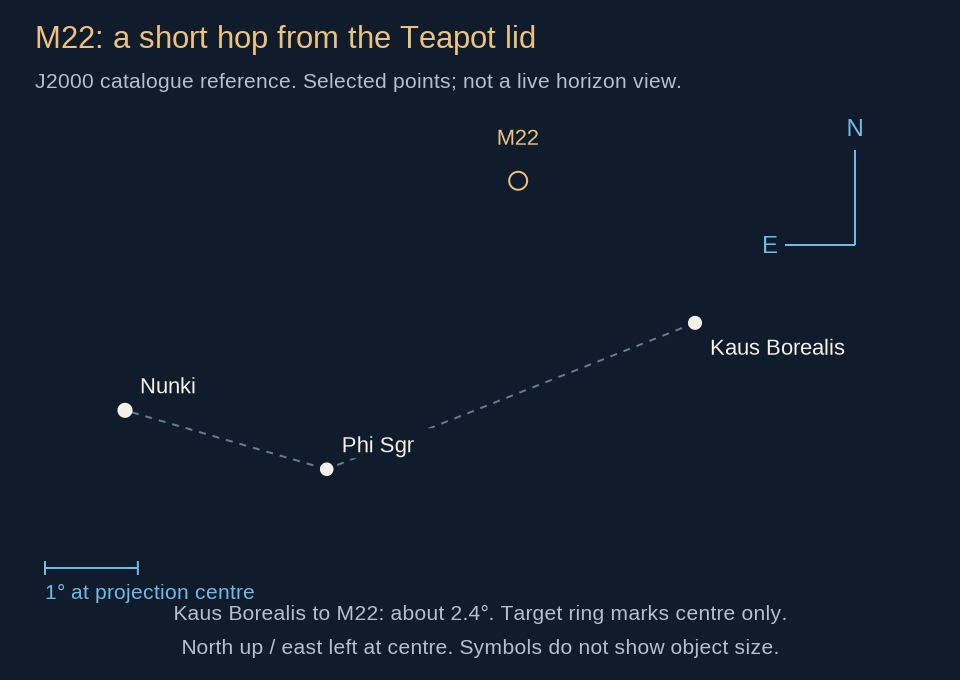
- M22 lies about 2.5° northeast of Kaus Borealis.
- It culminates about 52° high from 14.3° north.
- Visible extent depends on contrast as well as the target.
Confirm the lid of the Teapot
M22 lies near Kaus Borealis, the star at the lid of Sagittarius' Teapot asterism. First identify several Teapot stars with a location-based chart. Kaus Borealis is not simply whichever point appears highest on the page, because the pattern rotates relative to the horizon through the night.
The finder places M22 about 2.4° northeast of Kaus Borealis. That is a small binocular-scale step, though often several low-power telescope fields. Check the instrument's true field and orientation before moving. Match the surrounding reference stars again if the initial hop produces an uncertain patch.
Use its local height well
With declination near −23.9°, M22 reaches about 52° geometric altitude from 14.3° north. That is a useful height for a southern object and substantially higher than Omega Centauri reaches here. Observe near its upper transit when practical, rather than waiting until the region is sinking into western haze.
Evenings roughly June through October can be suitable, depending on the hour. August is a convenient seasonal reference rather than a guarantee of weather. Coastal cloud may interrupt the window and moonlight can weaken the cluster's outer glow. Check a current sky chart before choosing an observing time.
Know what the cluster should resemble
NASA lists M22 as a globular cluster roughly 10,000 light-years away with integrated visual magnitude about 5.1. Many stars contribute to that brightness. Binoculars may show a rounded misty patch while a telescope can begin to reveal its stellar texture under favourable conditions.
The chart's target ring marks the catalogue centre and is not a picture of its extent. NASA describes a roughly full-Moon-sized overall apparent span, but a visual observer may detect only the brighter interior. The apparent boundary depends on contrast, instrument and how faint a glow the observer can distinguish.
Compare brightness without confusing it with resolution
Begin at low power after the field is secure, then increase magnification cautiously. Compare whether the outer region becomes grainy or separates into points. A larger image can make individual stars easier to distinguish while simultaneously making diffuse light harder to notice. Record both effects if they appear.
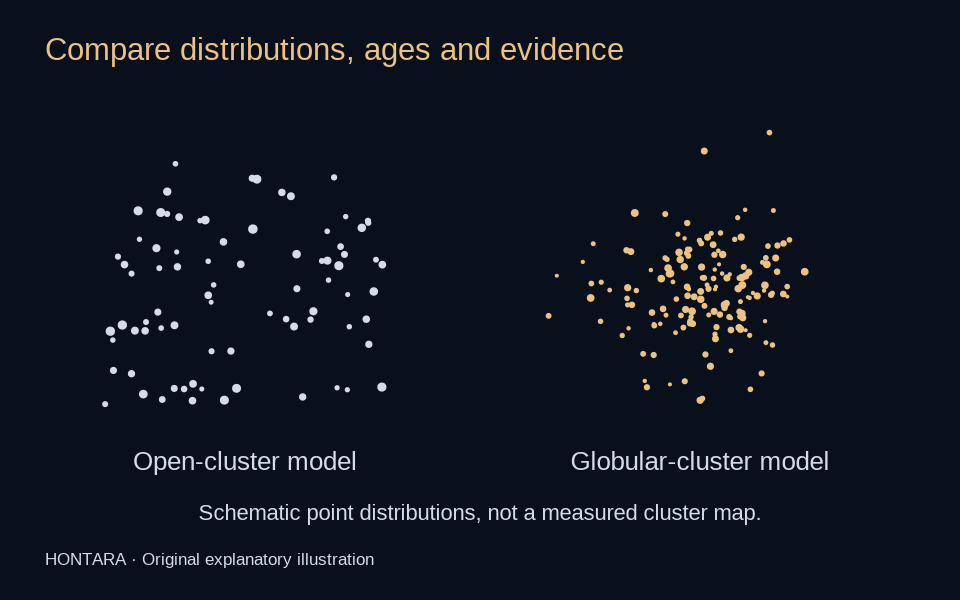
An averted glance may help show faint outer light. Take repeated looks and keep field stars sharply focused. Avoid reporting every momentary sparkle as a resolved cluster member. Foreground stars share the sightline and an individual visual identification does not establish membership or measure a star's age.
Turn the route into a short observing task
Draw Kaus Borealis and the direction of the hop before looking through the telescope. Afterwards sketch the field and add the cluster only where you can support its placement. Record date, time, Moon conditions and any southern haze. Label an unsuccessful attempt without inventing a detection.
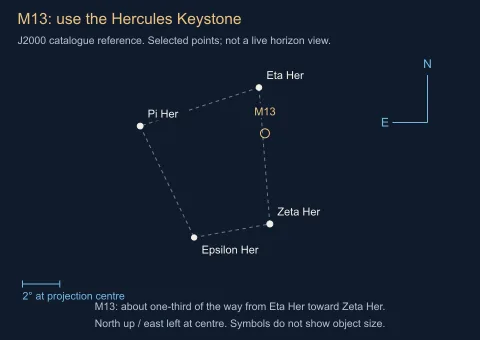
For a later comparison choose M13 at a reasonably high altitude. Compare their concentration, visible extent and ease of resolution with the same equipment where possible. Keep differences in sky brightness and altitude in the explanation. Two globular clusters provide a useful lesson in how physical targets and observing conditions combine.
PAUSE AND THINK
Why might M22 look smaller than its catalogue extent suggests?
Explore the answer
The faint outer light can disappear into the sky background while the brighter central region remains visible.