On this page
THE BIG IDEAS
- Confirm the four-star Keystone first.
- M13 is about one-third of the way from Eta to Zeta Her.
- An unresolved glow is a realistic first result.
Learn the Keystone before the cluster
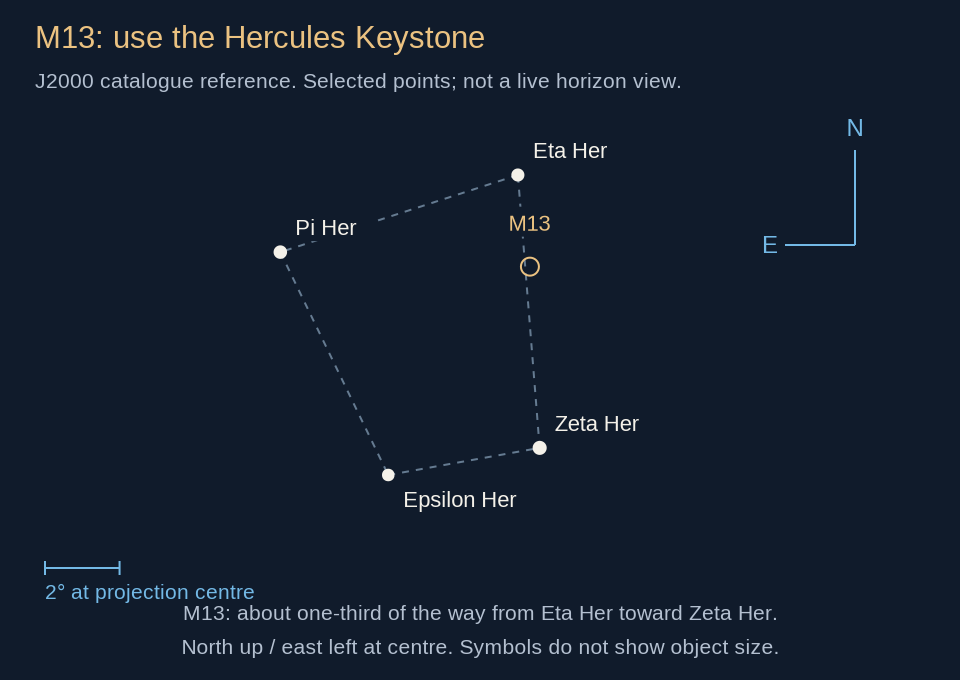
M13 lies in Hercules near one side of the four-star Keystone pattern. The finder marks Eta, Zeta, Pi and Epsilon Herculis, then places the cluster between Eta and Zeta. Identify the entire quadrilateral first. An isolated patch or point is much less persuasive than a target in a matched framework.
From Eta Herculis move about 2.5° toward Zeta Herculis. M13 sits about one-third of the way along that roughly 7.3° baseline. The route is an angular relationship derived from catalogue coordinates. It is not a physical line of stars leading through space to the cluster.
Choose an achievable time and field
M13 has declination about +36.5° and reaches about 68° geometric altitude from 14.3° north. Evenings roughly May through September offer a useful seasonal window, with the hour shifting across it. Check a current chart for your actual plan and allow for the local horizon and weather.
A binocular field may show a small unresolved glow near the expected position under good conditions. In a telescope start at low magnification so the surrounding field remains recognisable. The north-up reference has east left and no horizon. Rotate or mirror your working chart as required by the optical system.
Understand what the light represents
NASA identifies M13 as a globular cluster about 25,000 light-years away with integrated apparent magnitude around 5.8. Its many stars contribute to a concentrated glow. Integrated brightness is the combined light spread across the cluster, so it does not behave like a single magnitude-5.8 point against a bright sky.
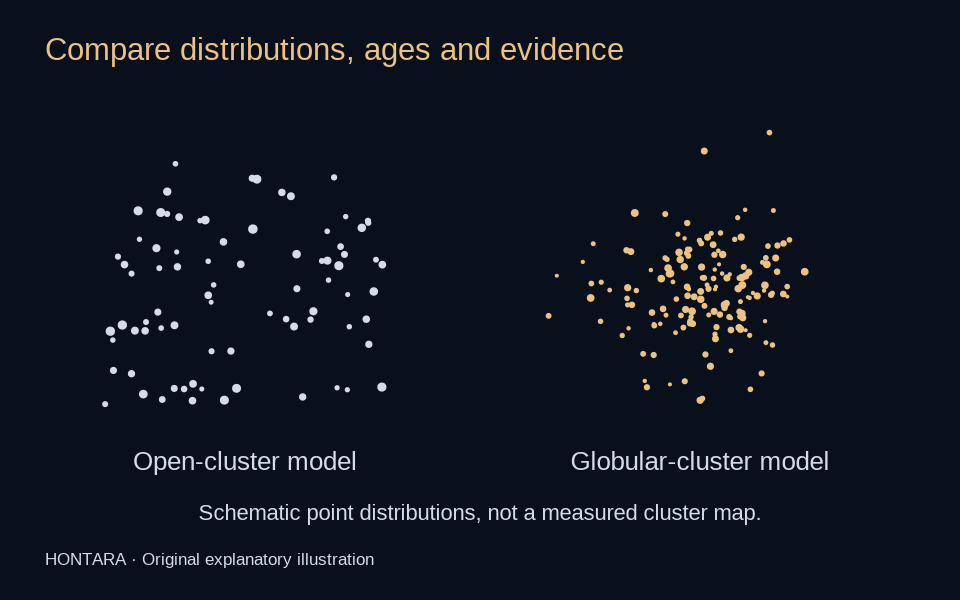
The original chart marks a centre with a symbolic circle rather than simulating the eyepiece appearance. Small equipment often shows a brighter middle fading outward. Larger aperture, a darker sky and good atmospheric steadiness may reveal individual outer stars, but no particular instrument or magnification guarantees that result.
Compare carefully at two magnifications
After confirming the field, try a modest increase in magnification. Keep focus on nearby stars and compare the apparent graininess, central concentration and outer boundary. More power spreads diffuse light over a larger apparent area and can reduce contrast even when the image is larger.
Averted vision may help detect faint outer light: look slightly beside the cluster while keeping it in attention. Alternate with direct vision rather than forcing an impression. If you see only a round glow, describe that. Do not replace the observation with details remembered from a photograph.
Make a defensible cluster record
Sketch a few field stars first and place the glow relative to them. Note whether its edge is sharp or gradual and whether any points are confidently resolved within it. Include time, Moon conditions, telescope aperture and magnification so a future comparison has enough context.
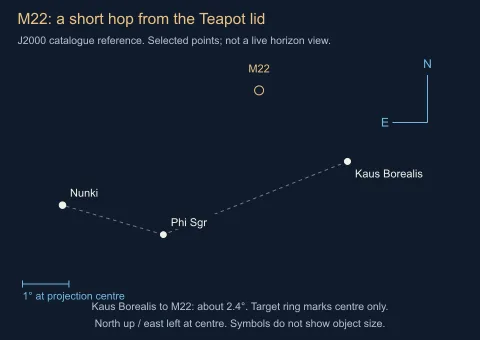
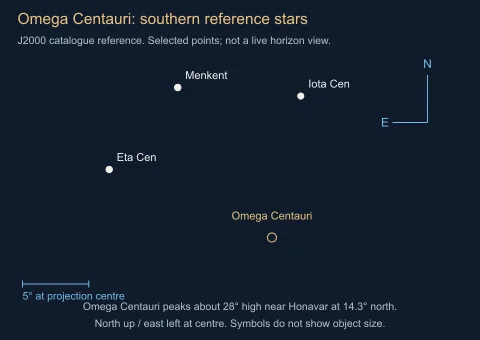
M22 and Omega Centauri provide useful later comparisons because their local heights differ markedly from M13's. Compare concentration and accessibility without ranking clusters solely by an image. A lower target can look poorer because of atmosphere or obstruction, even when its integrated light is intrinsically favourable for observation.
PAUSE AND THINK
Why is M13 harder than a star of the same integrated magnitude?
Explore the answer
The cluster spreads its combined light over an extended area. Against a bright sky its contrast differs from that of a concentrated stellar point.