On this page
THE BIG IDEAS
- Altair sits between Tarazed and Alshain in a compact unequal group.
- Aquila can climb very high from coastal Karnataka.
- Match a small pattern before tracing the whole constellation.
Begin with a distinctive three-star group
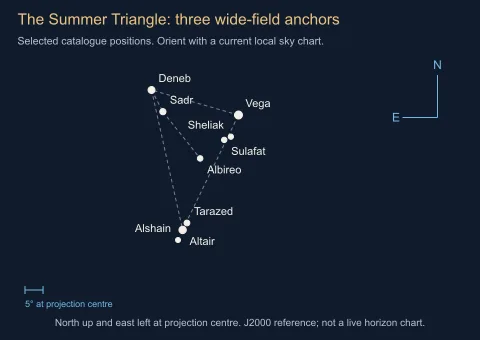
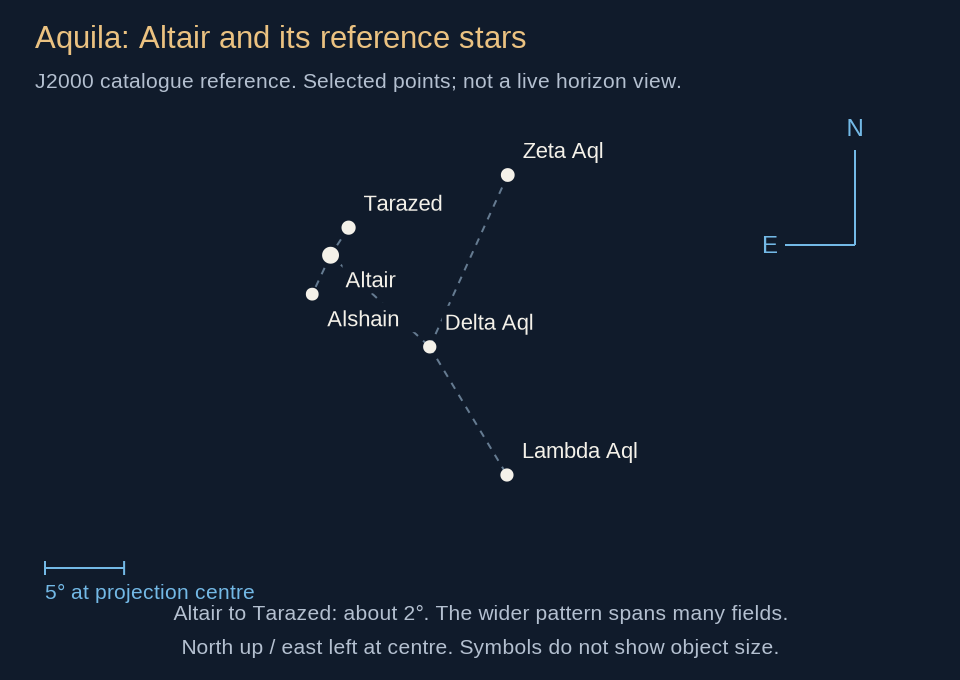
Altair is the bright anchor of Aquila and the southern corner of the Summer Triangle. Look for Tarazed and Alshain on opposite sides of it. They form a short, slightly bent line rather than a perfectly equal or symmetric triple. Confirm their unequal spacing with the finder before extending the pattern.
Tarazed lies about 2° from Altair while Alshain is about 3° away. A suitable binocular field can hold the group, making it a useful bridge between naked-eye navigation and smaller fields. The three points appear close together in our sky without that alone proving a physical association.
Use a favourable local altitude
Altair's declination is about +8.9°, so it reaches roughly 85° altitude from 14.3° north. Tarazed reaches about 86° at its own transit. These are upper-transit values at slightly different times, not a forecast for every evening. Check your planned hour rather than assuming the group is always high.
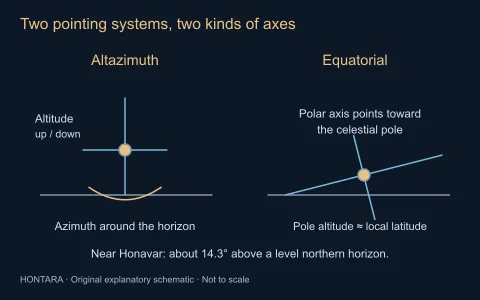
Evenings roughly July through November are often convenient. Near the zenith, an altazimuth telescope may require awkward movements even though the air path is short. Choose a comfortable observing time and position. If the target passes overhead, let it move to an easier part of the sky before continuing a shared view.
Expand beyond the anchor line
The finder includes Delta, Zeta and Lambda Aquilae to show a wider reference framework. Use them only after the central triple is secure. This larger pattern covers tens of degrees and is not one telescope field. Dashed connections organise navigation rather than reproducing official constellation boundaries or a universal cultural drawing.
Aquila contains far more stars than this reference diagram shows. Under a dark sky the Milky Way adds a rich background, but it should not be a prerequisite for identifying Altair. Compare the bright framework first and inspect selected short binocular sweeps only when transparency allows.
Orient the chart before moving an instrument
The plotted star positions use a north-up and east-left tangent projection. The reference has no date-specific horizon. Rotate it against a current location-based map to match the sky. A view facing east and a view facing west will not preserve the same relationship to the page edges.
Before a telescope hop, check whether the eyepiece image is rotated or mirrored and estimate its true angular width. An apparently small hand movement can jump several fields. Keep one recognised star group in your route so you can return to a confirmed position if the next step fails.
Record something more precise than a name
Sketch the Altair group with its unequal separations and compare your result with the catalogue pattern. Note whether Tarazed seems brighter than Alshain and whether haze changes that comparison. Colour impressions can be recorded too, provided they remain descriptions of your view rather than asserted measurements of stellar temperature.
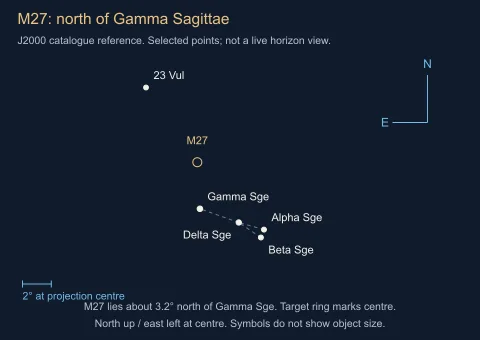
On another evening locate the triple without first reading the labels, then check yourself. If you cannot confirm one member, mark it as uncertain. A reliable small pattern is a useful result in its own right and a sound starting point for exploring nearby Sagitta and the Dumbbell Nebula region.
PAUSE AND THINK
Why might a nearly overhead Altair be inconvenient for a telescope?
Explore the answer
Some mounts become awkward to move near the zenith and the eyepiece position may be uncomfortable. A slightly earlier or later view can be easier.