On this page
THE BIG IDEAS
- Altazimuth coordinates follow the local horizon.
- An equatorial polar axis follows Earth’s rotation geometry.
- Tracking and preventing field rotation are different requirements.
Separate the tube from its support
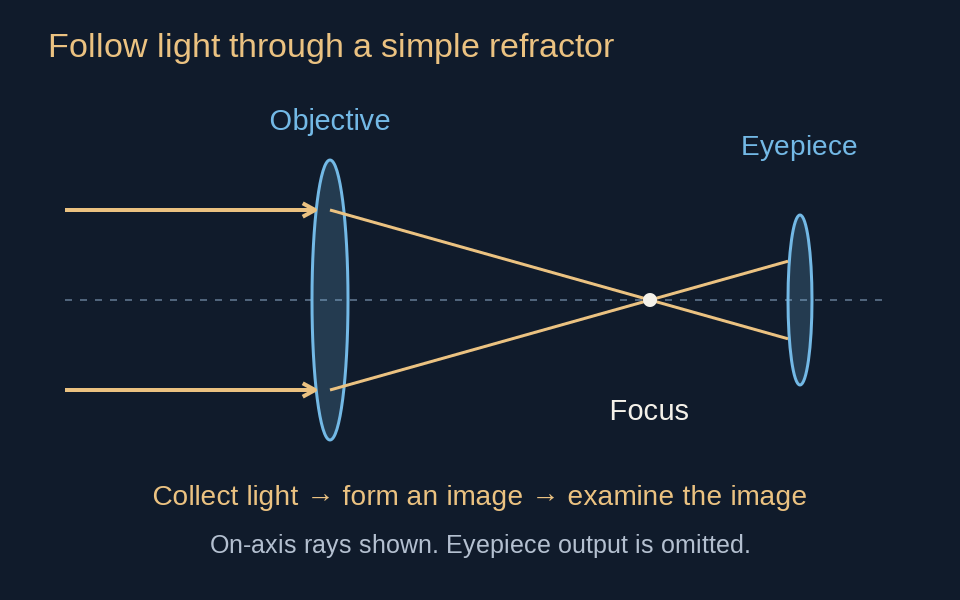
The optical tube gathers and focuses light. The mount supports it and controls where it points. A Newtonian reflector can sit on a Dobsonian altazimuth base or on a suitable equatorial mount. The name of an optical design therefore does not tell you how the instrument moves.
Before touching unfamiliar equipment, identify the altitude, azimuth or equatorial controls using its manual. Check that the telescope is secure and balanced as instructed. A loose tube or an incorrectly fitted counterweight is an equipment problem that must be resolved before a night-time observation.
Follow two different coordinate grids
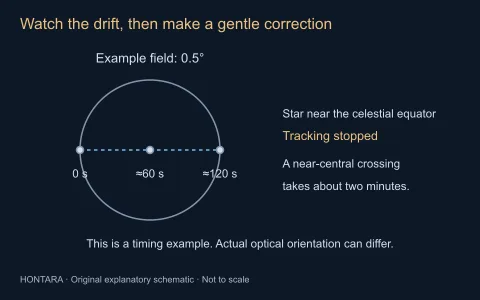
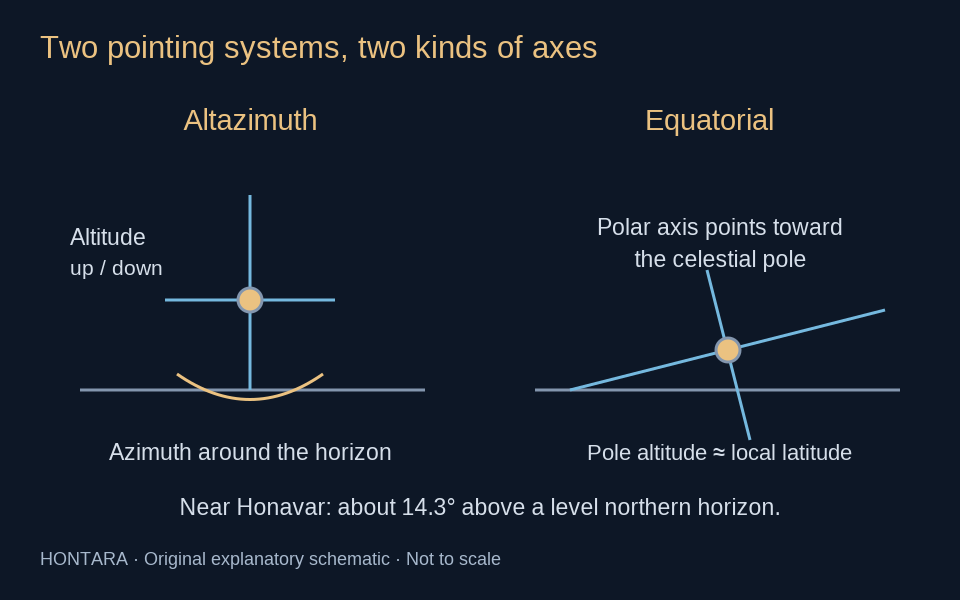
An altazimuth mount turns around an upright axis for azimuth and tilts up or down for altitude. These directions connect naturally with your local horizon. Following a star usually requires changes in both coordinates because Earth’s rotation carries it along a curved path relative to that horizon.
An equatorial mount has a polar axis aligned parallel to Earth’s rotation axis. Its other coordinate is declination. For a well-aligned instrument, following the ordinary daily motion of a star is mainly a rotation about the polar axis. Alignment quality and mechanical limits still influence the result.
Think about a low-latitude setup
In the northern hemisphere, the north celestial pole stands above a level northern horizon by approximately the observer’s latitude. Near 14.3° north this is only about 14.3°, so trees or buildings can hide the polar region. Polaris is close to the pole rather than exactly on it.
This does not make equatorial use impossible, but it makes the available alignment method and mount latitude range important. Check the actual manual instead of forcing a polar axis into an unsupported position. Level ground, stable support and safe clearance around moving counterweights all deserve attention.
Distinguish tracking from image orientation
A motorised altazimuth mount can track an object while the surrounding field slowly rotates. An equatorial configuration addresses that field-rotation problem for suitably aligned long exposures. Neither word motorised nor equatorial guarantees an accurately tracked photograph: balance, alignment, guiding and exposure length also matter.
Make a paper comparison before choosing equipment. Write one task, such as sharing lunar views for twenty minutes, then describe the movement and setup each mount needs. Add a second task involving long exposures. The more useful choice follows your task and practical handling needs rather than one universal ranking.
PAUSE AND THINK
Does a motorised altazimuth mount have to let the target drift out of the centre?
Explore the answer
No. It can track using both axes. The surrounding field can still rotate, which matters during long exposures.