On this page
THE BIG IDEAS
- Rotation and mirror reversal are different.
- Test the complete instrument and accessory arrangement.
- An asymmetric target reveals orientation more clearly than a circle.
A sharp image can face a different way
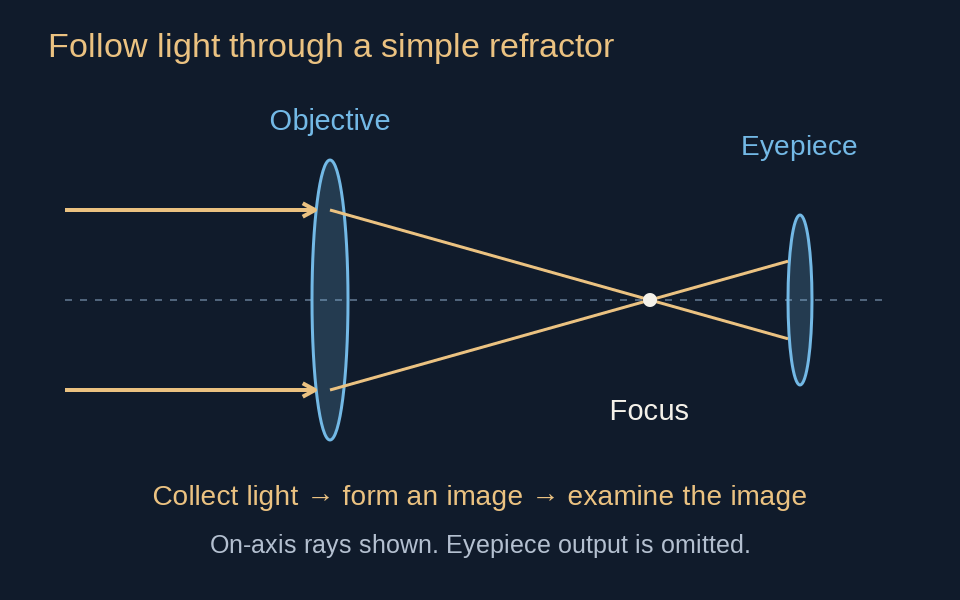
A telescope may show a rotated or mirror-reversed version of a familiar scene. That does not by itself mean the instrument is broken. Lenses, mirrors, diagonals and the direction from which you look into the eyepiece all affect how the view appears.
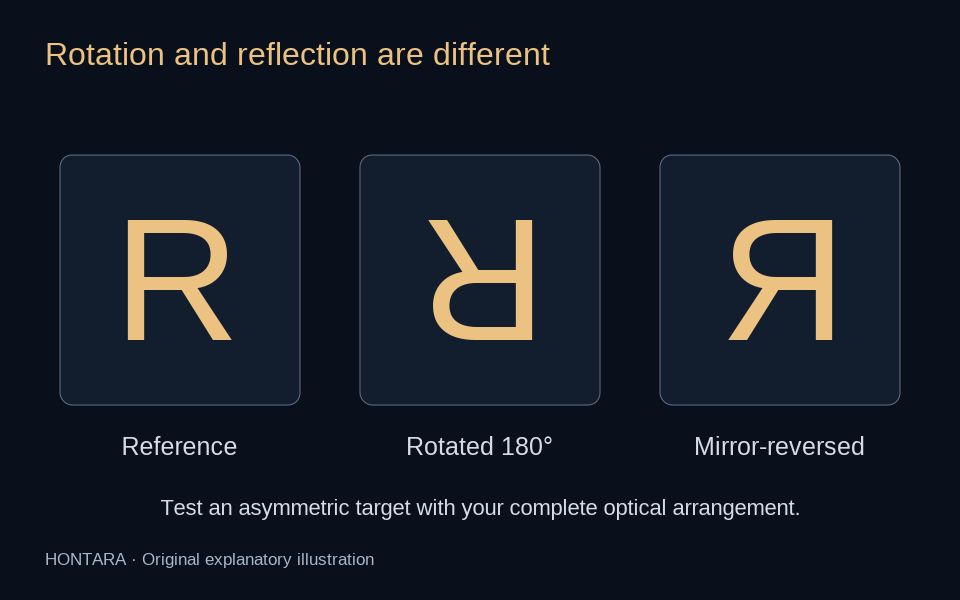
Rotation and reflection are different operations. Turning a printed letter through half a turn changes its direction without making it a mirror image. Flipping it across one axis reverses its handedness. The illustration uses an asymmetric letter so this distinction is visible.
Test instead of guessing
Before night observing, choose a safe distant ground target with an asymmetric detail. Keep all optics well away from the Sun. Compare the unaided-eye view, finder view and main telescope view without changing the target.
Write down what each instrument does to the same detail. For example, record whether a sign’s top appears at the bottom and whether its left side appears at the right. A simple arrow and a small corner mark make a better test than a circular object, because a circle can hide a reversal.
Check the complete optical arrangement
Manufacturer manuals show that a conventional star diagonal can produce a different orientation from straight-through viewing. An erecting prism can produce another result. Rotating the diagonal or moving around a Newtonian telescope can change how the view sits relative to the ground.
Avoid memorising one universal rule for every instrument labelled refractor or reflector. Record the exact telescope, finder and accessories you tested. Repeat the check after changing the arrangement. Focus tells you whether detail is sharp; orientation tells you how to match that detail to a reference.
Make the chart agree with your evidence
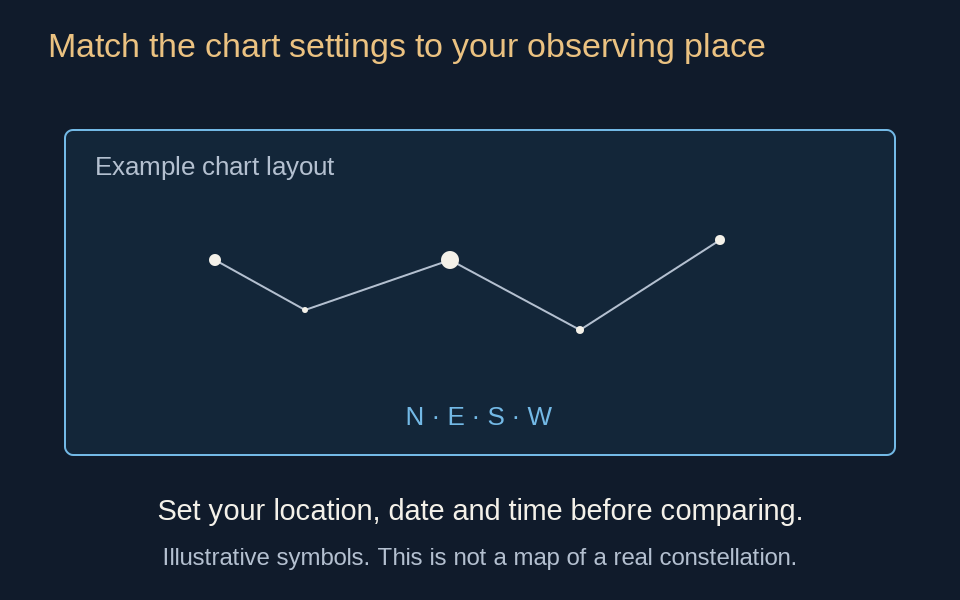
At night, use an already identified star pattern to establish orientation. Turn a paper chart to match a rotated view. A mirror-reversed view needs a mirrored chart or a mental reflection as well as rotation; simply turning the chart cannot reverse its handedness.
Draw three stars in an uneven triangle and mark one as the brightest. Compare their order in the finder and eyepiece. Keep that sketch with your observing notes. It gives you a reusable reference for star hopping and prevents accidental claims that a target moved when only the viewing arrangement changed.
PAUSE AND THINK
Can rotating a chart always correct a mirror-reversed telescope view?
Explore the answer
No. Rotation preserves handedness. A reflected view needs a corresponding reflection as well as any rotation.