On this page
THE BIG IDEAS
- A wide survey and follow-up investigations serve complementary roles.
- A target’s time coverage must be checked.
- A transit alone does not provide a unique mass or composition.
Start with bright accessible stars
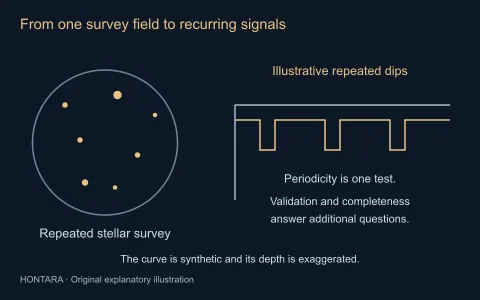
The Transiting Exoplanet Survey Satellite, TESS, launched in 2018. Its survey design monitors large regions of sky to find planets passing in front of relatively bright nearby stars. Bright host stars make many kinds of follow-up measurement more practical than they would be for much fainter targets.
TESS and Kepler both use brightness variations, but their survey choices are not identical. A useful comparison asks which stars were monitored, how long each field was followed and what follow-up opportunities the resulting targets provide. A mission name alone does not determine the information in a light curve.
Read a sector as a time window
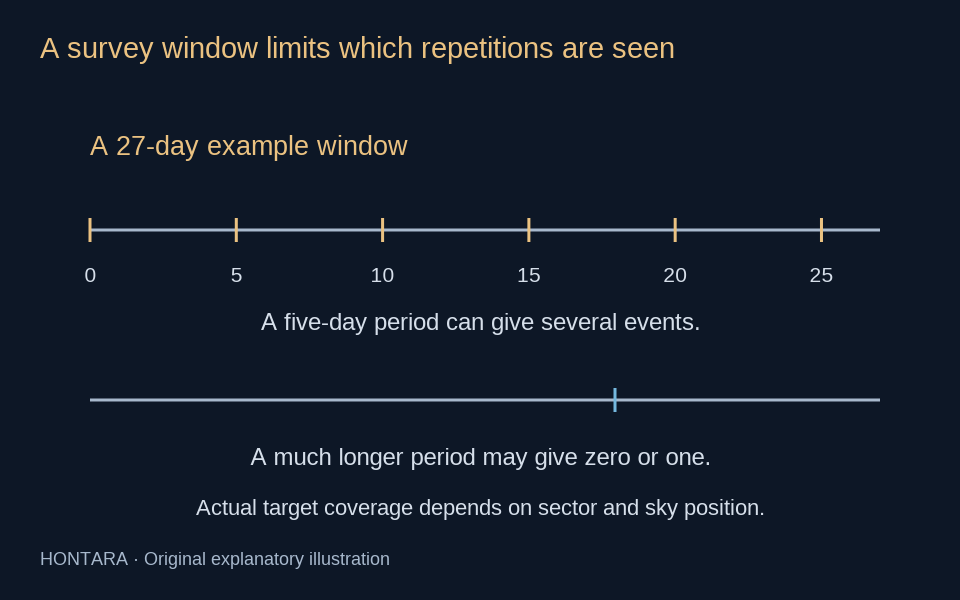
TESS observes broad sectors for roughly a month, with some regions receiving overlapping coverage. The exact time span available for a target depends on its location and the observing programme. Use the data’s actual time coverage rather than assuming every star received an uninterrupted year of observations.
Consider an invented system with a five-day orbital period inside a 27-day window. Several transits might fit, whereas a 100-day orbit might produce none or just one. That comparison describes an observing-window effect, not a numerical prediction of what every TESS target must show.
Ask what a transit measures
Transit depth constrains the planet-to-star radius ratio under an appropriate model. Event spacing can constrain the orbital period when enough transits are identified. Stellar properties, dilution and transit geometry still affect the inferred planetary radius and orbit.
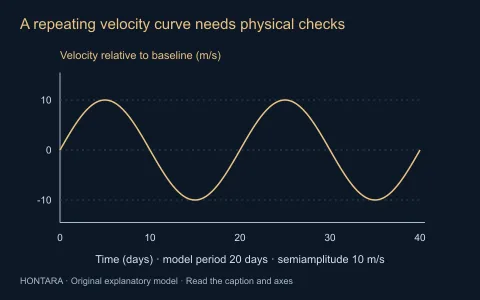
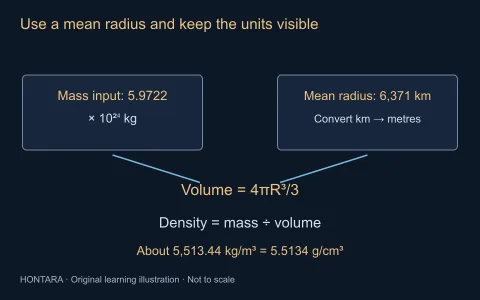
The light curve does not directly supply a unique planetary mass or composition. Radial-velocity measurements, timing information and other observations can add complementary constraints. Combining radius with a reliable mass can constrain bulk density, while still leaving possible interior models rather than one guaranteed composition.
Investigate a candidate rather than endorsing it
Check whether an apparent dip could arise from a binary star, stellar activity, a blended source or instrumental behaviour. Researchers use different diagnostics and follow-up observations to separate these possibilities. A candidate label is a description of the evidence stage, not a promise that every signal is a planet.
A practical reading exercise is to list three claims from a mission announcement and identify their supporting measurements. Radius from a transit fit, mass from another method and atmosphere from spectroscopy are separate inferences even when they concern the same named world.
Keep the archive and interpretation together
TESS data also support studies of stars and other time-variable phenomena. Its usefulness comes from repeated measurements with documented timing and instrument characteristics. A striking brightness pattern can be scientifically valuable even when it is not caused by a transiting planet.
When using a public light curve, preserve the data source, sector, time system and any processing choices. Do not compare raw and corrected curves as if they were automatically identical measurements. The path from survey signal to physical system is a sequence of checks in which each added observation answers a specific question.
PAUSE AND THINK
Why can a bright host star be useful after a transit candidate is found?
Explore the answer
More detected light can make follow-up spectroscopy and other precise measurements easier. Those measurements can test the candidate and constrain properties not supplied by the transit curve alone.