On this page
THE BIG IDEAS
- Cheops was designed to characterise selected known systems.
- A radius ratio still needs stellar information for a physical radius.
- Improved density constraints do not uniquely reveal an interior.
Characterise rather than repeat every survey
Cheops is ESA’s CHaracterising ExOPlanet Satellite, launched in 2019. Its central design is precise photometry of selected stars already known to host planets. Rather than treating every mission as a search for completely new objects, this approach concentrates effort on understanding specific systems better.
An already identified orbit allows observations to be planned around an expected transit. The important question becomes how accurately the changing stellar flux can constrain the planet’s size and geometry. Better characterisation can make a known system a more useful target for later studies.
Connect depth with a radius ratio
A transit hides part of the stellar disk, producing a small brightness decrease. In a simplified uniformly bright star model, the depth is approximately the squared radius ratio. Halving an uncertainty in transit depth does not automatically halve every uncertainty in a planetary radius or physical interpretation.
The star’s size must also be known to turn a radius ratio into kilometres or Earth radii. Limb darkening, contamination and orbital geometry contribute to the analysis. A helpful evidence table keeps each measured quantity separate from the model assumptions used to translate it.
Use a mass-radius example carefully
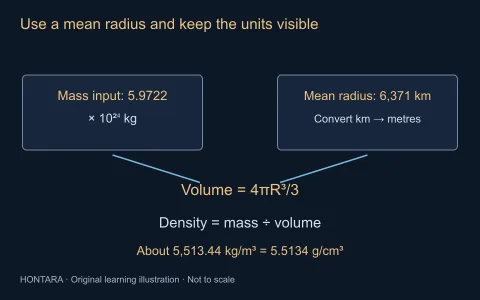
Imagine two fictional planets with the same reliably measured mass but radii in a ratio of 1:2. Their spherical mean densities would differ by a factor of eight. A radius improvement can therefore have a substantial effect on the density range allowed by the data.
Even a precise mass and radius do not uniquely determine every interior layer. Different combinations of materials and conditions can yield similar bulk averages. Cheops-style measurements sharpen the constraints; they do not replace the need for physical models and independent evidence about the system.
Read a targeted observation as a controlled task
A selected transit observation must deal with the instrument’s environment and the changing background. Accurate timing, stable response and appropriate correction procedures are part of the measurement, not cosmetic details added after a finished picture. Researchers inspect whether residual patterns could affect the fit.
For a paper exercise, label a model light curve with baseline, transit and residuals. Ask which part informs the depth and which behaviour might signal a systematic effect. Do not smooth away an inconvenient feature simply because a perfectly symmetric transit was expected.
Explain the value of complementary missions
A survey can identify promising systems; targeted photometry can refine sizes; radial velocities can constrain masses; spectroscopy can investigate atmospheres. The same object may need several facilities because these methods encode different physical information. Precision is useful when the meaning of the measured quantity remains explicit.
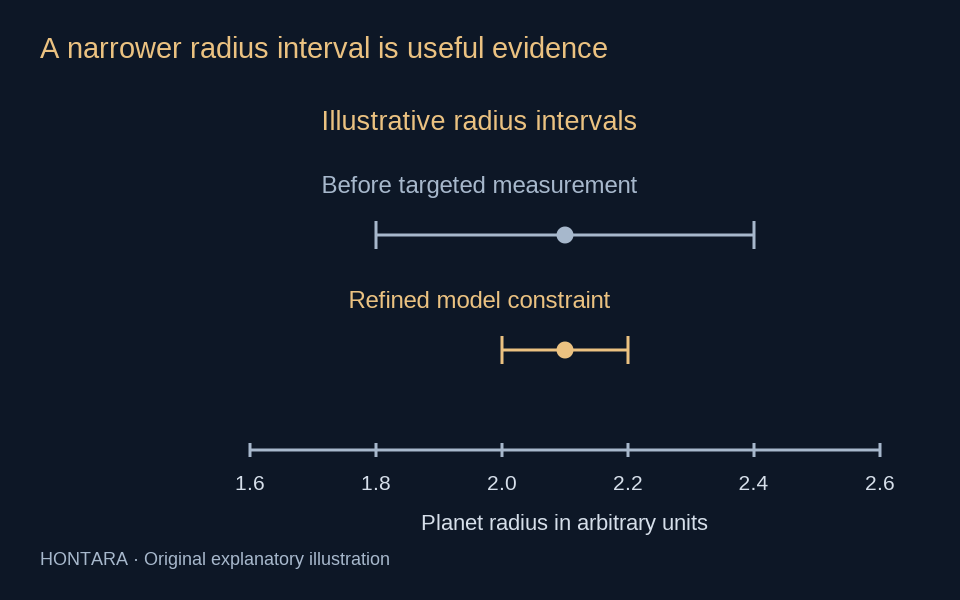
When reading a Cheops result, look for the planet’s prior evidence, the new measurement and the resulting change in its allowed properties. A narrower uncertainty interval is itself a scientific contribution. It need not be recast as proof of a specific surface, atmosphere or biological condition to be interesting.
PAUSE AND THINK
If a planet’s mass stays fixed but its inferred radius doubles, how does its spherical mean density change?
Explore the answer
Volume grows by 2³ = 8, so the mean density falls to one eighth. This model comparison illustrates why radius information matters.