On this page
THE BIG IDEAS
- Bennu sample collection and Earth delivery occurred on different dates.
- Laboratory measurements need collection and curation context.
- OSIRIS-APEX is the spacecraft’s extended mission to a different asteroid.
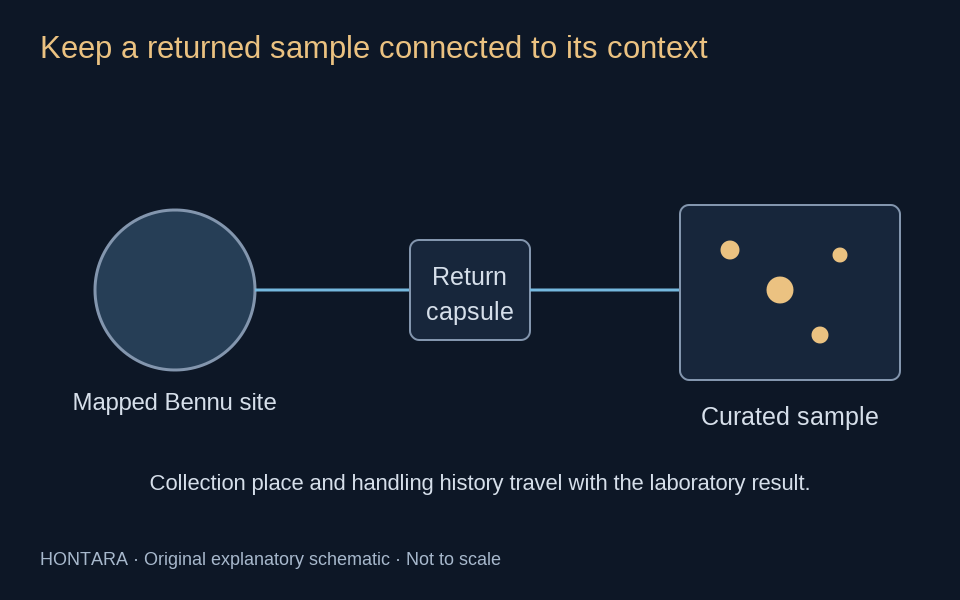
Connect a sample with a mapped place
OSIRIS-REx was NASA’s mission to collect material from the near-Earth asteroid Bennu and return it to Earth. It launched in 2016, reached Bennu in 2018 and collected its sample in October 2020. Mapping before collection supplied context for understanding where that material came from.
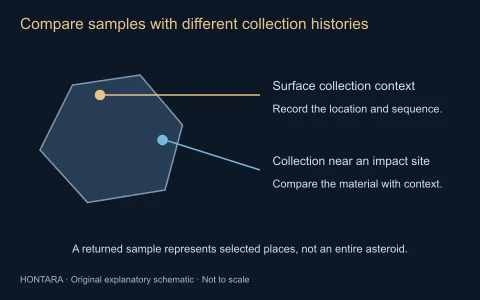
A sample is not a miniature copy of an entire asteroid. Its collection location, particle sizes and handling history affect what scientists can infer from it. Images and remote measurements help connect laboratory results with geological features observed across a much larger body.
Return the capsule rather than the whole spacecraft
The sample capsule landed in Utah on 24 September 2023. The spacecraft released the capsule toward Earth and continued on a different path. That distinction explains how one vehicle could deliver material while remaining available for an extended mission beyond the sample return.
NASA reports a returned sample mass of 121.6 grams. The value describes the recovered scientific material, not the mass of Bennu or of the entire capsule. Much of its value comes from measurements that can be repeated with different instruments and from material preserved for future investigations.
Keep the material’s history with the measurement
Laboratory researchers can investigate mineral composition, chemical relationships and features too small for the spacecraft’s distant instruments to resolve. Careful curation limits contamination and records how material is divided and handled. A result becomes easier to evaluate when its sample history and analytical method are known.
Organic compounds are carbon-containing molecules; detecting them does not by itself establish the presence of living organisms. Similarly, evidence involving water-bearing minerals concerns geological and chemical history rather than a claim that the returned capsule contained an inhabited world. Separate what was detected from the larger explanation being investigated.
Distinguish the original mission from its extension
After releasing the Bennu capsule, the spacecraft continued as OSIRIS-APEX toward a planned encounter with Apophis in 2029. That later investigation has different goals. NASA describes observations of changes associated with the asteroid’s close Earth encounter; it is not another Bennu sample collection.
Create a four-box chain: map the site, collect material, preserve its context and analyse it. For each box, write one question that the next step cannot answer alone. Then compare this chain with Hayabusa2’s Ryugu sampling. Two sample-return missions can use related methods while asking different questions about different asteroids.
PAUSE AND THINK
Why are the collection-site images useful after the sample is already in a laboratory?
Explore the answer
They connect the small returned sample with its larger geological setting and help researchers judge what the material can represent.