On this page
THE BIG IDEAS
- Hayabusa2 connected Ryugu observations with returned material.
- Collection context matters alongside laboratory precision.
- An extended flyby and the original sample-return mission are different investigations.
Meet the original destination
Hayabusa2 is JAXA’s asteroid sample-return spacecraft. Launched in 2014, it reached Ryugu in 2018 and returned a sample capsule to Earth in December 2020. The original investigation linked close observations of the asteroid with material that scientists could study using laboratory instruments.
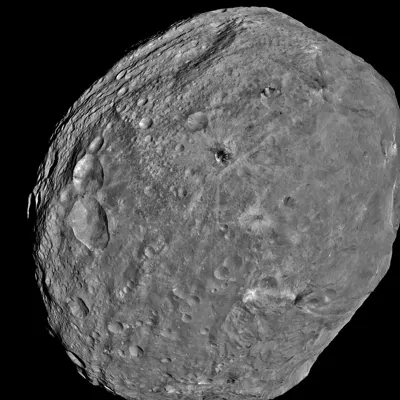
Ryugu is a small carbon-rich asteroid with a surface covered in rocks and loose material. A photograph shows shape, texture and brightness patterns, while spectroscopy and thermal measurements add other kinds of information. None of these measurements alone is a complete account of the asteroid’s origin.
Compare remote observations with collection
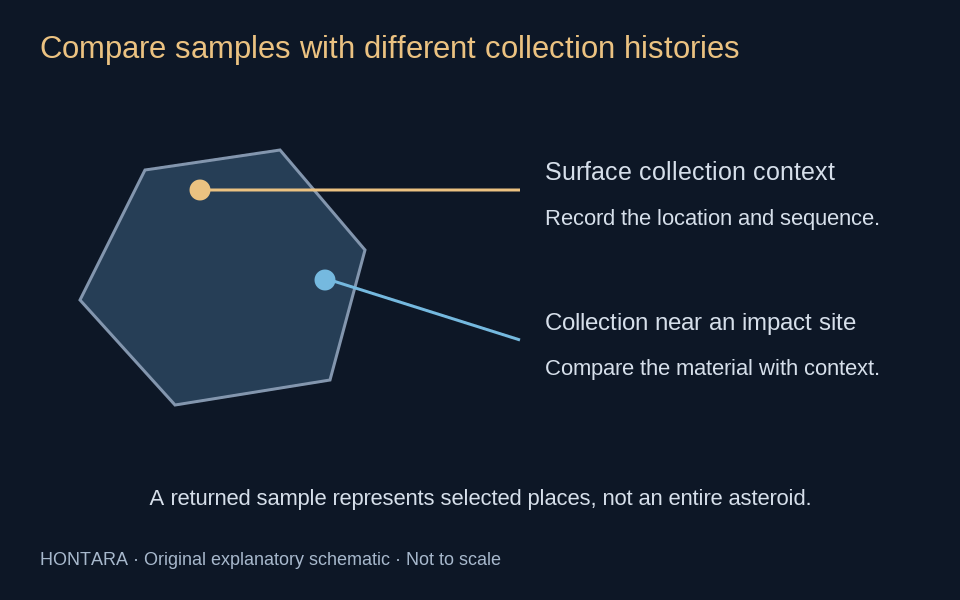
The spacecraft investigated more than one sampling context, including material associated with an artificially created impact site. The purpose was to help compare exposed surface material with material whose history might differ. Such a comparison needs the location and sampling sequence recorded alongside each returned specimen.
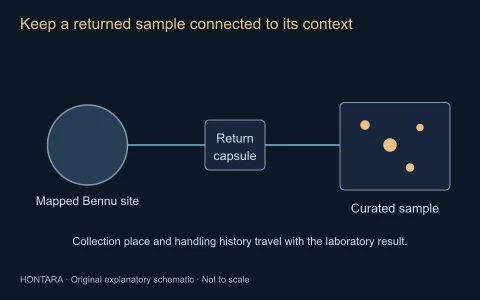
An impact experiment in space is different from simply collecting a dark grain on Earth and naming it an asteroid sample. Researchers need the mission record connecting collection, storage, capsule recovery and curation. Without that chain, a laboratory measurement can be chemically precise while its geological interpretation remains uncertain.
Bring the material into a controlled laboratory
The capsule returned to Australia in December 2020 and the samples were transported for curation in Japan. Researchers could then compare remote measurements with examinations of actual Ryugu material. Small grains can preserve mineral and chemical evidence, but a sample still represents selected places and particle sizes rather than every part of an asteroid.
In a classroom comparison, use two labelled photographs of the same ordinary rock under different lighting and one hand specimen. Ask which questions the photographs help answer and which need direct examination. This is an analogy about evidence types, not a demonstration that a school rock has the same history or composition as Ryugu.
Keep the extended journey distinct
Hayabusa2’s spacecraft continued after releasing the Earth-return capsule. JAXA published results from its extended-mission flyby of asteroid Torifune in July 2026. A fast flyby supplies a different observing opportunity from remaining near an asteroid and selecting a sampling location over many months.
Make a comparison table for Hayabusa2 and OSIRIS-REx using destination, collection context, return date and laboratory questions. Do not rank the scientific value by sample size alone. Different locations, instruments and research questions can make a small well-documented sample valuable. Keep confirmed milestones separate from later mission plans as the extended journeys continue.
PAUSE AND THINK
Why is a larger sample not automatically the more informative scientific sample?
Explore the answer
The question, geological context, contamination control and available analytical methods all affect what can be learned. Sample mass is only one consideration.