On this page
THE BIG IDEAS
- DART deliberately impacted Dimorphos in a controlled test.
- The measured change was in its orbit around Didymos.
- One deflection result does not supply a universal asteroid-defence formula.
Define the experiment
NASA’s Double Asteroid Redirection Test intentionally struck Dimorphos on 26 September 2022. Dimorphos is the smaller member of the Didymos asteroid pair. The target was chosen for a controlled deflection test, not because the pair was on a collision course with Earth.
The experiment used a kinetic impactor: a spacecraft transferred momentum by hitting the asteroid. It was not a mission to blow an asteroid apart. Observations before and after the impact provided a way to test how effectively that collision changed the motion of a real small body.
Measure an orbital change
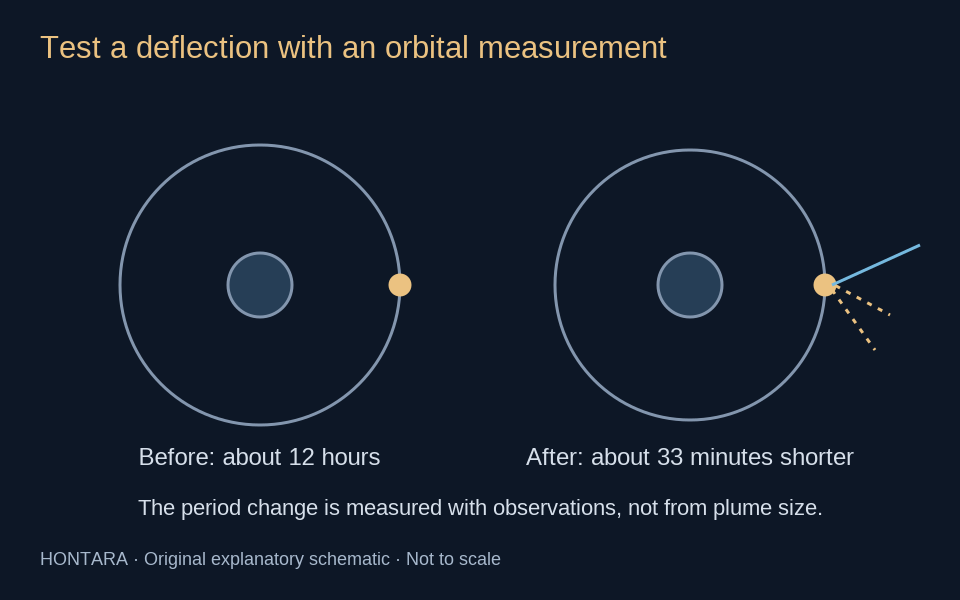
Astronomers studied the time Dimorphos takes to orbit its larger companion. Earth-based and space-based observations showed that the period became shorter by about thirty-three minutes. The orbital period is a repeated time interval, not a direct measurement of the distance an asteroid would miss Earth by.
Compare approximately twelve hours with a thirty-three-minute change. Converting twelve hours to 720 minutes gives a change of roughly 4.6% for that rounded classroom comparison. More precise research uses the measured pre-impact period and its uncertainties. This worked percentage is not a substitute for the mission’s orbital analysis.
Explain why debris matters
Material thrown outward by the impact also carried momentum. The asteroid’s response therefore depends on more than treating spacecraft and target as two solid balls that simply stick together. Surface structure, internal properties and the direction and amount of escaping material influence the result.
Images of the impact and later debris observations provide evidence alongside the timing measurements. A bright plume alone would not quantify the final orbital change. Good explanations connect the physical mechanism with several observations and acknowledge which properties still require modelling or further investigation.
Keep the conclusion proportional to the evidence
DART demonstrated a deflection technique in one particular asteroid system. It did not show that every asteroid can be redirected with the same spacecraft mass or the same warning time. Real planetary defence also requires discovery, orbit determination, assessment and enough preparation time to act.
Draw a simple before-and-after orbital diagram and label it not to scale. Add one box for the deliberate action and another for the measurement that tested its effect. Then list two conditions that could make a different asteroid respond differently. A successful experiment is valuable because its outcome can be measured and its limits can be stated.
PAUSE AND THINK
Why does a picture of an impact plume not by itself establish the change in orbital period?
Explore the answer
A plume shows that material was ejected. Determining the period change requires timing and orbital observations before and after the impact.