On this page
One world turning
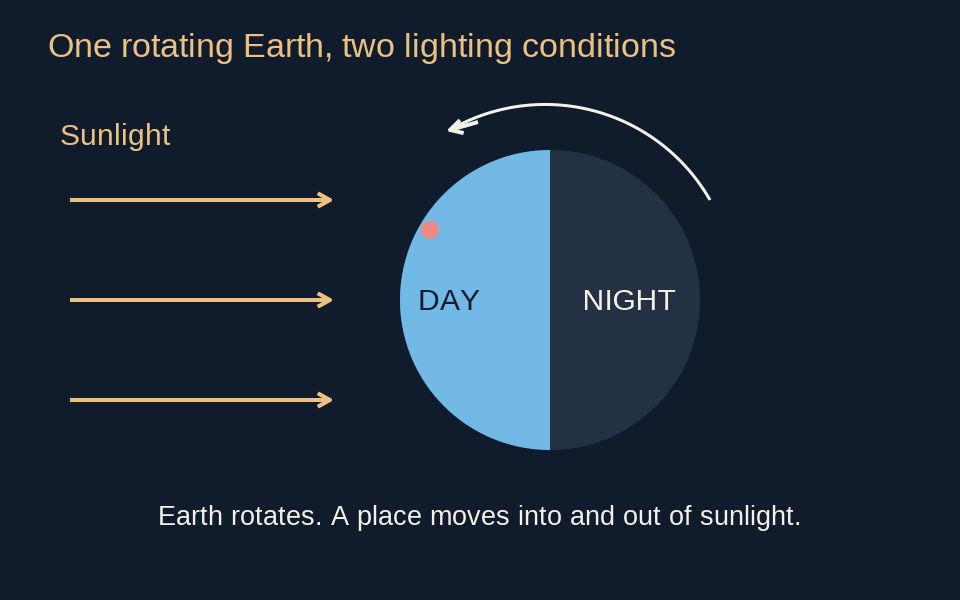
Earth rotates while sunlight arrives from one direction. The side facing the Sun experiences daytime and the side turned away experiences night. As the ground beneath you turns, your location enters and leaves the sunlit hemisphere. This is why the Sun appears to cross the sky. The daily motion is mostly a consequence of Earth’s rotation rather than the Sun travelling around Earth once every day.
THE BIG IDEAS
- Earth’s rotation produces the daily cycle.
- A solar day differs slightly from a rotation measured against stars.
- Latitude and axial tilt affect daylight length.
The direction matters
Earth rotates from west to east. From the ground, that produces the familiar apparent movement of the Sun and many stars from east toward west. Objects close to a celestial pole trace smaller circles. A globe makes this easier to picture: mark a location and slowly rotate the globe eastward beside a lamp. Watch the marked location cross the boundary between light and darkness. Keep the lamp still during this part of the model.
Why a day is about 24 hours
A solar day is the time from one local noon to the next. During one rotation Earth also moves a little way around the Sun, so it must turn slightly further to bring the Sun back to the same direction. A rotation measured against distant stars takes about 23 hours and 56 minutes. The difference explains why stars appear slightly farther west at the same clock time on successive nights.
Daylight is not always twelve hours
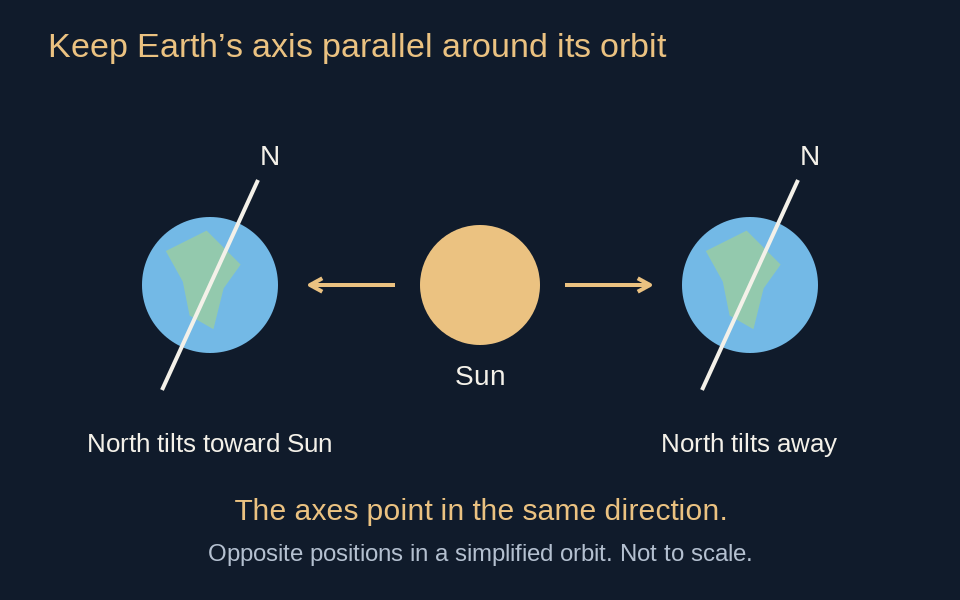
The length of daylight depends on latitude and season because Earth’s rotation axis is tilted relative to its orbital plane. Around the equator the variation is smaller than at high latitudes. Near the poles there are periods when the Sun remains above or below the horizon for many days. Sunrise and sunset also depend on how the horizon is defined and on the bending of light through the atmosphere.
Observe without looking at the Sun
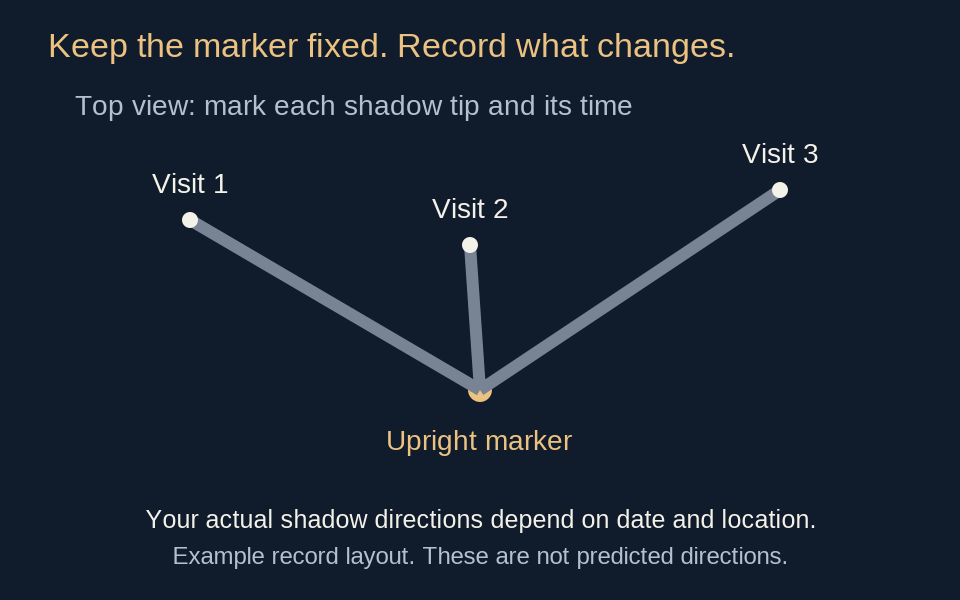
A safer way to follow the daily pattern is to observe shadows. Record the direction and length of a fixed object’s shadow at several times from a safe place. Do not stare at the Sun or use a telescope for this activity. A shadow changes because the Sun’s apparent direction changes. The shadow record is a local observation; a globe model helps explain the same pattern on a rotating Earth.
PAUSE AND THINK
If Earth stopped rotating but continued orbiting, would the ordinary 24-hour day remain?
Explore the answer
No. The normal daily cycle depends on rotation. Orbital motion alone would produce a very different and much slower pattern of sunlight.