On this page
What each telescope measures
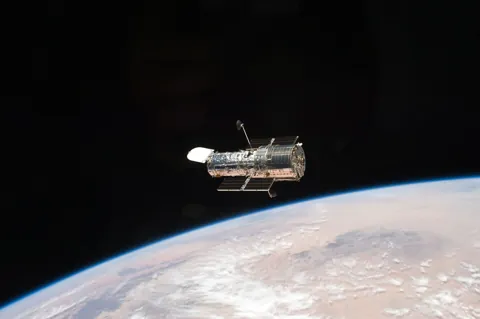
A larger mirror collects more light, which helps detect fainter sources in the wavelengths its instruments record. The wavelength also affects how finely features can be resolved. Pick the telescope and instrument that see the feature you want to study.
| Feature | Hubble | Webb |
|---|---|---|
| Main wavelengths | Ultraviolet and visible, plus some near-infrared. | Near- and mid-infrared. |
| Primary mirror | 2.4 metres, in one piece. | 6.5 metres across, made of 18 segments. |
| Orbit | Low Earth orbit. | Orbits the Sun in a path around the Sun–Earth L2 region, roughly 1.5 million km from Earth. |
| Example use | Ultraviolet light from hot young stars. | Redshifted light from very distant galaxies and infrared signatures of molecules. |
What the Pillars of Creation reveal
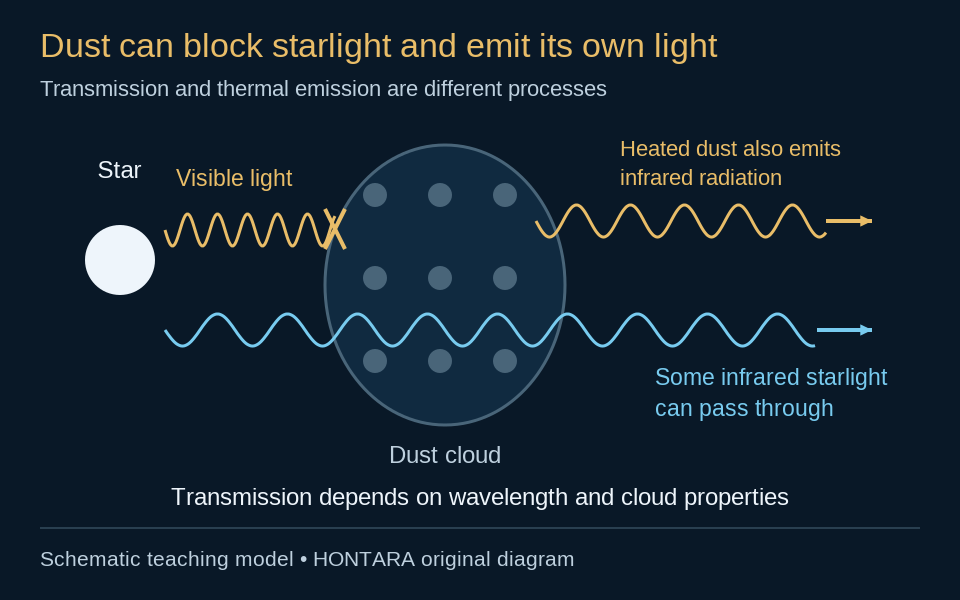
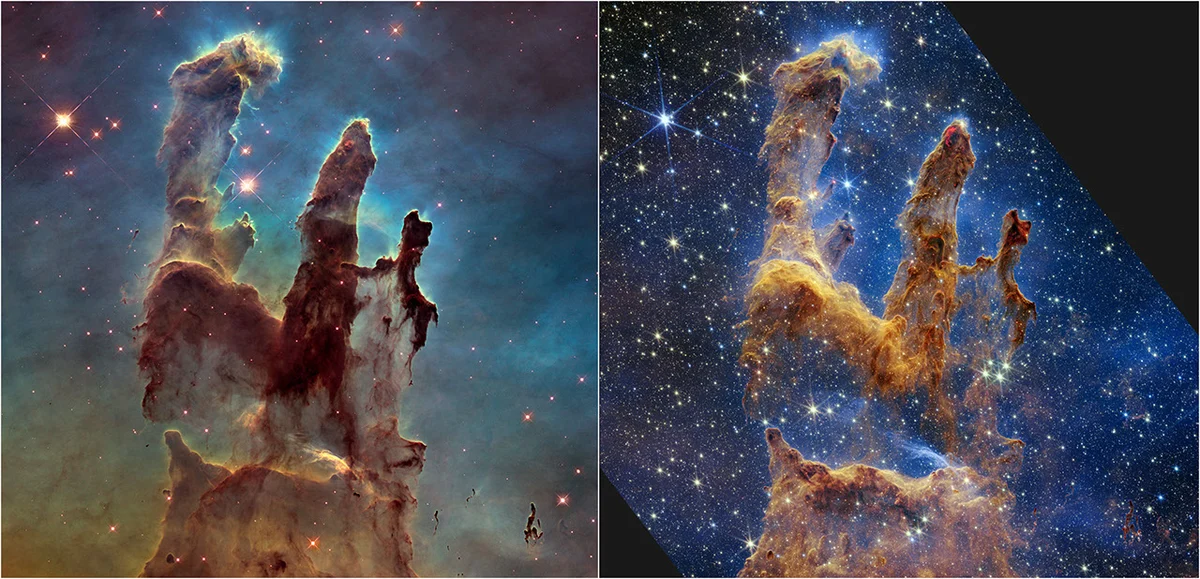
Start with the tall column on the left side of each picture. In Hubble’s visible image the dust blocks much of the light behind it. In Webb’s near-infrared image more points of light are visible through thinner dust and beyond the edges of the pillars. The thickest parts still obscure light.
The display colours help show measurements made through filters. Near-infrared wavelengths lie outside human vision. Read the image caption before comparing a patch of colour. Check the position and shape of a feature in both frames before deciding what changed.
Why Webb has a sunshield
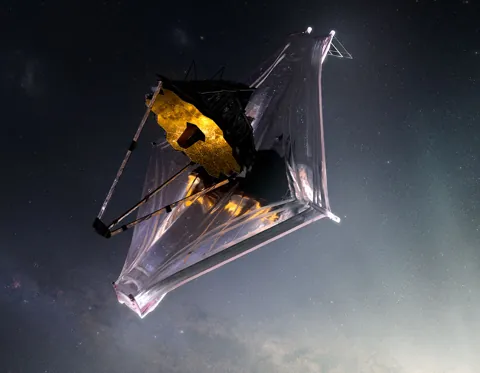
Warm instruments and mirrors give off infrared radiation. Webb’s sunshield helps the telescope stay cold so its own heat does not drown out faint cosmic signals. Its orbit keeps the Sun and Earth on the shield side while it observes a different part of the sky.
For a question about young stars hidden by dust, use infrared images. For a question about ultraviolet radiation around exposed hot stars, use Hubble’s ultraviolet measurements. For a question about how both populations relate to the cloud, put the observations together.