On this page
THE BIG IDEAS
- Albedo is a reflected fraction rather than an energy amount.
- Reflected plus absorbed starlight equals the supplied incoming amount.
- This limited budget does not specify a surface temperature.
Define one boundary and one interval
Treat each fictional world together with its atmosphere as one system. The table supplies the total incoming starlight energy during the same model interval. Its arbitrary units are energy units, not degrees of temperature. Every part of the incoming light is assigned either to reflection or absorption within this simplified boundary.
Albedo A is the fraction of that incoming starlight reflected out of the system. The absorbed fraction is therefore 1−A. This exercise concerns incoming shortwave energy accounting, not the outgoing thermal radiation that would also matter in a complete planetary energy balance.
Copy the four fictional cases
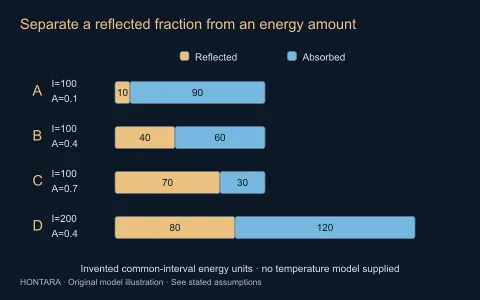
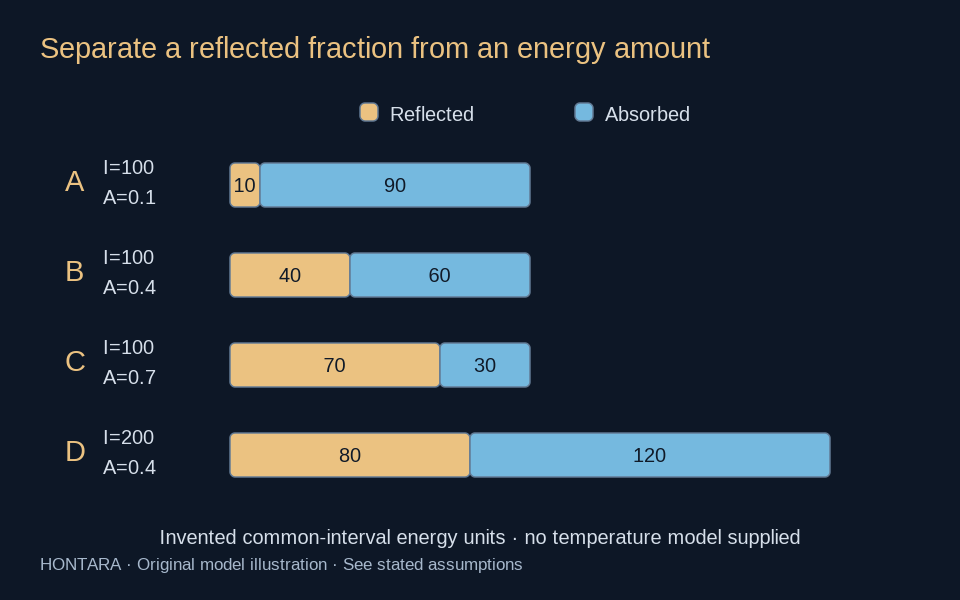
Worlds A, B and C each receive 100 model energy units and have albedos 0.1, 0.4 and 0.7 respectively. D receives 200 units with albedo 0.4. Record incoming energy and albedo as separate inputs so their different roles remain visible.
Before calculating, predict which world reflects the greatest fraction and which absorbs the greatest total amount. Those are not the same question when incoming energies differ. Do not rank the worlds by surface temperature because the supplied table does not contain the required physical information.
Make the energy account close
Calculate reflected energy as I×A and absorbed energy as I×(1−A). A reflects 10 and absorbs 90 units; B reflects 40 and absorbs 60; C reflects 70 and absorbs 30; D reflects 80 and absorbs 120.
For each row add the reflected and absorbed amounts and compare the sum with I. If the sum differs, check whether you mixed a fraction with a percentage or added energy in different units. Keep a fraction such as 0.4 distinct from 40 energy units.
Check the limiting fractions mentally: albedo zero would reflect none of the input, while albedo one would reflect all of it in this model.
Use controlled comparisons
A versus C holds incoming energy fixed while albedo changes. B versus D holds albedo fixed while incoming energy doubles. Explain why D’s reflected and absorbed amounts both double without changing the fractions assigned to those pathways.
C reflects the greatest fraction, 0.7, but D reflects the greatest total amount, 80 units. D also absorbs more energy than any other model row. A high or low reflected fraction cannot be interpreted without the incoming amount and a clearly defined boundary.
Stop before an unsupported climate claim
Write one supported energy comparison and one missing requirement for a temperature inference. A physical temperature calculation would need a specified model of outgoing radiation, heat storage and atmospheric behaviour, among other relevant assumptions.
Finally state which omitted pathway would need to be added to investigate a steady energy balance over time. Reflected starlight and emitted thermal radiation are different components. The arithmetic here organises the supplied input; it does not measure a real planet or determine whether its surface supports liquid water.
PAUSE AND THINK
Why can D reflect more total energy than C despite having lower albedo?
Explore the answer
D receives twice as much incoming energy. Its 0.4 fraction of 200 is 80 units, larger than C’s 0.7 fraction of 100, which is 70.
RECORD YOUR OWN EVIDENCE
Your activity sheet
You need: Paper, pencil and a calculator.
Treat each invented world plus atmosphere as one system. All incoming starlight not reflected is absorbed. Compute reflected energy I×A and absorbed energy I×(1−A) for the stated common model interval.
Name or group: Date:
| World | Incoming units I | Albedo A | Reflected / absorbed |
|---|---|---|---|
| A | 100 | 0.1 | |
| B | 100 | 0.4 | |
| C | 100 | 0.7 | |
| D | 200 | 0.4 |
Which comparison changes only albedo? Which changes only incoming energy?
Check that reflected plus absorbed energy equals incoming energy in every row.
Why do these numbers alone not give a surface temperature?
Invented whole-system shortwave budgets in arbitrary energy units. Outgoing thermal radiation, heat storage and atmospheric details are not supplied.