On this page
THE BIG IDEAS
- Assess fraction and total as distinct quantities.
- Keep the selected boundary visible throughout the lesson.
- Temperature claims need an outgoing-energy model and other assumptions.
Specify the model boundary and objective
Learners should account for reflected and absorbed incoming starlight and identify a missing component before making a temperature claim. The model boundary includes a world and its atmosphere. It assigns all unreflected incoming shortwave energy to absorption inside that boundary.
Prepare the four fictional rows with incoming energy and albedo. Keep the interval and arbitrary energy units explicit. Do not replace the whole-system fraction with a local surface albedo without explaining that it represents a different boundary and may require additional atmospheric information.
Use a 45-minute sequence
Use five minutes for fraction versus amount, ten for individual calculations, ten for closing the four accounts, ten for controlled comparisons and ten for a temperature-claim exit response. Ask learners to predict greatest reflected fraction separately from greatest reflected total.
Provide a bar template or spoken number comparison where useful. A learner need not distinguish colours to show that a 100-unit bar can split into 40 reflected and 60 absorbed units. Label every pathway with a quantity and unit rather than relying on the drawn segment alone.
Check all numerical results
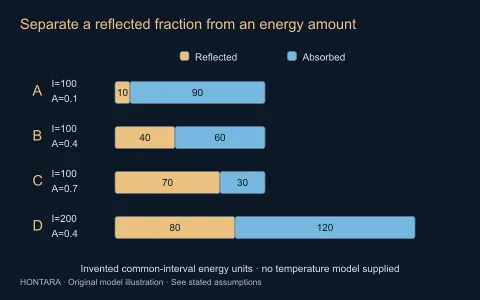
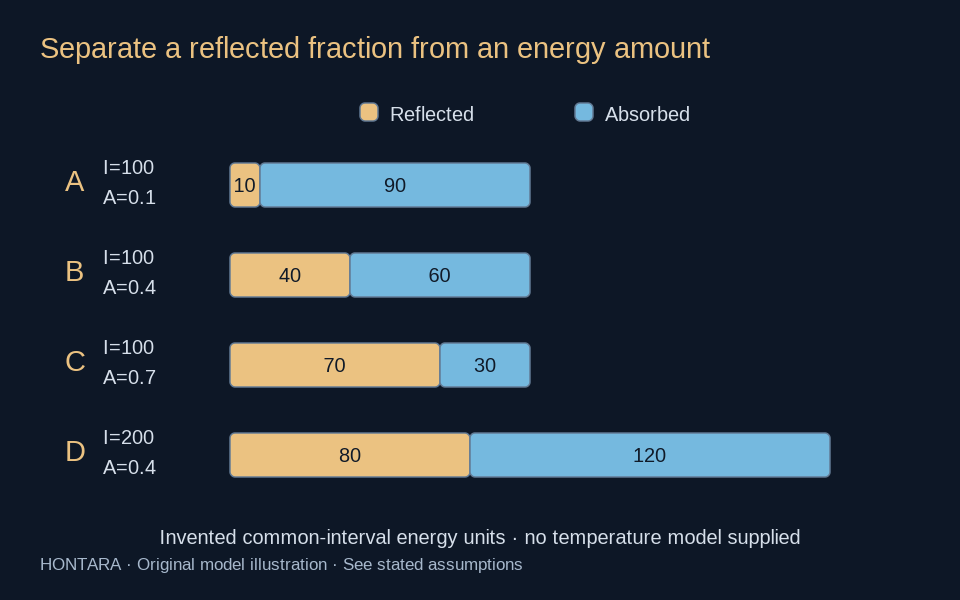
A gives reflected/absorbed values 10/90, B gives 40/60, C gives 70/30 and D gives 80/120. Every sum equals its supplied incoming amount. B/D isolate a twofold change in incoming energy at fixed albedo; A/C isolate albedo at fixed incoming energy.
If a learner writes that D absorbs 0.6 units, ask whether 0.6 represents a fraction or an energy. If they select C for greatest reflected total, compare its 70 units with D’s 80 rather than simply repeating the definition of albedo.
Also check that every albedo lies between zero and one before calculating.
Protect the temperature distinction
The largest absorbed input does not alone fix a surface temperature. The table omits outgoing thermal emission, storage and atmospheric details. A steady-state model needs a balance between absorbed input and an appropriate outgoing-radiation description; a transient model must also track changing stored energy.
Avoid converting the table directly into degrees or ranking habitability. Instead ask learners to name the missing physical relation they would need. This keeps the task useful as energy accounting without presenting a toy split of incoming light as a full climate simulation.
Assess a new row and its limits
For the exit task supply incoming energy 150 units and albedo 0.2. Expect 30 reflected and 120 absorbed, with the sum still 150. Ask whether matching D’s absorbed amount proves equal surface temperatures. The supported answer is no from the supplied information.
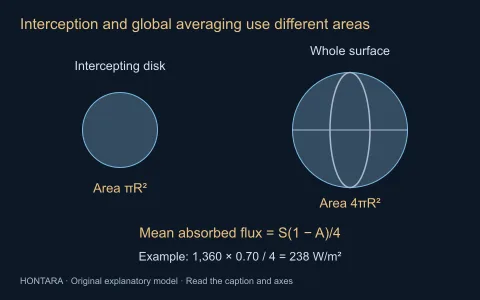
For extension discuss how a real observed reflectivity depends on wavelength and how a planetary mean requires appropriate averaging. Keep those questions separate from the common simplified fraction used here. More detailed evidence can improve the model, but it does not change which assumptions the original arithmetic actually contained.
PAUSE AND THINK
What makes the 150-unit, albedo-0.2 exit case a useful comparison with D?
Explore the answer
Both absorb 120 model units despite different incoming amounts and albedos. That equality in one budget component still does not establish equal climates.
RECORD YOUR OWN EVIDENCE
Your activity sheet
You need: Paper, pencil and a calculator.
Verify all four reflected/absorbed budgets, then add the 150-unit, albedo-0.2 transfer case and evaluate a temperature claim.
Name or group: Date:
| World | Incoming units I | Albedo A | Reflected / absorbed |
|---|---|---|---|
| A | 100 | 0.1 | |
| B | 100 | 0.4 | |
| C | 100 | 0.7 | |
| D | 200 | 0.4 |
Explain why C has the greatest reflected fraction but not the greatest reflected total.
Identify the controlled comparison B/D.
State what additional model information is needed before comparing surface temperatures.
Invented whole-system shortwave budgets in arbitrary energy units. Outgoing thermal radiation, heat storage and atmospheric details are not supplied.