On this page
THE BIG IDEAS
- Average corresponding positions in aligned frames.
- Mean counts per frame and summed counts are different quantities.
- A persistent artifact does not vanish merely because frames are averaged.
Start with fixed pixel positions
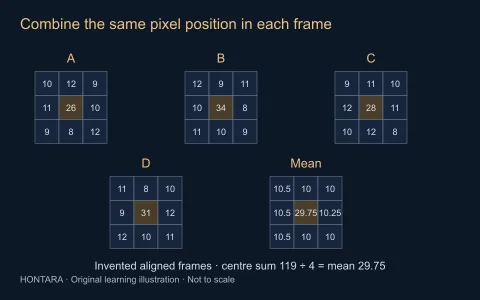
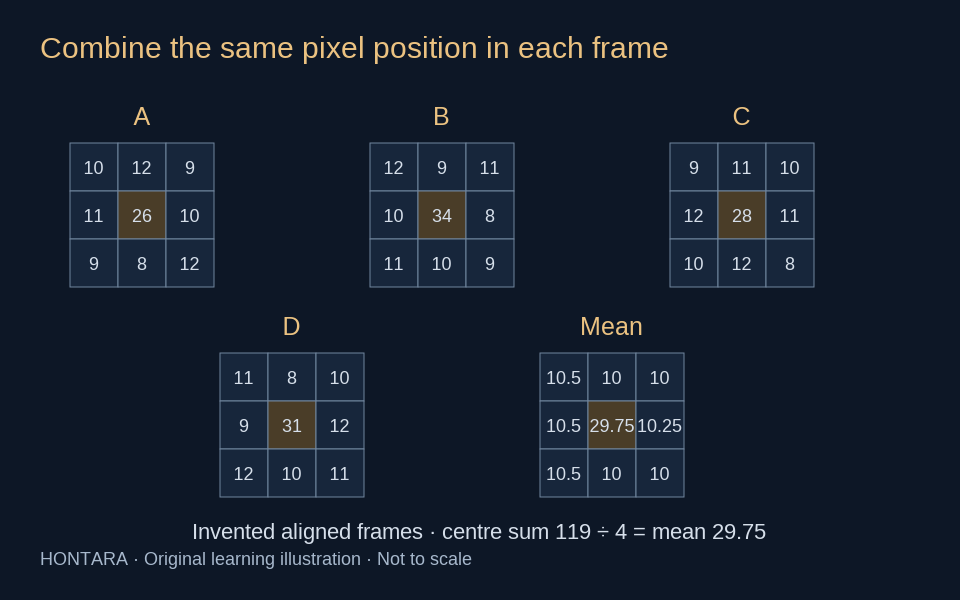
Use four invented 3×3 frames labelled A to D. Rows run from top to bottom and columns from left to right. Every frame describes the same aligned field. The centre pixel contains a model source over a background; all values are synthetic detected counts for this exercise.
Write each frame as three rows. A: 10,12,9 / 11,26,10 / 9,8,12. B: 12,9,11 / 10,34,8 / 11,10,9. C: 9,11,10 / 12,28,11 / 10,12,8. D: 11,8,10 / 9,31,12 / 12,10,11. Keep the frame labels attached to your copies.
Predict what averaging can change
Before calculating, compare the four centre values and one corner. Predict whether a mean image will preserve the centre’s excess over neighbouring values. Do not predict that every background pixel must become identical or that the centre must become an exact known number.
These small arrays are deliberately invented for transparent arithmetic. They are not a randomly generated sample from a validated camera model. You can investigate the effect of a mean here without claiming that the observed changes measure a real instrument’s signal-to-noise.
Build the mean image
At each position add the four corresponding values and divide by four. The centre is (26 + 34 + 28 + 31)/4 = 29.75. Top left is 42/4 = 10.5. Top right is 40/4 = 10. Calculate the remaining six positions in the same way.
The complete mean grid is 10.5,10,10 / 10.5,29.75,10.25 / 10.5,10,10. A mean can be fractional even though the original counts are whole numbers. Keep adequate calculation precision and label the result as mean counts per frame rather than total summed counts.
Test a shared artifact
As a separate extension, add 20 to the top-left value in every original frame. Recalculate that mean pixel. It rises from 10.5 to 30.5. Averaging did not remove a feature repeated at the same position in all four frames.
Now imagine that one frame is shifted by one pixel. Its centre no longer describes the same location as the other centres. Combining without registration would mix different parts of the field. Explain the problem without secretly moving values until the answer looks more attractive.
State the result and its boundary
Write a conclusion describing the centre and neighbouring values in this particular mean grid. Include one limitation: a shared artifact persists, misalignment mixes locations or this invented data set cannot establish a real camera performance gain.
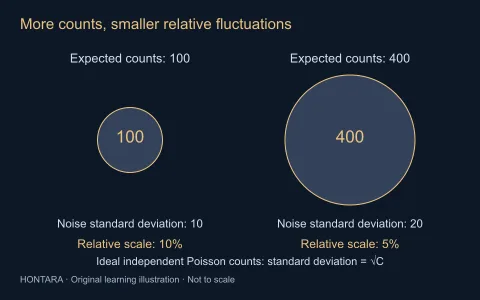
For ideal independent equal exposures, a suitable counting-noise model predicts square-root improvement with added exposure time. That prediction is not proven by this one hand-picked grid. Real image combination also needs calibration, alignment and documented treatment of bad measurements.
PAUSE AND THINK
What happens to a fixed +20-count offset at one pixel in every frame?
Explore the answer
The mean at that pixel also increases by 20. A shared offset persists; averaging alone does not identify or correct it.
RECORD YOUR OWN EVIDENCE
Your activity sheet
You need: The four invented 3×3 number grids in the resource, squared paper, pencil and calculator.
Keep the row and column positions fixed. Add the four values at each selected pixel, divide by four and build the mean grid. Do not discard a value merely because it differs from the others.
Name or group: Date:
| Pixel position | Four readings | Sum | Mean |
|---|---|---|---|
| Centre (2,2) | 26, 34, 28, 31 | ||
| Top left (1,1) | 10, 12, 9, 11 | ||
| Top right (1,3) | 9, 11, 10, 10 |
Compare the centre with neighbouring pixels in one frame and in the mean grid.
Why must images be aligned before averaging corresponding pixels?
Would an error added at the same position in every frame necessarily disappear?
Invented model data. This exercise does not measure a real camera’s noise or demonstrate a guaranteed recovery of an exact true image.