On this page
THE BIG IDEAS
- Assess alignment and labelling as well as division.
- Use a persistent offset as an explicit counterexample.
- An illustrative data set is not a camera performance test.
Define the learning outcome
Learners should calculate means at fixed image positions and explain one circumstance where averaging fails to remove an error. Assess that explanation alongside the numerical answer. Avoid making a beautiful-looking picture the only indicator of understanding.
Prepare the four invented 3×3 frames from the paired activity, squared paper and calculators. Provide large-print number grids or read values aloud where useful. Assign row/column checking and arithmetic roles so accurate copying does not depend on one learner managing every step.
Organise the 45 minutes
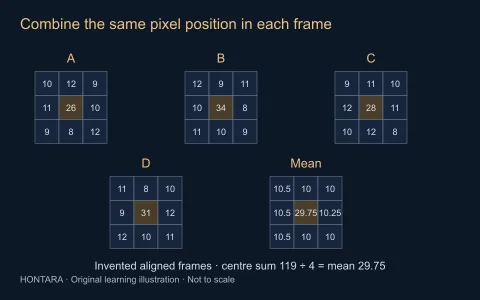
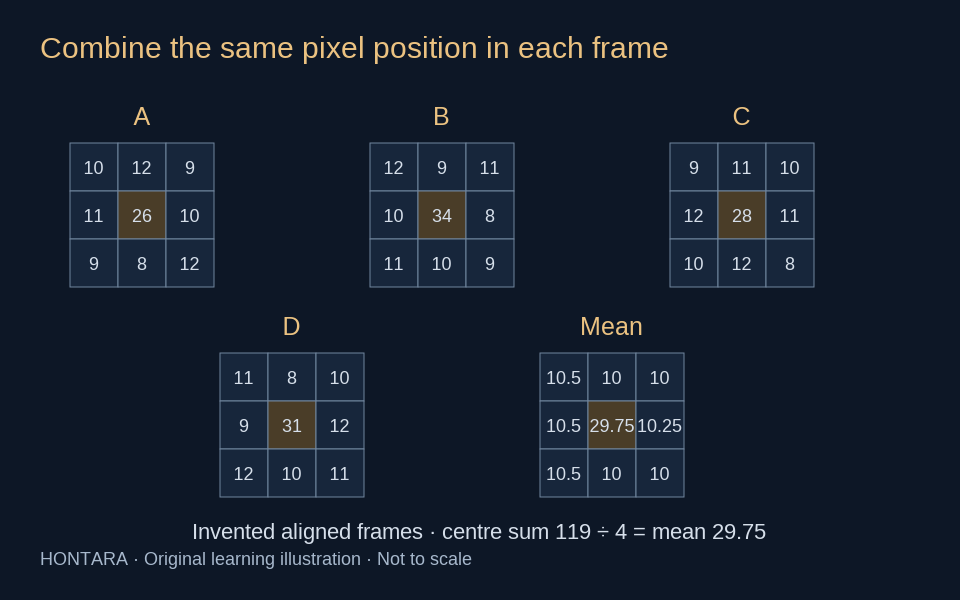
Use five minutes to label rows and columns, ten to compare frames and predict, fifteen to construct the mean grid, ten for the shared-offset and shifted-frame cases and five for an exit response. Preserve at least one worked pixel with its four contributing values.
Keep total and mean operations separate on the board. The centre values sum to 119 counts across four frames; dividing by four gives a mean of 29.75 counts per frame. Ask learners to include that distinction in the output label rather than treating 119 and 29.75 as conflicting results.
Check the arithmetic independently
The reference mean grid is 10.5,10,10 / 10.5,29.75,10.25 / 10.5,10,10. Top left is 10.5 and top right is 10. Keep one complete sum visible so a partner can check how corresponding positions were combined.
If a value differs, trace its row and column before checking division. Some mistakes come from combining neighbouring positions rather than corresponding ones. Ask for a corrected record that keeps the original copied values visible enough to explain the change.
Make the failure cases part of assessment
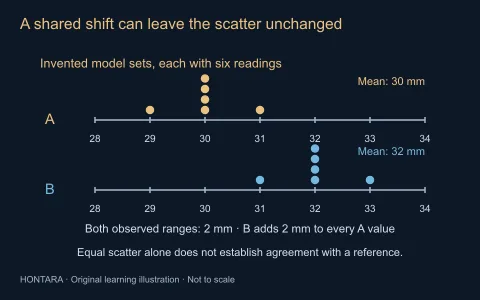
Adding 20 to the same corner in all four frames changes its mean from 10.5 to 30.5. Ask why this is a counterexample to “averaging removes all noise”. Explain that real systematic effects and persistent detector artifacts need appropriate calibration or other treatment.
A one-pixel shift is a different problem. Registration must identify corresponding sky positions before combining them. Do not suggest that averaging can reconstruct arbitrary missing detail or reverse saturation simply by using more frames. The lesson establishes an operation and its assumptions.
Connect the model to a qualified prediction
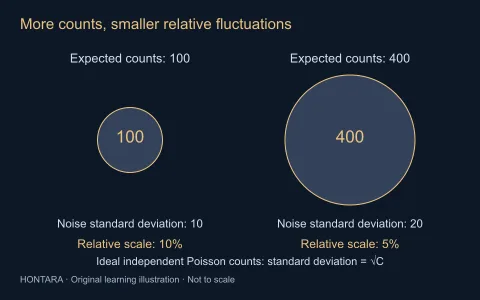
Use the ideal photon-counting calculator to compare one frame with four equal frames. With source 100 and background 400 per frame, ideal S/N rises from about 4.47 to 8.94. The four-frame case also uses four times the exposure time.
For the exit task ask for the centre mean plus one reason the classroom arrays do not prove that every real camera will achieve exactly that improvement. Accept a clear distinction between invented arithmetic, a probabilistic model and instrument-dependent conditions.
PAUSE AND THINK
Why should a learner not call 29.75 the exact true count of the model source?
Explore the answer
It is the arithmetic mean of the stated centre values, which include background and are invented. A sample mean is not an exact physical truth or a background-subtracted source measurement.
RECORD YOUR OWN EVIDENCE
Your activity sheet
You need: The four invented 3×3 number grids in the resource, squared paper, pencil and calculator.
Check the mean of the stated four aligned frames, then investigate a common +20-count corner offset and a one-pixel registration error.
Name or group: Date:
| Pixel position | Four readings | Sum | Mean |
|---|---|---|---|
| Centre (2,2) | 26, 34, 28, 31 | ||
| Top left (1,1) | 10, 12, 9, 11 | ||
| Top right (1,3) | 9, 11, 10, 10 |
Explain the difference between 119 summed centre counts and 29.75 mean counts per frame.
Why does the shared +20-count artifact persist?
What extra information would you need before claiming a real instrument’s S/N improvement?
Invented model data. This exercise does not measure a real camera’s noise or demonstrate a guaranteed recovery of an exact true image.