TRY IT YOURSELF
Ideal photon-counting model
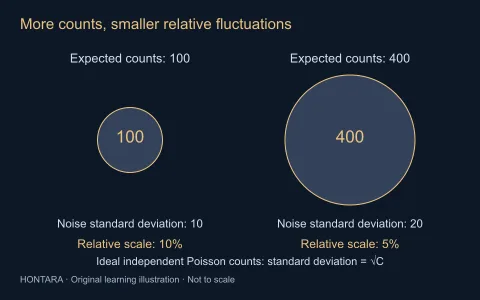
100 source counts plus 400 background counts per exposure: four equal exposures give ideal S/N about 8.94. This is not an instrument exposure-time calculator.
On this page
THE BIG IDEAS
- Source and background inputs describe the same region and exposure.
- More equal exposures add time as well as counts.
- This shot-noise model omits several real observing limitations.
Enter expected counts in one measurement region
Enter expected source and background detected counts per equal exposure, then a whole number of exposures. Use the same measurement region for both count inputs. These are expected detected counts, not a brightness in magnitudes, a camera ISO setting or a flux in unrelated units.
The model treats source and background arrivals as independent Poisson counts and assumes the mean background level is known without additional estimation uncertainty. It excludes read noise, dark current, saturation, calibration errors and changing conditions. It is an educational model rather than an instrument exposure-time prediction.
Follow the summed-count formula
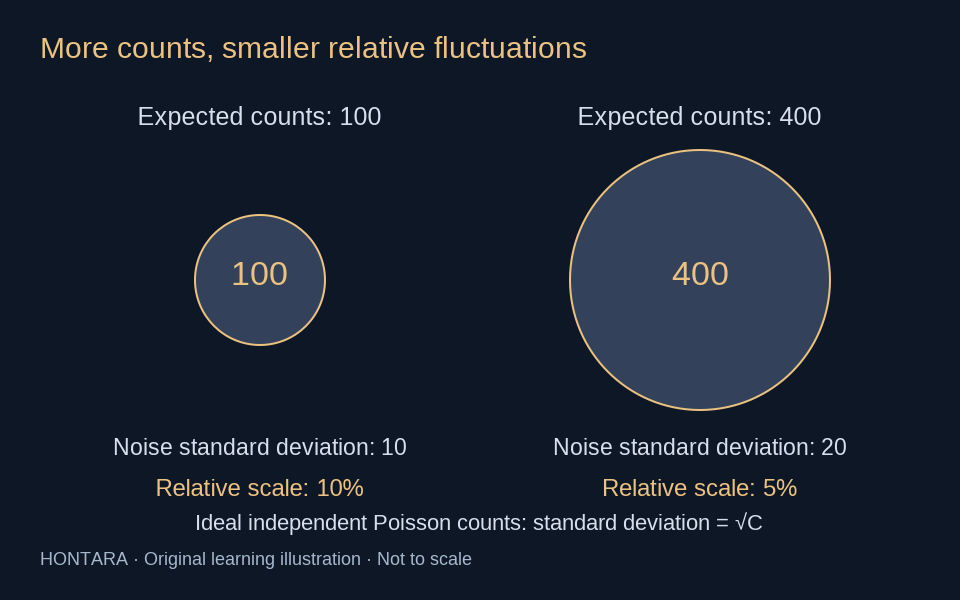
For N equal independent exposures with source S and background B per frame, total source signal is NS and counting-noise standard deviation is √[N(S+B)]. Their ratio is the ideal source S/N. Subtracting a known mean background does not remove its counting variance.
The calculator reports the ratio and both quantities used to form it. If source and background are both zero, it displays no defined ratio rather than dividing zero by zero. A source of zero over a positive background produces zero source S/N in this model.
Check a worked example
With S=100, B=400 and N=1, total source signal is 100 counts and noise is √500, about 22.36 counts. The ideal S/N is about 4.47. At N=4 the source total is 400 and noise is √2000, about 44.72, giving S/N about 8.94.
Both cases use the same per-frame expectations. The four-frame case therefore uses four times the exposure time. It does not show that four files extracted from one original exposure contain four times the independent information.
Keep the real observing problem separate
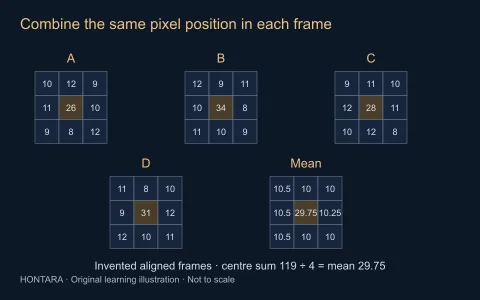
Dividing one fixed total exposure among more frames does not improve ideal shot-noise S/N when the total source and background counts stay fixed. Read noise and overheads can further change real comparisons. Alignment and a suitable treatment of artifacts are also needed before images are combined.
If the background must be estimated from finite data, its estimation uncertainty contributes another term that is absent here. Use the relevant instrument documentation for quantitative planning. A large ideal number alone cannot guarantee an unsaturated image, reliable calibration or a successful detection in real data.
PAUSE AND THINK
Does splitting one fixed exposure into four files create the four-frame improvement shown by the example?
Explore the answer
No. The example adds four independent equal exposures and therefore quadruples total exposure time. Merely subdividing fixed total counts does not create extra shot-noise information.