On this page
Choose your hour and frame
Pick a clear hour near the shower’s expected peak when the Moon is low or down. Set up away from lights with a wide view. Point the camera toward a dark patch roughly 40° to 60° from the radiant if you know where it is. Trails close to the radiant look short because the meteors are travelling toward you. A wider view off to one side gives their paths room to show.
Take a test frame to check that headlights, streetlamps or a bright Moon are outside the frame. A low horizon can add context, but tilt upward if the brightest part of the sky is near the ground.
Set focus and try a short exposure
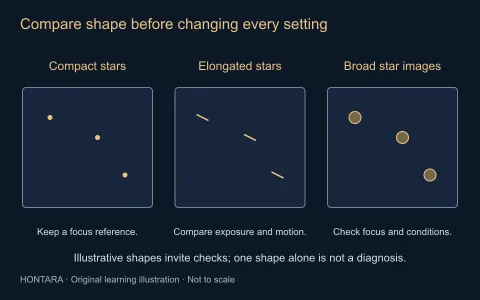
With a camera, switch to manual focus. Magnify a bright star in live view and turn the focus ring until the star looks smallest. Zoom in on a test image to confirm. On a phone, use the main rear camera. Lock focus on a distant light or use manual focus if your app offers it. Check that stars are points before starting the sequence.
For a wide-angle camera, a starting test is 10 seconds at about f/2.8 and ISO 1600. Shorten the exposure if stars stretch or the sky looks washed out. Open the lens as far as it gives you sharp stars. With a phone, use its tripod or long-exposure control if available and start with a few seconds. Some night modes combine frames and can faintly show or omit a brief streak. Try a mode that saves individual exposures if your phone offers one.
Keep recording while you watch
Run a 30-minute sequence with an interval timer or your camera’s continuous exposure mode. Start each exposure soon after the previous one ends. A long pause between shots leaves time for a meteor to pass while the shutter is closed. Check the manual to see whether the interval is measured from the start or end of each exposure.
Bring a charged battery and clear some storage first. Check focus once more if the temperature changes or you move the tripod. Look for condensation on the lens if stars become fuzzy after several sharp frames.
Check a streak against neighbouring frames
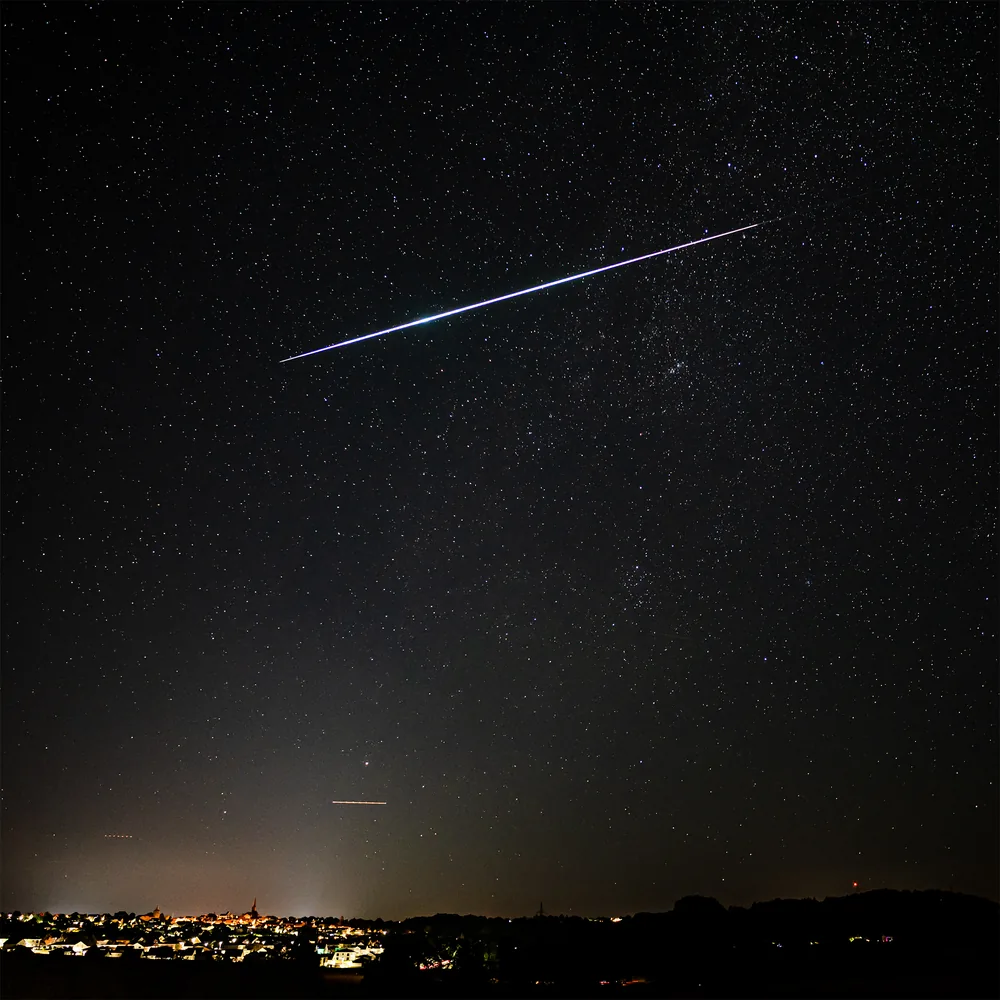
A trail that appears in one frame and tapers unevenly is a meteor candidate. A satellite often makes a more even line that continues into another exposure. An airplane can leave repeating dots or dashes from flashing lights. A satellite flare can also appear in just one frame, so use both the trail’s shape and its position in the sequence.
If several candidates seem to trace back toward the shower’s radiant, that supports the identification. Keep the original frames and exposure times. If you combine several photos into one final image, label it as a composite and say how much time it covers.