On this page
THE BIG IDEAS
- Eye relief and exit pupil measure different things.
- Adjust eye position gently before diagnosing the optics.
- Observers should use the setup that works with their own vision.
Eye position is part of the setup
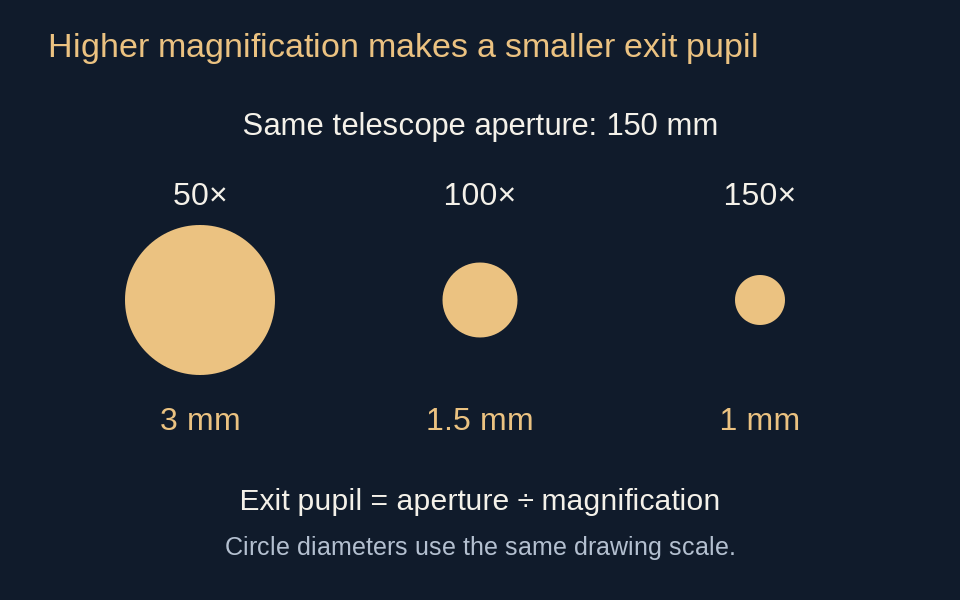
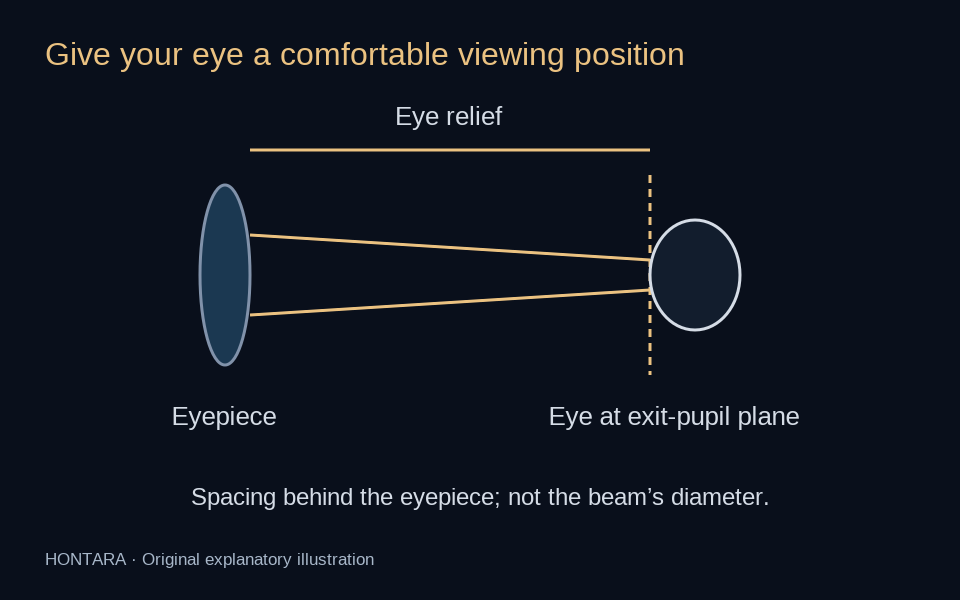
Eye relief is the spacing behind an eyepiece at which your eye can take in its full field. It is different from exit pupil, which describes the width of the emerging light beam. A large exit pupil does not automatically provide generous room for glasses.
If your eye is too far away, part of the field may disappear. If you press too close, the view can black out or become awkward. Begin with your head slightly back and approach gently until the circular field is comfortable. You should not need to press your face against the glass.
Let the eyecup help
If the eyepiece has an adjustable or folding eyecup, follow its instructions. Observers wearing glasses often need the eyecup lowered to reach the intended position. Other observers may find a raised cup a useful guide that keeps the head at a repeatable distance.
There is no single eye-relief number that suits every face, frame and observing posture. Compare the actual field you can see. Avoid choosing an eyepiece solely from a specification without checking how your own glasses and eye position work together.
Separate focus from other corrections
A telescope’s focuser can compensate for many observers’ ordinary near- or far-focus differences. Astigmatism can still affect the view, so some people need their glasses while observing. Personal requirements differ. Keep glasses available rather than treating their removal as a rule.
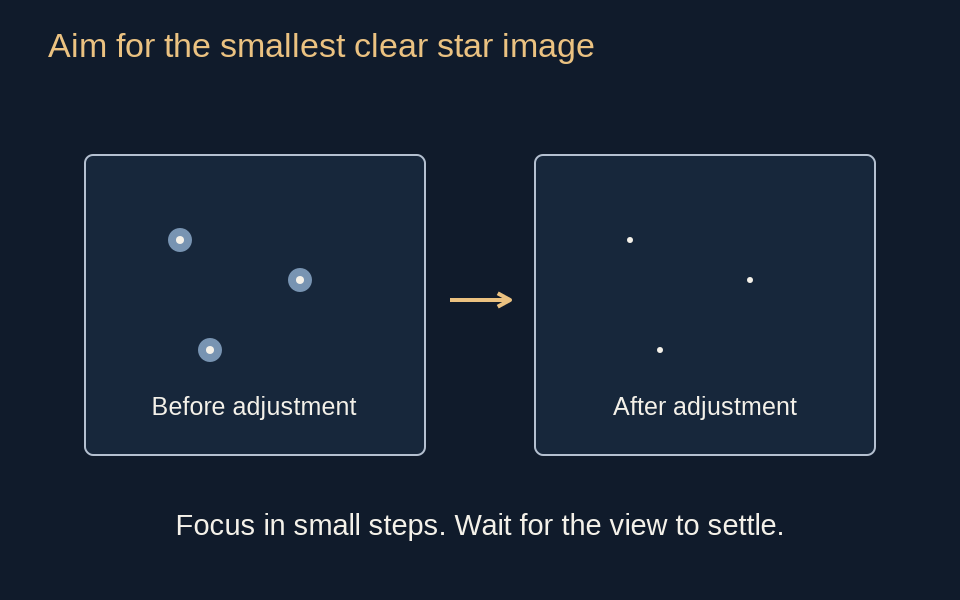
Use a known bright night target and let each observer focus carefully. Ask whether the field edge is visible and whether the image stays steady in a comfortable posture. Do not interpret every dark crescent as a focus error; it may change simply because the eye moved sideways.
Make a repeatable comfort record
Try one eyepiece in two comfortable positions with the instrument fixed. Record the eyecup setting, whether glasses were worn, whether the full field was visible and whether the observer could remain steady. These are personal observations rather than a ranking of other people’s eyesight.
For a group, begin with an easy target and give a short explanation before each turn. Invite the observer to describe the view instead of assuming that silence means success. Provide a stable seated or standing position suited to the person and never ask them to lean on the telescope for support.
PAUSE AND THINK
Why might an observer see only part of the field while the image itself is focused?
Explore the answer
Their eye may be too far from the eyepiece or off the exit-pupil axis. Check position and eyecup settings as well as focus.