On this page
Check the telescope design first
These steps apply to a Newtonian reflector, including many Dobsonians, with a primary mirror marked at its centre. Follow your model’s instructions for which screws adjust tilt and which lock the mirror. Some designs need a different procedure. If the manual advises a specialist adjustment, use that guidance.
The focus knob sharpens an image by moving the eyepiece. Collimation changes where the mirrors direct the light. If the view gets sharply focused at the centre and then blurs only when a star drifts toward the edge, first try centring it again.
Check the secondary, then the primary
Set the telescope tube nearly horizontal in a stable mount. Use a well-lit indoor wall or a bright shaded wall and keep the telescope pointed away from the Sun. Remove the eyepiece and seat the cap or Cheshire squarely in the focuser.
With a sight tube, check that the secondary mirror appears round and centred under the focuser. Check the aim of the secondary by bringing the sight-tube crosshairs onto the primary mirror’s centre mark. The primary reflection should be visible inside the secondary. If the secondary needs work, use your manual to identify its tilt screws and make small changes. Leave its centre mounting screw alone during a routine tilt adjustment.
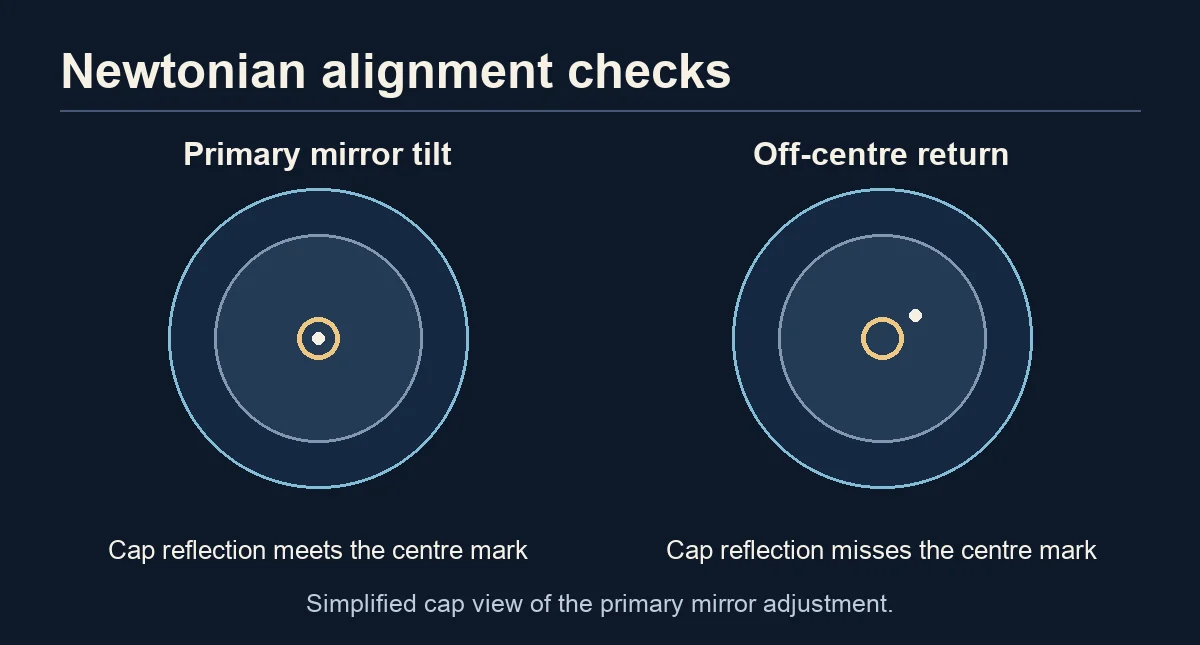
When the secondary is aimed, adjust primary tilt so the centre mark lines up with the pupil reflection in a cap or the bright ring of a Cheshire. Follow the manual for any locking screws and look again after tightening them. The dark silhouette of the secondary can appear offset in a correctly aligned fast Newtonian. Use the alignment marks for the final check.
Confirm on a star when the air is steady
Let the telescope cool outdoors. Choose a bright star high above the horizon and hold it at the centre of the view. At moderate or high power, defocus only slightly. If the pattern consistently looks asymmetric with the star centred, recheck the tools. If the rings boil or drift with turbulent air, wait for steadier conditions before adjusting.