On this page
Plan a view near Honavar
- Height
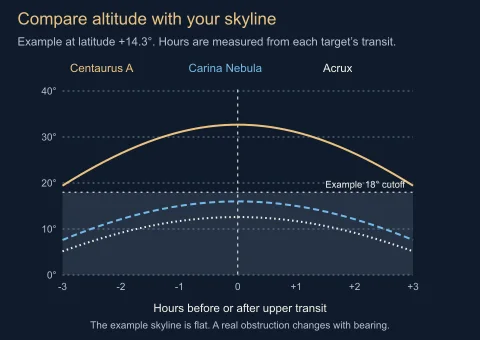
- The nebula centre reaches about 16° above due south at its highest.
- When to try
- Try March or April. An example near the highest point is 10 April 2027 at 10 pm IST.
- First look
- On a transparent night use binoculars or a wide-field telescope and look for a faint uneven glow.
Set your location and time in Stellarium Web, then search for NGC 3372. Check the Moon and your actual skyline. Record whether you could identify the target and what affected the view.
Set a realistic first target
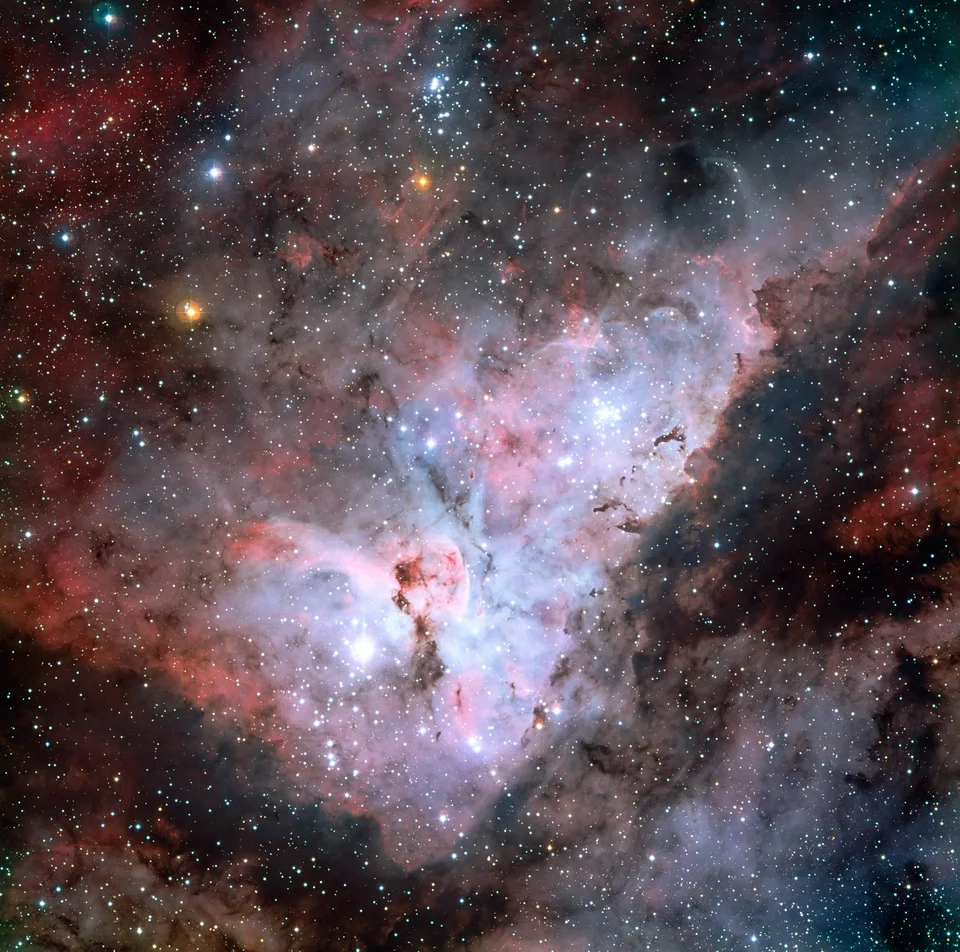
The Carina Nebula is NGC 3372, an extended star-forming region in the Milky Way. Hot young stars energise the surrounding gas. Dust clouds break up the glowing field. Eta Carinae is a bright stellar system inside the region, so identifying a star does not in itself establish that you saw the surrounding nebula.
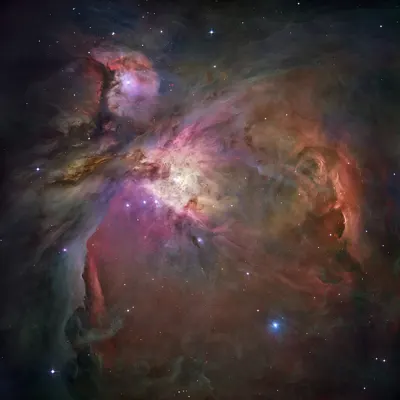
NASA’s Hubble images reveal structure across a part of the complex. They were built from instrument exposures and are far more detailed than a view through binoculars. Aim first for an irregular light patch with neighbouring stars that fit your chart.
Use the Carina field to work inward
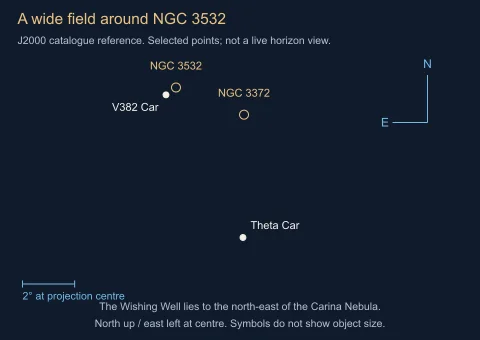
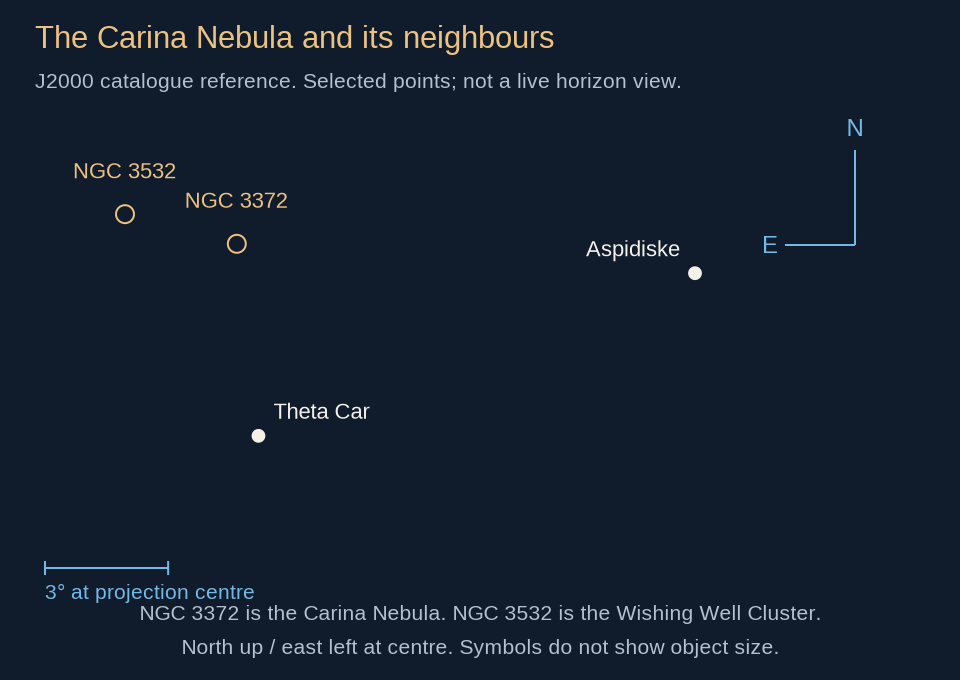
Match the wide field with a local chart before lifting binoculars. The original finder marks NGC 3372 near the Wishing Well Cluster. The cluster lies roughly 3° to the northeast of the nebula centre. Start from whichever landmark you have identified securely. A low-power field will give you room to recognise the star pattern before trying to decide which part looks diffuse.
Give the chart’s rings the meaning of centre markers. Both the nebula and the cluster spread far beyond their plotted centres. A narrow field can make it harder to distinguish a patch of gas from the unresolved light of many stars.
Plan a short window near the meridian
The nebula centre reaches only about 16° above the level horizon near Honavar. Look for an evening opportunity in March or April and choose a time close to transit using a dated chart. Compare the route with a real south-facing skyline. Avoid dates when bright moonlight or low cloud occupies the field.
Keep your observing position fixed for a comparison. Take a brief look at a neighbouring field of similar altitude. If both fields are equally pale and the bright stars have broad halos, poor transparency may explain the impression better than the nebula.
Record the edge you can actually trace
Make an uncoloured sketch of the bright stars first. Shade only a patch whose position repeats in multiple looks. Write down its directions relative to two stars. If you cannot relocate it after moving away, record a suspected rather than definite view. A later comparison with an optical reference image can show which portions of the much larger region were realistic from your site.
PAUSE AND THINK
What supports a nebula identification better than a single pale patch?
Explore the answer
The patch should repeat at the same position relative to several stars in the correct field. Compare against a nearby patch of sky to test haze.