On this page
THE BIG IDEAS
- XPoSat launched on 1 January 2024.
- POLIX and XSPECT provide complementary kinds of X-ray measurements.
- Mission objectives and dated scientific milestones should be read separately.
An observatory beyond visible light
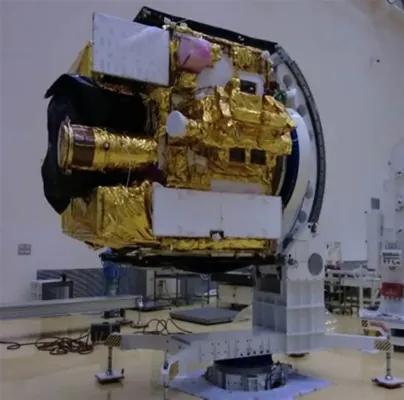
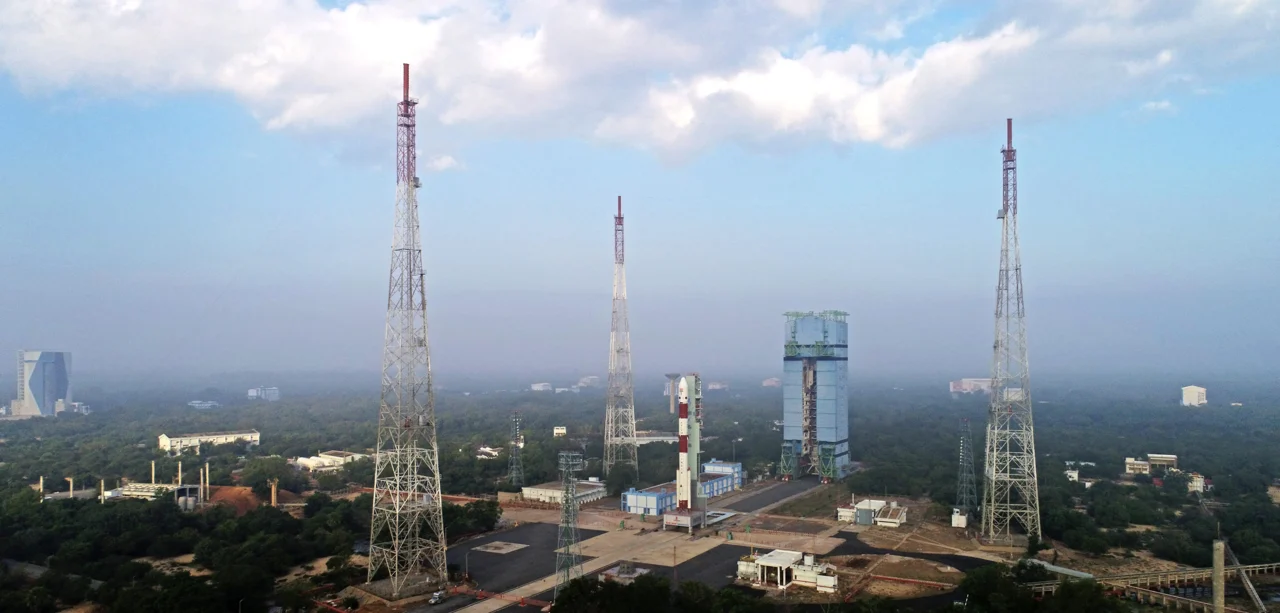
XPoSat, the X-ray Polarimeter Satellite, was launched by PSLV-C58 on 1 January 2024. Its purpose is to study astronomical X-rays rather than make ordinary visible-light photographs. Such observations help investigate energetic environments associated with neutron stars, black-hole systems and other sources.
An X-ray image alone cannot explain every mechanism producing that radiation. Researchers also examine when the signal varies, how photons are distributed in energy and how their electromagnetic oscillations are oriented statistically. Each measurement adds a different constraint to an explanation.
Two complementary instruments
The spacecraft carries POLIX and XSPECT. POLIX measures polarisation in the medium-energy X-ray band, while XSPECT provides spectral and timing information at lower X-ray energies. Polarisation is described using both a degree and an angle. It should not be pictured as a coloured arrow attached to every photographed star.
A simple comparison is a worksheet with three headings: energy, time and polarisation. Put a question under each, such as whether the source changes its energy distribution, pulses regularly or shows a preferred orientation. These questions concern different features of the same incoming radiation.
A verified milestone
On 13 October 2025, ISRO released XPoSat scientific data to the research community and opened an opportunity for guest observation proposals. That is evidence of an operating scientific programme, not a statement that every planned result has already been achieved. Archived mission descriptions written before launch sometimes retain future-tense language.
When reading a spacecraft page, separate its objectives from dated achievements. A promise to investigate a source class is different from a published measurement of a particular object. The useful question is what data were collected, how the instrument was calibrated and what uncertainties accompany the interpretation.
Build a three-measurement analogy
Imagine an invented lamp whose brightness pulses once each second. A timing record could reveal that repetition. A spectrum could compare the light at different wavelengths. A suitable polarisation measurement could ask whether some orientations are favoured. Knowing one record would not automatically supply the other two.
The lamp is an analogy for organising questions, not a recreation of an X-ray source. Do not attempt to generate X-rays for a school activity. Instead, label three drawn graphs with their axes and write one explanation that each could rule out. Always mark invented data as invented.
From a detector to a scientific claim
Detectors register signals alongside background and instrumental effects. A useful result needs analysis and uncertainty, not just a striking plot. Repeating observations or combining different measurements can help researchers decide between competing models of an emitting region.
Compare XPoSat with AstroSat by listing the measurements each was designed to make rather than choosing a winner by telescope size. Ask how a polarisation result might complement a spectrum. Their value lies in the evidence they contribute to a question and the careful way that evidence is tested.
PAUSE AND THINK
Would a regularly repeating X-ray signal alone tell you its polarisation angle?
Explore the answer
No. Timing describes when the signal varies. A polarisation angle is a different measurement requiring an appropriate instrument and analysis.