On this page
THE BIG IDEAS
- Perseverance investigates ancient environments in Jezero crater.
- Geological context strengthens chemical and textural measurements.
- Collecting samples is different from returning them to Earth.
A question about ancient Mars
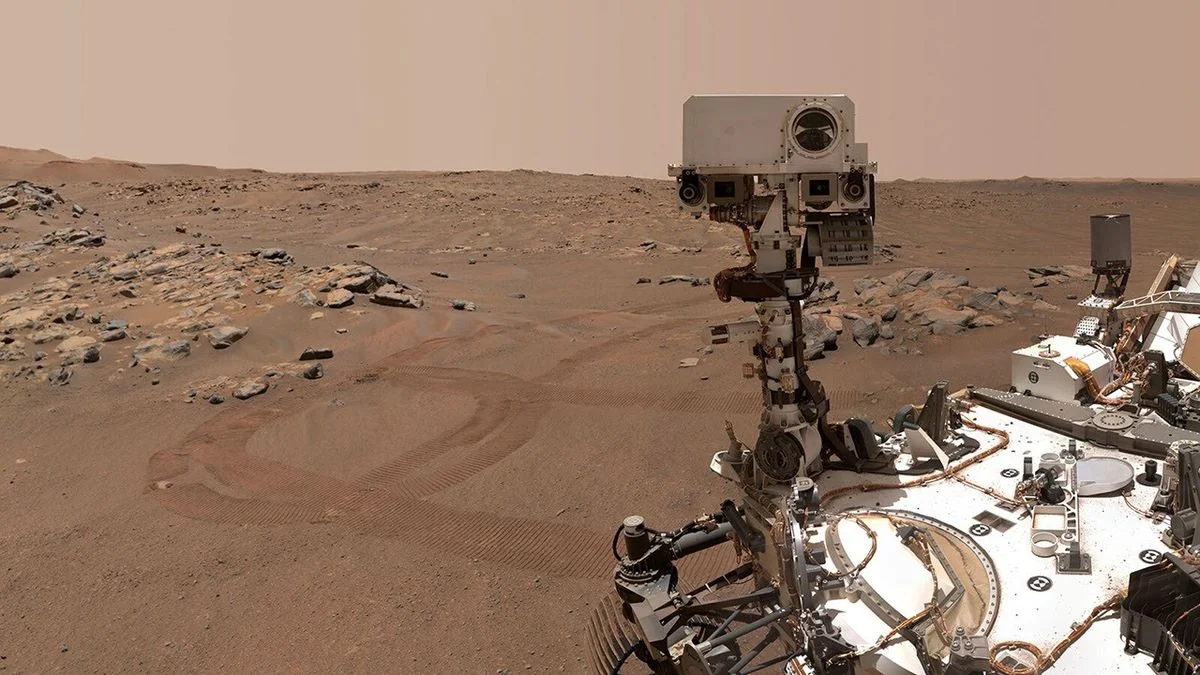
NASA’s Perseverance rover landed in Jezero crater on 18 February 2021. The site was selected because its geology preserves evidence of an ancient lake and river-delta environment. The mission investigates past conditions and seeks evidence relevant to possible ancient microbial life. That scientific objective is not a statement that life has been found. Distinguishing a search strategy from a confirmed result is essential when reading astrobiology headlines.
Why geological context matters
A rock is more informative when its relationship to nearby layers and landforms is known. A rover can inspect textures, compare outcrops and select targets after seeing the local environment. Instruments then investigate composition and other properties. Evidence of past water can help identify a potentially favourable environment, but water alone does not prove biology. Scientists look for several lines of evidence and consider non-biological explanations for interesting patterns.
A laboratory on wheels
Perseverance carries cameras and instruments that analyse rocks and soils using methods including spectroscopy. Different instruments operate at different scales, from distant landscape observations to close examination of selected targets. The rover also drills cores that can be sealed in sample tubes. Choosing a sample involves more than finding an unusual colour: researchers consider its geological context, diversity and potential to answer questions with laboratory methods.
Samples and the future
Collecting and caching samples preserves material for possible later return to Earth. The rover itself is not a return rocket and does not send those physical tubes home through its radio antenna. Returning samples requires additional mission systems and planning. Earth laboratories could apply instruments and techniques unavailable on the rover, but the interpretation would still depend on the field records collected at the sampling site.
Experiments beyond rock studies
Perseverance also carried technology demonstrations, including MOXIE, which demonstrated oxygen production from the carbon-dioxide-rich Martian atmosphere before completing its experiment in 2023. Such an experiment explores a possible capability for future missions rather than proving that a complete human settlement is ready. The educational lesson is to separate scientific investigation, engineering demonstration and future application. A successful small-scale test can be important while leaving major challenges of scale, reliability and operations unresolved.
PAUSE AND THINK
Why is finding a rock’s original position useful before collecting a sample?
Explore the answer
Its location and relationship to surrounding layers help reconstruct how it formed and what environment it records.