On this page
THE BIG IDEAS
- The atmospheric probe and orbiter supplied different evidence.
- A direct local sample does not automatically describe a whole planet.
- Europa’s ocean interpretation combines magnetic evidence with physical models.
Different instruments reached different places
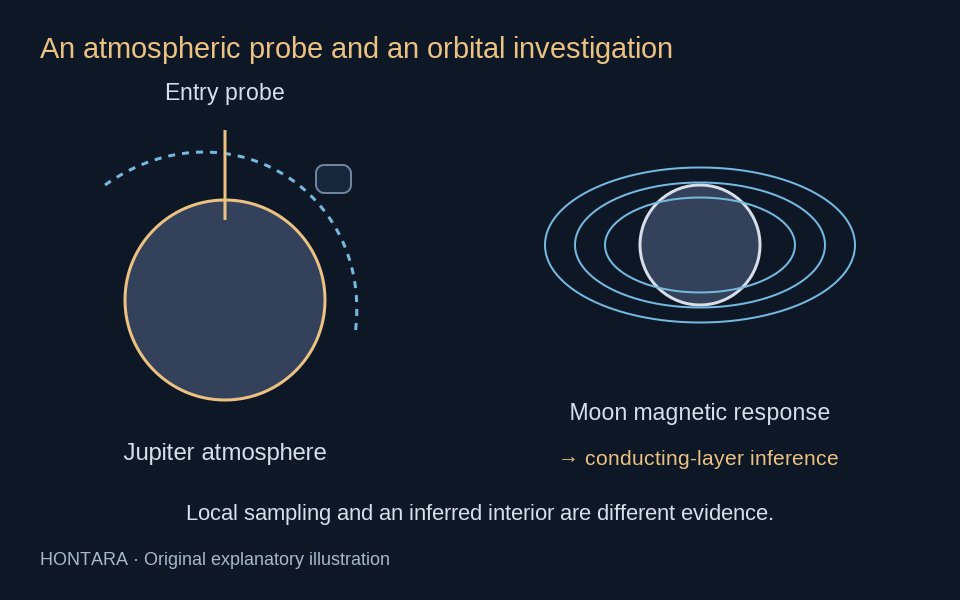
NASA launched Galileo in 1989. It reached Jupiter in 1995, delivering an atmospheric entry probe while the main spacecraft entered orbit. The orbiter investigated the planet, its moons and magnetic environment through repeated observations over years rather than one brief encounter.
The mission ended in September 2003 when the orbiter was deliberately sent into Jupiter. It is a historical mission, not a spacecraft currently sending new observations. Separating the probe from the orbiter also prevents treating measurements from one atmospheric descent as a survey of every part of Jupiter.
Interpret a local atmospheric sample
The entry probe directly measured conditions along its descent path. Direct sampling is powerful because it investigates local gas and environmental properties in a way that distant imaging cannot. Yet the sample remains tied to the place and time of entry.
Imagine measuring rainfall once at one point on Earth and using it to describe every continent. The comparison shows why a local atmospheric measurement needs context. Jupiter’s structure and weather differ from Earth’s, but the sampling lesson remains: direct does not mean automatically global.
Join moon images with magnetic evidence
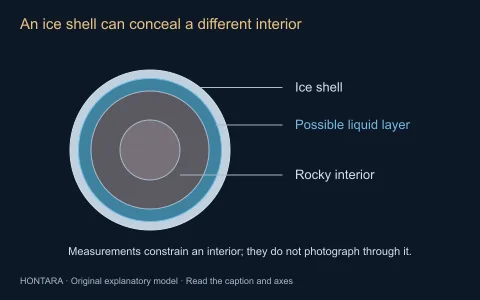
Galileo’s repeated moon encounters supplied images, spectra and magnetic measurements. At Europa, an induced magnetic response helped support the interpretation of a conducting subsurface layer, consistent with a salty ocean. This is a chain of physical inference rather than a photograph looking directly through the entire ice shell.
Surface features add complementary information about the moon’s geological behaviour. Neither a smooth patch nor a fractured surface alone uniquely establishes every property of an ocean. Researchers combine observations with models and compare possible explanations for the measured response.
Compare the diversity of the system
Io’s volcanism, Europa’s icy surface and the different properties of Ganymede and Callisto show why Jupiter’s moons should not be treated as one repeated example. Their histories reflect different internal conditions, orbital relationships and interactions with the surrounding environment.
Create an evidence table with one row per moon and columns for observation, proposed process and unanswered question. Use an official caption for each observation instead of assigning a process from colour alone. Keep a spacecraft image’s scale and processing information with the record.
Connect mission endings with scientific responsibility
Galileo’s controlled end reduced the possibility of an uncontrolled future impact on a moon of scientific interest. The decision joined engineering limits with a concern about contaminating environments that later missions may investigate. Mission design includes what happens when routine control can no longer be maintained.
The archived measurements continue to support new questions even after the hardware is gone. When comparing Galileo with later Jupiter missions, identify which places, instruments and times each sampled. More data are valuable when those differences are kept explicit rather than collapsed into one undifferentiated picture of Jupiter.
PAUSE AND THINK
Why is an induced magnetic response at Europa not the same as directly photographing an ocean?
Explore the answer
The response is a measured signal interpreted through models of a conducting layer. It supports an ocean-related inference alongside other evidence rather than showing liquid directly through the ice.