On this page
THE BIG IDEAS
- Cassini’s repeated observations complemented Huygens’s local measurements.
- Titan’s liquids are not ordinary surface water.
- Evidence of a potentially habitable environment is not proof of life.
An orbiter and a probe
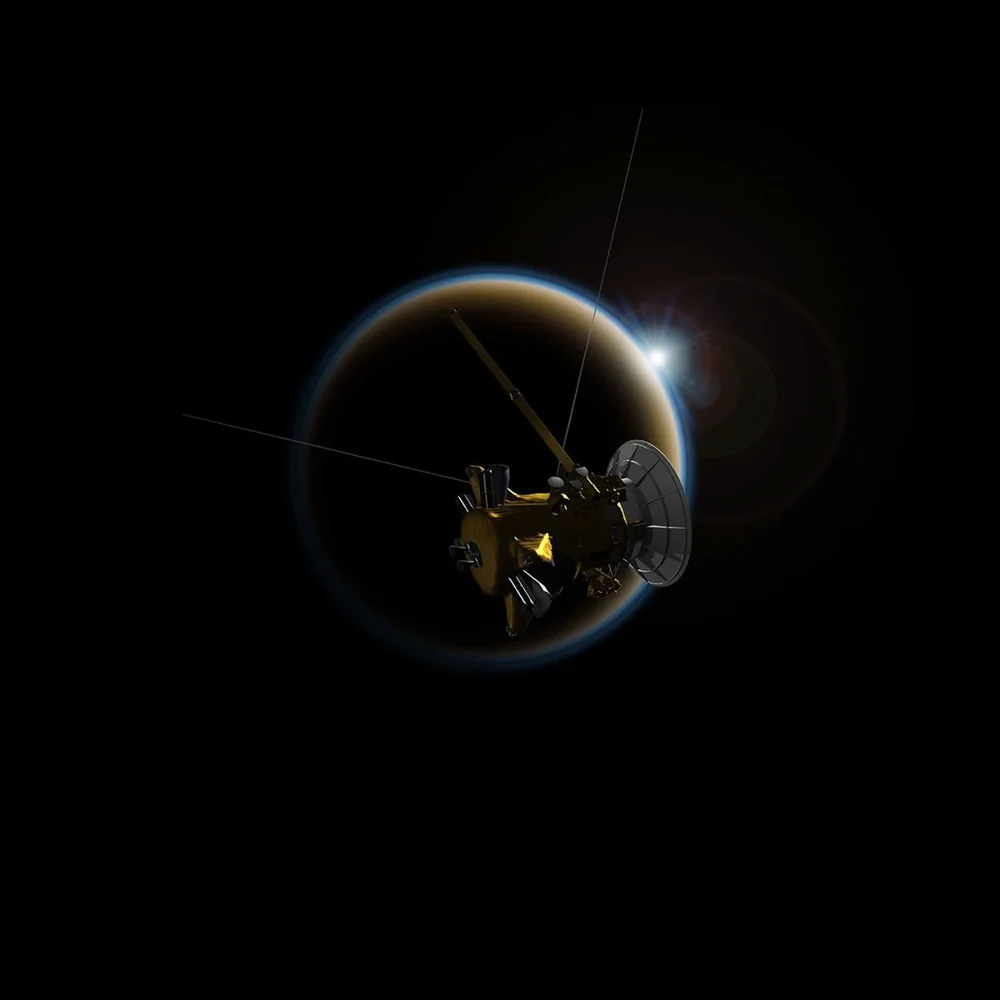
Cassini–Huygens launched in 1997 and reached Saturn in 2004. The international mission paired an orbiter with the Huygens probe, which descended to the surface of Titan in January 2005. These two roles provided very different scales of investigation. The orbiter could revisit Saturn’s rings and moons over years, while the probe measured one atmospheric descent and landing site directly. The combination connected global context with local evidence.
Why repeated visits matter
A single flyby captures one short interval. An orbiter can observe changes, return under different illumination and choose new targets based on earlier results. Cassini studied Saturn across a substantial part of its long seasonal cycle. Repeated encounters also revealed relationships between rings, moons and the planet’s environment. A ring is not a single rigid solid disk: it is a population of particles whose collective patterns respond to gravitational influences.
Titan’s unfamiliar weather
Titan has a thick atmosphere and surface environments involving liquid methane and ethane. Huygens measured conditions as it descended and returned images from the surface. Lakes and channels on Titan invite comparisons with Earth, but the materials and temperatures differ greatly. A familiar shape does not imply an identical substance. Understanding that distinction is one reason instruments measuring composition and temperature are essential companions to photographs.
Enceladus and the question of oceans
Cassini investigated jets of material emerging from the south-polar region of Enceladus. Measurements supported the interpretation of a subsurface ocean beneath its icy exterior. Such observations make the moon important for questions about potentially habitable environments. An ocean and ingredients relevant to life, however, are not a detection of life itself. Scientific claims must remain tied to what the instruments actually measured and to the models used to interpret those data.
A deliberate ending
Cassini’s mission ended in September 2017 with a planned plunge into Saturn. The decision helped avoid an uncontrolled future collision with a potentially habitable moon. Its final observations also investigated the region between Saturn and the rings. This ending shows that mission planning includes responsibility for a spacecraft after its main work is done. The data continue to support research even after the spacecraft can no longer send a signal.
PAUSE AND THINK
Why could an orbiter learn things that a brief flyby would miss?
Explore the answer
Repeated visits reveal change over time and allow observations under different conditions, providing context that one short encounter cannot supply.