On this page
THE BIG IDEAS
- Aryabhata launched on 19 April 1975 after being built in India.
- Its scientific experiments were limited by an early power failure.
- Orbital lifetime is different from the duration of useful instrument operation.
A satellite built in India
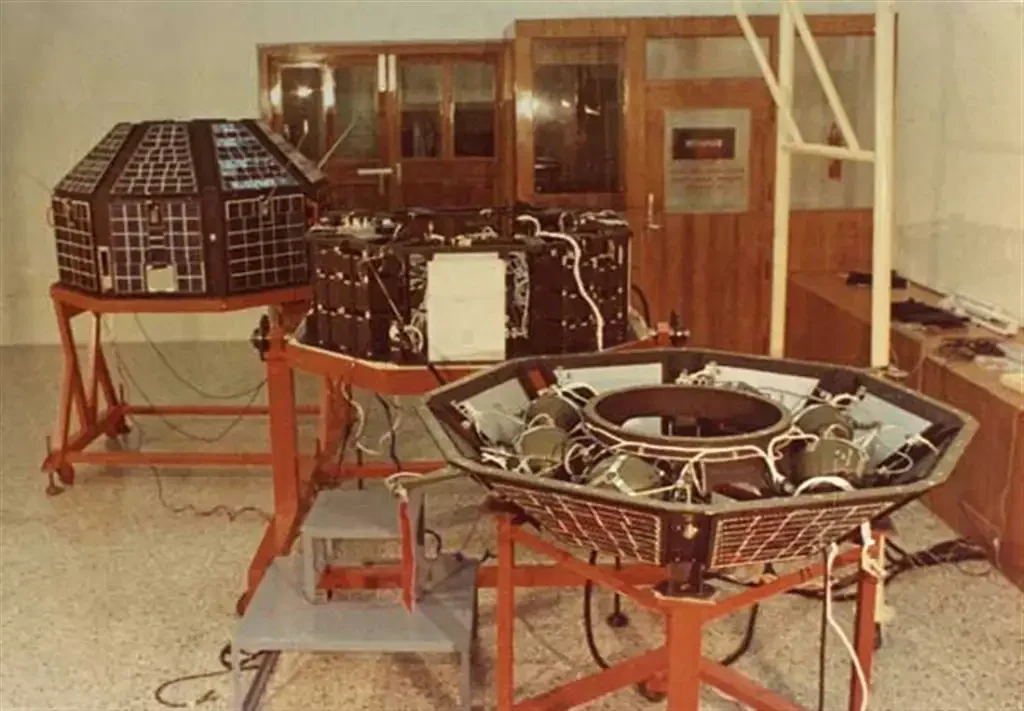
Aryabhata, India’s first satellite, was designed and built in India and launched on 19 April 1975 by a Soviet rocket from Kapustin Yar. Its name honoured the Indian mathematician and astronomer. The project developed experience in constructing a spacecraft and operating scientific experiments in orbit.
It is useful to distinguish who built a satellite from who supplied its launch. Those are different contributions to a mission. A spacecraft can be an Indian scientific project even when a launch vehicle and launch site are provided through an international arrangement.
Science depended on the spacecraft
The mission carried experiments connected with X-ray astronomy, aeronomy and solar physics. Aeronomy concerns the physics and chemistry of the upper atmosphere. Instruments depended on electrical power, communication and the spacecraft’s orientation and thermal behaviour. A successful launch did not remove those dependencies.
In a simple system diagram, place a detector beside blocks labelled power, orientation, thermal conditions and data link. Draw connections to show which functions the measurement needs. The exercise helps explain why a science result is more than the presence of an instrument on a payload list.
An early limitation mattered
A power-system failure interrupted the scientific experiments within the first few days. The mission should therefore not be presented as years of uninterrupted astronomical observations. Its engineering history and its orbital lifetime are different records.
ISRO’s mission table separates a nominal mission duration, later mainframe activity and an orbital life of nearly seventeen years. These labels describe different things. A satellite remaining in orbit does not imply that its original instruments are still collecting useful data. The historical lesson becomes clearer when those categories are kept separate.
Build a mission evidence table
Make three columns headed planned capability, dated evidence and limitation. Under planned capability, put a scientific experiment or an engineering function. Under evidence, record only a statement supported by an identified mission history. Leave a cell open when a source does not establish the result.
For example, a launch date supports reaching the initial mission stage but does not establish the amount of usable detector data. A later orbital-decay date concerns the end of the object’s time in space, not a guarantee of instrument operation throughout that interval. Do not convert longevity into scientific output without evidence.
Why the history remains worth studying
An early satellite project combines scientific aims with the development of engineering methods, testing and operations. Learning from a subsystem failure is part of that history. Describing a limitation accurately does not make the wider achievement disappear. It makes the account more informative.
Compare Aryabhata with a later Indian observatory such as AstroSat or XPoSat. Ask how the instruments, observing programmes and data analysis differ while retaining common needs for power and communication. Use specific comparisons rather than assuming that more recent always means every part of the older mission was unsuccessful.
PAUSE AND THINK
Why is nearly seventeen years in orbit not the same as nearly seventeen years of successful experiments?
Explore the answer
An object can remain in orbit after its instruments or support systems stop working. Orbital survival and productive science operation must be supported by different evidence.