On this page
Separate the source from its recorded shape
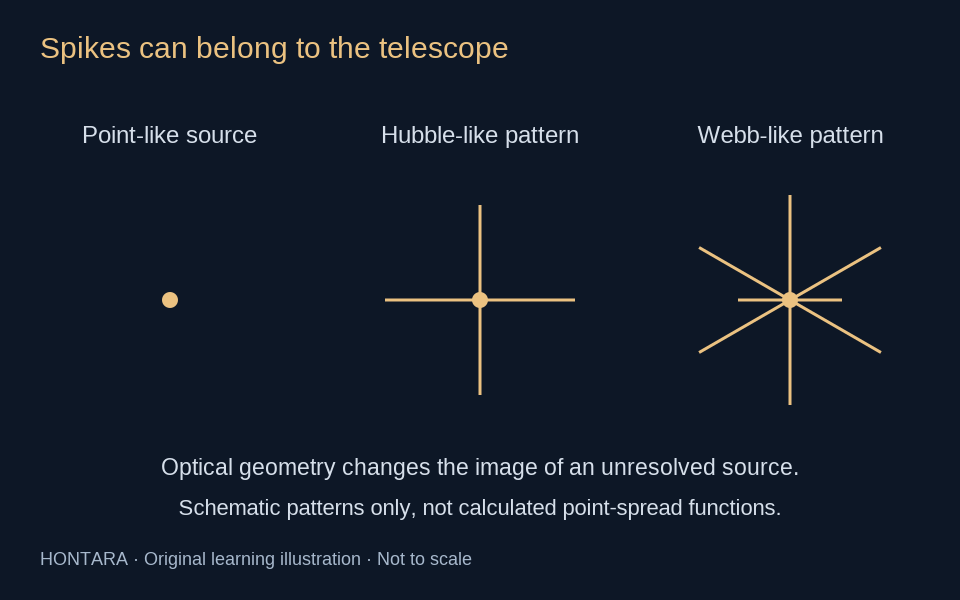
A distant star is often too small in angular size for a telescope to resolve its physical disk. Its recorded appearance then reflects the instrument’s response to a nearly point-like source. Light behaves as a wave, so an aperture does not concentrate all of it into a mathematical point.
Diffraction spreads some light into a pattern around the main image. Features of the opening and obstructions can give that pattern a preferred direction. The visible spikes in many space-telescope images are part of this optical response, not enormous beams physically extending from the star.
THE BIG IDEAS
- A point source is recorded through an instrument’s optical response.
- Aperture edges and supports affect diffraction patterns.
- Do not infer a star’s shape or a jet from spikes alone.
Connect geometry with the pattern
Hubble’s secondary-mirror supports produce a characteristic four-spike appearance around suitable bright stars. Webb’s segmented primary mirror and secondary supports combine to produce six prominent spikes plus two smaller horizontal ones. The exact pattern reflects the optical geometry.
These are broad descriptions of recognisable patterns, not a rule that every star in every exposure displays an equally obvious set. Wavelength, source brightness, exposure and display stretch affect which portions of a diffraction pattern become visible in a published image.
Avoid reading spikes as a stellar measurement
A brighter-looking spike does not directly measure the star’s radius. Nor does a cross-shaped star image mean that the star itself is cross-shaped. The same instrument can place related patterns around many unrelated point sources in the field.
Compare faint and bright stars in a single credited image, then compare images from two instruments. Ask which recurring features might belong to the imaging system. Keep this pattern-recognition exercise separate from a calibrated analysis of the point-spread function, which requires instrument-specific information.
Keep other artifacts separate
Not every streak near a bright object has the same cause. Saturation, detector effects, internal reflections and motion can create other structures. Image orientation can also rotate how a telescope’s optical pattern appears on a page.
Begin with the instrument name, filters, exposure and caption. A useful conclusion is that the recorded shape combines source structure with the imaging system. A false conclusion is that any long feature must be a physical jet. Genuine jets require evidence about the object and a careful distinction from instrumental patterns.
PAUSE AND THINK
If many unrelated stars share similarly oriented spikes, what explanation should you investigate?
Explore the answer
A common instrumental diffraction pattern is a strong possibility. Inspect the telescope’s aperture/support geometry and the image documentation before attributing those spikes to each star.