On this page
THE BIG IDEAS
- Apparent retrograde motion is measured against background stars.
- The observer’s own orbital motion changes the line of sight.
- A planet need not reverse its orbit to appear to reverse its sky track.
Two different motions on the same sky
During one night, Earth’s rotation carries most celestial objects westward across our view. A planet also changes position relative to the stars over many nights. Apparent retrograde motion concerns that slower change against the stellar background. Mixing these two timescales makes a genuine observation difficult to explain.
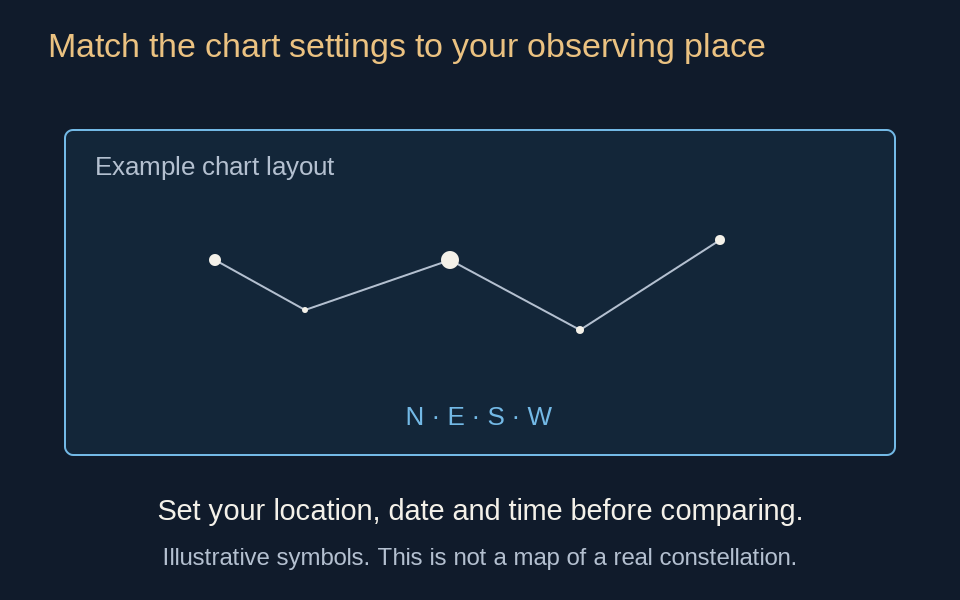
Imagine placing Mars on a star chart at the same clock time every few nights. Its track usually progresses one way, then can slow, reverse for a while and resume its earlier direction. The dates belong beside the plotted positions. Joining them in order makes the reversal visible.
The observer is moving too
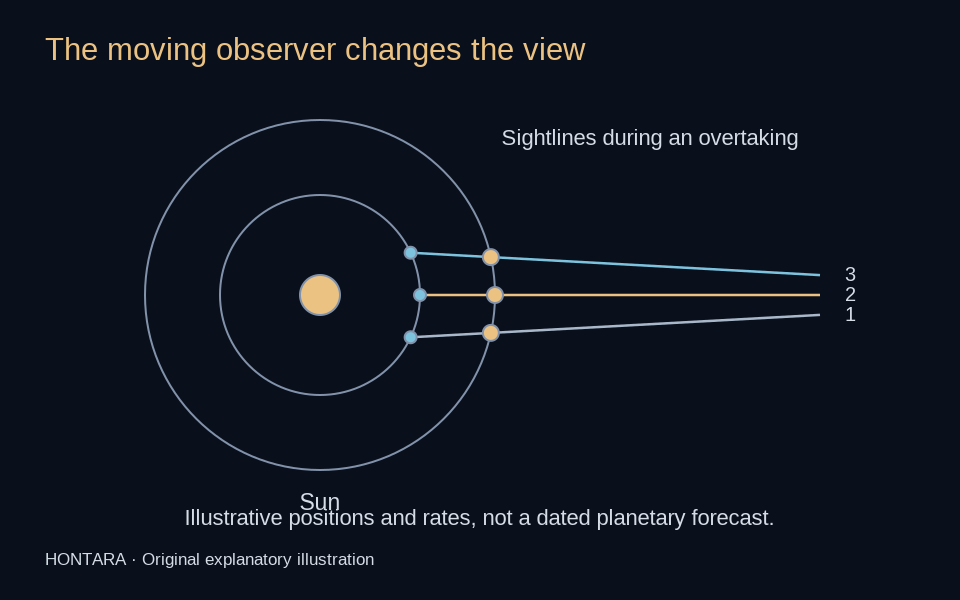
Earth and Mars both travel around the Sun. Earth follows a smaller orbit and overtakes Mars periodically. Near an overtaking, the direction from Earth toward Mars changes in a way that can make Mars drift westward against the distant stars. Mars continues along its orbit. It does not stop and reverse its path around the Sun.
A line-of-sight diagram needs two moving markers and a distant reference. A picture with Earth fixed at the centre may reproduce the apparent track, but it cannot by itself show the physical cause of the changing viewpoint.
Try a tabletop sightline model
Draw a small Earth orbit inside a larger Mars orbit. Put paired date labels at several positions, advancing the inner marker farther around its circle between dates. These are illustrative positions rather than a prediction of real dates. For each pair, draw a line from Earth through Mars and extend it to the edge of the page.
Compare the directions of the extended lines in time order. Near the overtaking, their sequence can turn back. Use a pencil and paper rather than trying to reproduce actual orbital speeds by walking. The model tests geometry; real forecasts require accurate orbits and a specified observer and date.
What a loop does and does not mean
A plotted path can look like a loop or a flattened reversal because the orbits and viewing geometry are three-dimensional. Inner planets also show apparent retrograde motion, but their geometry is different from the simple Earth-overtaking-Mars example. The same sketch should not be presented as an exact explanation of every planet’s complete track.
Actual orbital motion described as retrograde has another meaning: moving opposite a chosen reference direction. That is distinct from an apparent reversal seen from a moving Earth. State which meaning you intend whenever using the word.
Make a useful comparison
Compare two dated charts or a verified sequence of images that uses the same star field. Identify at least three reference stars before marking a planet. A changed camera orientation can make an unregistered sequence misleading. Weather gaps should remain gaps rather than guessed positions.
Write two separate sentences: one describing the observed track and another explaining it using moving sightlines. The first is evidence. The second is a model that can be checked against many positions. Never infer a planet’s current direction from an undated illustration.
PAUSE AND THINK
Does the usual westward movement of Mars during a single evening demonstrate retrograde motion?
Explore the answer
No. That daily sweep is mainly caused by Earth’s rotation. Apparent retrograde motion is identified by comparing Mars with background stars over many dates.