On this page
THE BIG IDEAS
- The surface arc and central angle must refer to the same two sites.
- The supplied geometry is deliberately idealised and invented.
- Angle uncertainty can substantially change a circumference estimate.
A large question from a small measurement
Can measurements at two places reveal the size of a whole planet? Work with the supplied data rather than collecting outdoor readings. You need paper, pencil and a calculator. A protractor helps draw the geometry but is not required for the numerical calculation.
The values below are invented for a spherical-Earth exercise. They are neither historical measurements by Eratosthenes nor new observations from Indian schools. Their purpose is to make the assumptions and proportional reasoning visible.
Read the complete data packet
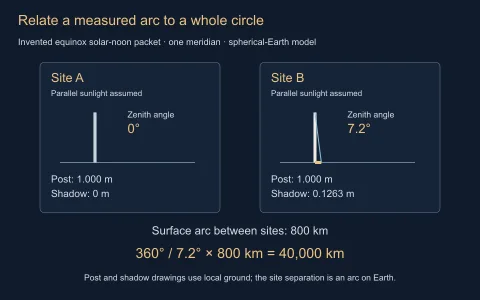
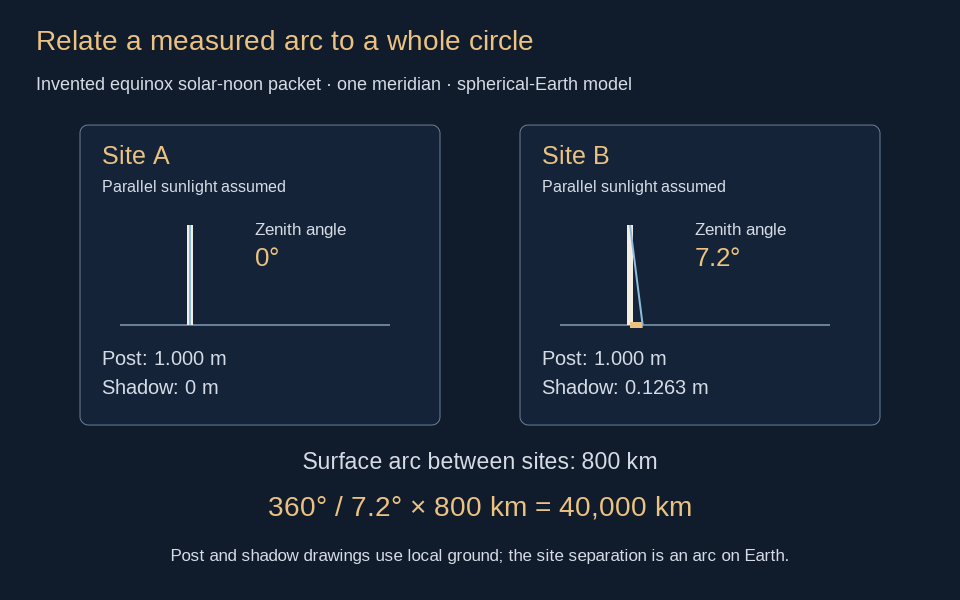
Imagine sites A and B on the same meridian, with B 800 km north of A along Earth’s surface. Both observations occur at the same local solar noon on an ideal equinox. At A the Sun is overhead. A vertical 1.000 m post has no shadow. At B a vertical 1.000 m post casts a horizontal shadow 0.1263 m long.
The solar zenith angle is the angle between the upward vertical and the direction to the Sun. At B it is approximately arctan(0.1263/1.000) = 7.2°. You may use the supplied 7.2° directly. It is not the Sun’s altitude above the horizon, which would be approximately 82.8°.
Draw why the angle represents an arc
Draw Earth as a circle, place A and B on the same meridian and extend each local vertical toward Earth’s centre. Draw parallel incoming sunlight. Because sunlight is nearly parallel across Earth, the difference in the two zenith angles represents the central angle between the sites in this ideal arrangement.
Here one angle is zero, so the difference is simply 7.2°. Using two arbitrary shadows without their directions, dates and site geometry would not justify the same shortcut. A curved-Earth model is an assumption being used, not something proved by dividing numbers alone.
Scale the arc to a whole circle
A full circle is 360°. The observed arc occupies 7.2/360 = 1/50 of that circle. If the corresponding surface distance is 800 km, the full circumference estimate is 50 × 800 = 40,000 km. Write the units at every step and explain why multiplying, rather than dividing, extends the small arc.
The distance is measured along the meridian surface arc. A road journey with bends or a straight tunnel distance would be a different input. Actual Earth is not a perfect sphere, so a simple estimate should not be presented as an exact universal circumference.
Test how uncertainty changes the result
Keep 800 km fixed but try angle differences of 7.0° and 7.4°. You obtain approximately 41,143 km and 38,919 km. A larger angle assigned to the same arc implies a smaller Earth. Explain this direction of change before checking your arithmetic.
Finish with two improvements a real measurement would need: correctly vertical posts, level ground, reliable arc distance, matched solar geometry or better angle measurement. This desk activity requires no direct solar viewing. Do not use an optical instrument to look at the Sun.
PAUSE AND THINK
Why is 800 ÷ 7.2 not yet a circumference?
Explore the answer
It gives kilometres per degree in this model. Multiplying by 360 degrees completes the circle: (800/7.2) × 360 = 40,000 km.
RECORD YOUR OWN EVIDENCE
Your activity sheet
You need: Paper, pencil and a calculator. The site data below are invented for a spherical-Earth geometry exercise.
Sites A and B are 800 km apart along one meridian. At the same local solar noon, A has an overhead Sun and B has a 7.2° solar zenith angle. Explain the model before estimating circumference.
Name or group: Date:
| Site | Vertical post height | Shadow length | Solar zenith angle |
|---|---|---|---|
| A | 1.000 m | 0 m | 0° |
| B | 1.000 m | 0.1263 m | about 7.2° |
Calculate 360° ÷ 7.2° × 800 km and explain each factor.
With distance fixed, compare results for 7.0° and 7.4°. What do they show about angular uncertainty?
Record what happened, including uncertain results. Use the answer guidance in this resource to discuss your explanation.