On this page
THE BIG IDEAS
- Start with the purpose of each light.
- Record glare and spill without making unsupported energy claims.
- Lighting changes need the responsible owner’s agreement.
Investigate a practical question
Which lights help people use a space and which send light into places where it is not needed? An audit records evidence before suggesting changes. It should not become an argument that every outdoor lamp must be removed. The aim is to understand the lighting task and identify options that preserve necessary visibility while reducing waste and unwanted spill.
Agree on boundaries
Obtain permission from the school or property owner. Begin in daylight to map the area and identify safe paths. A night check must be supervised by an adult. Do not enter private areas, inspect electrical connections, climb to fixtures or switch off lights that others depend on. Use a simple map, pencil and clipboard; photography is optional and should avoid identifying people or homes.
Record each fixture
- 1. Give each visible light a number on your map and write its likely purpose, such as illuminating a doorway.
- 2. From a safe observation point, note whether the lamp itself causes uncomfortable glare. Do not stare into it.
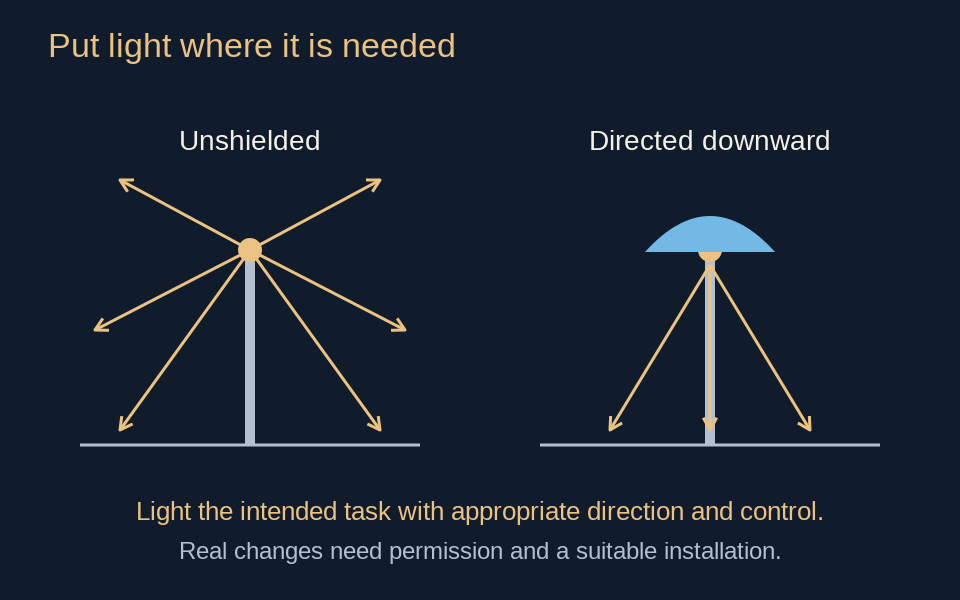
- 3. Look for light falling above the horizontal, across boundaries or into unused areas. Record what you actually see.
- 4. Note whether lighting seems needed throughout the evening or only when people approach. Ask the responsible adult about existing controls.
- 5. Select one fixture and propose a specific change for discussion, such as better direction or a suitable timer.
Separate observation from inference
A bright-looking fixture is not automatically the largest electricity consumer. You need reliable power and operating-time information to estimate energy use. Similarly, a phone photograph with automatic exposure cannot provide a calibrated brightness comparison between two places. Keep uncertain interpretations clearly labelled.
Glare, unwanted spill and brightening of the sky are different effects. A shield can direct light more carefully, but suitability depends on the fixture and the space. Changes should be agreed with the people responsible for safety, accessibility and maintenance.
Create a constructive recommendation
Prepare a one-page report with the map, three observations and one feasible next step. Include who would need to approve it and how you could check whether it helped. For example, compare the same doorway from the same position before and after a professional adjustment. Treat the audit as a starting point for a conversation, not proof that a particular installation violates a rule.
PAUSE AND THINK
Can a brighter-looking phone photograph prove that one lamp wastes more electricity?
Explore the answer
No. Camera exposure and the light’s direction affect the picture. Energy comparisons require reliable power and operating-time data.
RECORD YOUR OWN EVIDENCE
Your activity sheet
You need: Permission, a simple site map, clipboard and pencil. Begin in daylight; any night inspection needs adult supervision.
Observe from approved safe positions. Do not change electrical equipment.
Name or group: Date:
| Fixture + purpose | Useful lit area | Glare or spill observed | Question to check |
|---|---|---|---|
Propose one improvement that preserves the lighting task.
Who would approve the change and how could you check its effect?
Record what happened, including uncertain results. Use the answer guidance in this resource to discuss your explanation.