On this page
THE BIG IDEAS
- Lighting should respond to a defined need.
- Direction, intensity, timing and colour work together.
- A proposal must identify missing evidence and responsible decision-makers.
Learning objectives
Students will identify a lighting task, distinguish different unwanted effects and justify a feasible improvement. Use a fictional school entrance plan with a doorway, path, trees and neighbouring window. A fictional example keeps the lesson accessible in daylight and avoids requiring children to inspect unfamiliar places at night. Provide paper and pencils; a small covered LED demonstration is optional.
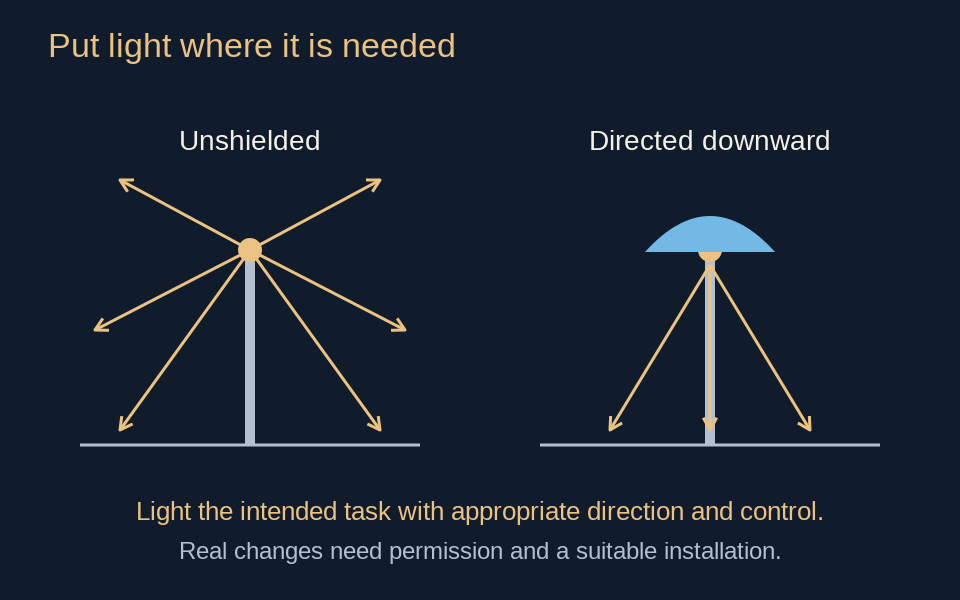
Make the fictional plan on the board: draw a school doorway near the top, a path leading down to the bottom edge, a neighbouring window on the right and a tree on the left. Add a lamp above the doorway with a broad beam reaching the path and window. Label it a schematic with no fixed scale. Give groups a copy or ask them to reproduce it, then compare their redesigns using the same starting layout.
Lesson sequence
- Minutes 0-8: Ask what people need to see when entering the school after dark. Include mobility and accessibility needs in the discussion.
- Minutes 8-18: Introduce glare, light falling outside its intended area and sky brightening as different effects.
- Minutes 18-30: Groups annotate the entrance plan with intended lit areas and places where light is unnecessary.
- Minutes 30-40: Each group proposes direction, timing and brightness choices, explaining the purpose of each.
- Minutes 40-50: Groups review one another’s proposals and identify what must be checked before a real change is made.
Student proposal prompts
- 1. What exact task does this light support and who uses the space?
- 2. Where should light reach and where should it be reduced?
- 3. When is lighting required? Could a suitable control help?
- 4. What information is missing about power use, visibility or maintenance?
- 5. Who must approve and install any real equipment change?
Teacher answer guide
A strong proposal links light to a specific need rather than arguing that brighter is always better or that darkness is always preferable. Students might suggest directing light toward the path, avoiding an exposed glaring source, using only the needed level and considering appropriate controls. Warm-coloured light can be part of a responsible design, but colour alone does not solve poor direction or excessive intensity.
Energy savings cannot be calculated without reliable power and operating-time data. Claims about improved safety also need evidence about the actual setting. Any real installation should be assessed by the responsible adults and suitable professionals.
Support and assessment
For support, provide a plan with the route already marked and ask students to compare two fixture directions. For extension, give hypothetical power and operating-time figures and calculate energy use while clearly labelling the figures as examples. Score the proposal on defined purpose, evidence, consideration of users and stated uncertainties. Conclude by asking what a follow-up inspection would measure. The goal is a reasoned design decision, not a campaign to disable lights without permission.
PAUSE AND THINK
Why is replacing every light with a warmer-coloured lamp not a complete solution?
Explore the answer
A warm lamp can still be unnecessarily bright, poorly directed or left on when unneeded. Responsible design considers the whole installation.
DEVELOP YOUR PROPOSAL
Your lighting design sheet
You need: Fictional school entrance plan, paper and pencils. Draw a doorway, path, neighbouring window, tree and lamp as a schematic with no fixed scale.
Annotate the fictional plan to show the task each light supports, where light is useful and where it spills. Propose direction, timing and brightness choices. Do not inspect or modify real equipment for this exercise.
Name or group: Date:
| User / lighting task | Useful lit area | Unwanted light | Proposed change + reason |
|---|---|---|---|
Explain how your proposal preserves the lighting task while reducing unwanted light.
What evidence and approvals would be needed before any real change could be made?
Explain your design choices and the evidence a real site would need. Use the answer guidance in this resource to discuss your proposal.