TRY IT YOURSELF
Blackbody wavelength peak
At 5,772 K the ideal per-wavelength peak is about 502.039 nm. A spectral peak is not a perceived colour.
On this page
THE BIG IDEAS
- This is the peak of spectral radiance per unit wavelength.
- Doubling blackbody temperature halves this peak wavelength.
- A peak wavelength is not a perceived colour or a full spectrum.
Choose the spectral quantity first
Enter a positive temperature in kelvin. The result is the wavelength at which an ideal blackbody’s spectral radiance per unit wavelength peaks. This specification matters: a spectrum expressed per unit frequency has a different peak location.
Simply converting the frequency-density peak through wavelength = c/frequency does not reproduce the per-wavelength peak. The two distributions assign energy to different kinds of intervals. A statement about a spectral maximum should therefore name the quantity and horizontal-axis convention.
Apply the displacement relation
Wien’s wavelength displacement law is λmax T = b. The calculation uses b ≈ 2.897771955 × 10⁻³ metre kelvin from the CODATA listing. Dividing by temperature gives metres, which the tool reports in nanometres and micrometres.
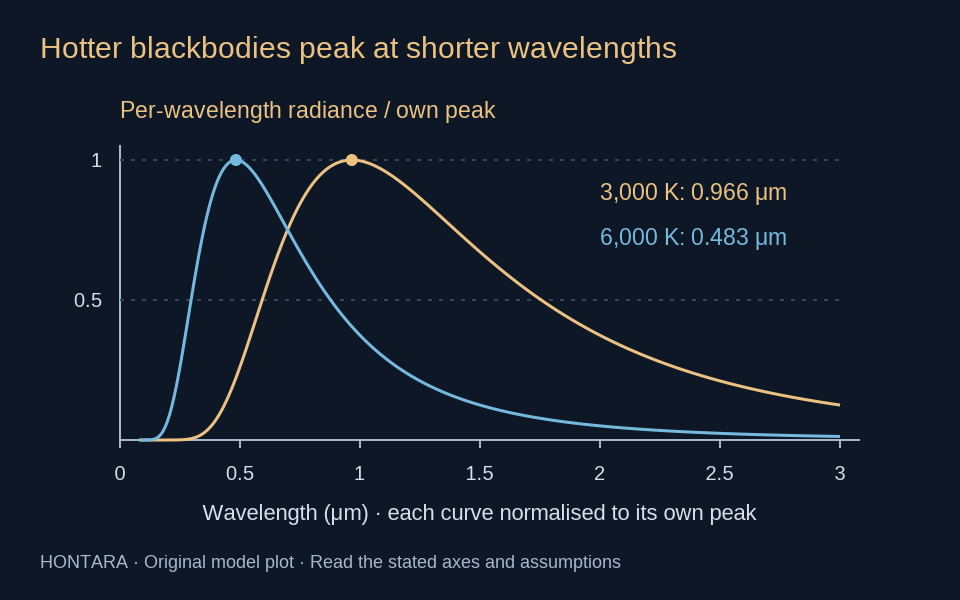
Because λmax is inversely proportional to T, doubling temperature halves the peak wavelength. This is a relation for an ideal blackbody. A real object’s spectrum may also contain absorption or emission lines and depend on material properties, atmospheric opacity and the measurement system.
Compare two model temperatures
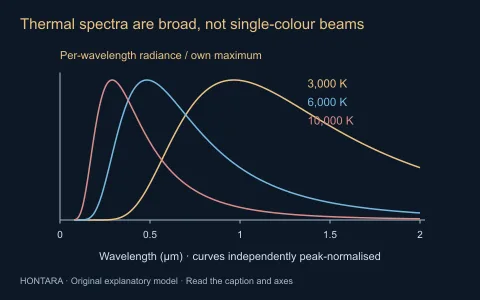
At 3,000 K the per-wavelength maximum is about 965.924 nm, in the infrared. At 6,000 K it is about 482.962 nm. The temperature ratio is two and the peak-wavelength ratio is one half, exactly as the model predicts.
An infrared peak does not mean there is no visible radiation. A blackbody emits across a broad distribution of wavelengths. The peak identifies a maximum of that distribution, not a narrow single-colour beam or a boundary beyond which no radiation exists.
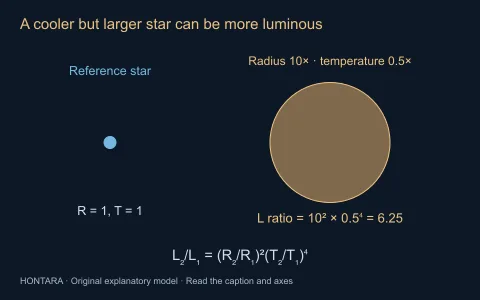
At 10 K, the model peak is about 289.777 micrometres. This cool example does not supply a source’s distance, radius or emitting area. Those additional quantities are needed before a spectral shape becomes a prediction of the flux received by an observer.
Do not paint a star from one maximum
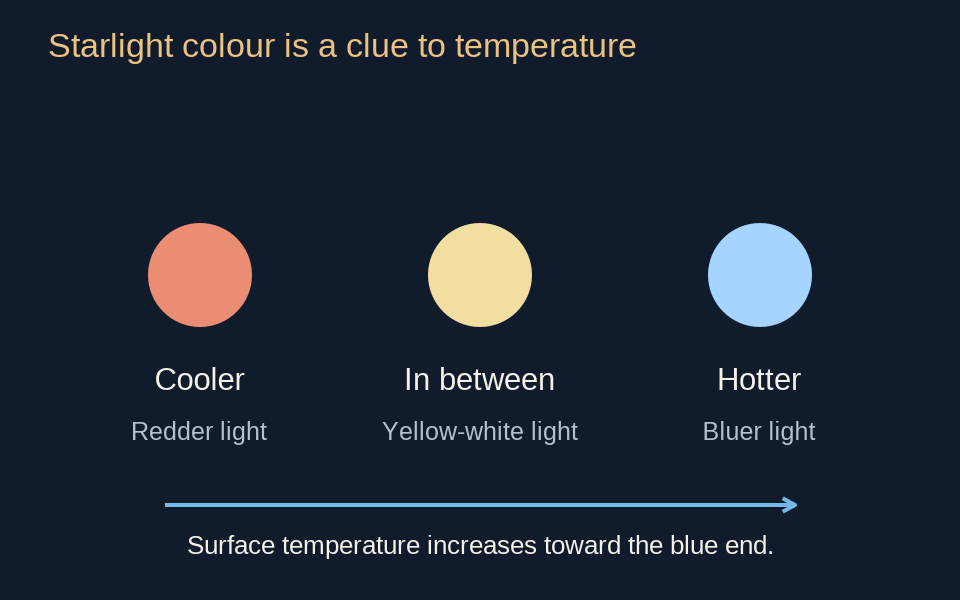
At the nominal solar effective temperature of 5,772 K, the ideal wavelength-density maximum is about 502.039 nm. That number does not make the Sun a green monochromatic source. Perceived colour depends on the full visible spectrum and the observer or display response.
The nominal solar temperature is a useful convention for an example, not a claim that every solar surface region has the same temperature. Nor does an ideal blackbody curve replace a measured stellar spectrum or an atmosphere model.
Keep display and physical inference separate
An illustration may normalise several curves to their individual maxima to compare where they peak. Such a plot cannot also be read as a comparison of total emitted energy unless that normalisation is accounted for. Check the axis labels and caption before drawing a luminosity conclusion.
This calculator returns a model wavelength, not a calibrated colour, luminosity or observation. Use it to connect temperature with spectral shape and to recognise where additional measurements and physical assumptions enter an interpretation of real stars or planets.
PAUSE AND THINK
Does a 502 nm model maximum mean that a source emits only green light?
Explore the answer
No. The ideal source has a broad spectrum. The maximum of a wavelength-density distribution does not identify a monochromatic source or its perceived colour.