On this page
THE BIG IDEAS
- A drawn nominal length is not an independent exact reference.
- Assess what a summary leaves out as well as how it is calculated.
- Keep invented teaching values clearly labelled.
Set the question before the arithmetic
Ask whether closely repeated measurements must be close to a suitable reference value. The objective is to distinguish sample scatter from a shared systematic effect, not to teach a complete professional uncertainty analysis. Learners should leave with a qualified measurement statement and a counterexample to “repeating fixes every error”.
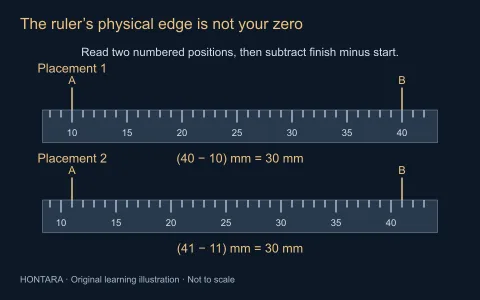
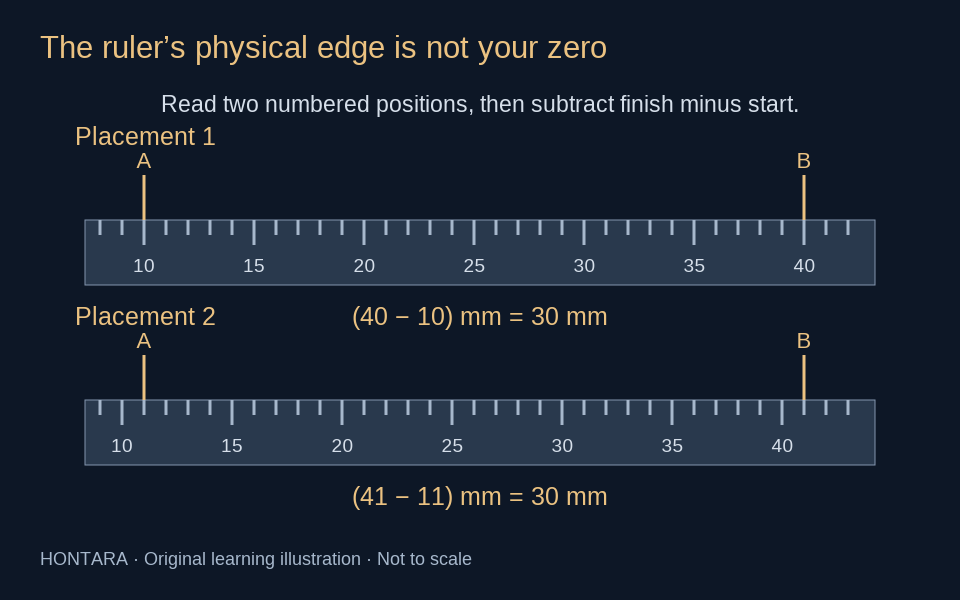
Prepare paper endpoints about 30 mm apart, millimetre rulers and calculators. Keep the actual separation unspecified unless you have a justified reference and its uncertainty. A length you drew with the same ruler is not automatically an independent exact standard for checking that ruler.
Structure the 45 minutes
Use five minutes for predictions, ten for six repeated ruler placements, ten for means and ranges, ten for comparing the deliberately shifted synthetic set and ten for discussion and the exit response. Preserve raw readings before calculating summaries.
Let one learner place the ruler while another reads aloud or records. Offer enlarged endpoints or an accessible partner task where needed. Keep a consistent definition of the endpoints and record the ruler’s graduation spacing. Reading convention and unit choice are part of the evidence.
Use the synthetic comparison honestly
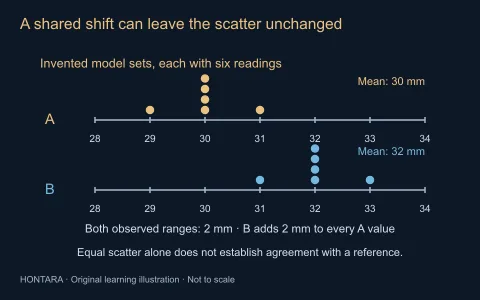
Display A = 29, 30, 30, 31, 30, 30 mm and B = 31, 32, 32, 33, 32, 32 mm. Label both invented. Their means are 30 and 32 mm, while both observed ranges are 2 mm. B is A with a deliberately added 2 mm offset.
For this model only, supply a stipulated reference of 30 mm and ask how the means compare with it. Explain that this stipulated value is not the unknown true length of every group’s paper. The activity illustrates a logical distinction; it does not certify an actual classroom ruler’s calibration.
Respond to common misconceptions
If learners call the range the measurement uncertainty, ask what it leaves out: limited sample size, graduation spacing, endpoint ambiguity and shared effects. A range can be a useful description without being a standard uncertainty or a guaranteed coverage interval.
If a mean has many calculator decimals, ask which digits are supported by the scale and the method. If identical readings are described as perfectly accurate, request an independent reference comparison. Distinguish a consistent result from a justified claim about closeness to a reference.
Assess transfer to an astronomy example
Present two fictional star-position measurements that both have small repeated scatter but share an unknown calibration offset. Ask whether averaging more repeats alone guarantees the correct position. Expect no, with a reason that identifies the shared effect.
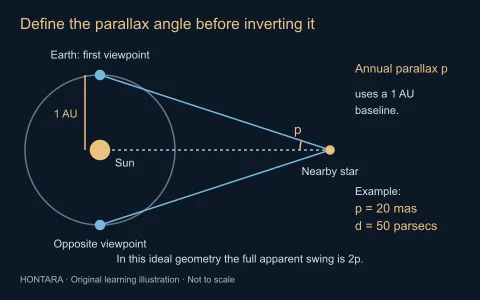
For extension use the parallax calculator to compare 20 ± 1 mas with 20 ± 10 mas. The first supports a small-error reciprocal approximation; the second triggers a warning. Ask why a transformation can magnify input uncertainty and why formal distance inference needs more information. These are synthetic teaching values, not measurements of a named star.
PAUSE AND THINK
Can both model sets have equal observed range but different agreement with the stipulated 30 mm reference?
Explore the answer
Yes. Both ranges are 2 mm, but their means are 30 and 32 mm. The deliberately shared offset changes reference agreement without changing that sample range.
RECORD YOUR OWN EVIDENCE
Your activity sheet
You need: Paper with endpoints A and B, a millimetre ruler, pencil and calculator.
Compare your own six readings with two explicitly invented sets: A = 29,30,30,31,30,30 and B = 31,32,32,33,32,32 mm. Use the stipulated 30 mm reference only for those model sets.
Name or group: Date:
| Data set | Mean (mm) | Range (mm) | What remains unknown? |
|---|---|---|---|
| Own readings | |||
| Synthetic A | |||
| Synthetic B |
Explain why adding 2 mm to every model reading preserves the observed range.
Why is the class drawing’s nominal 30 mm target not an exact independent reference?
Write one claim about a mean that this activity does not justify.
Assessment sheet. The model reference is stipulated for the invented sets, not a calibration certificate for the paper or ruler.