On this page
When do stars start showing?
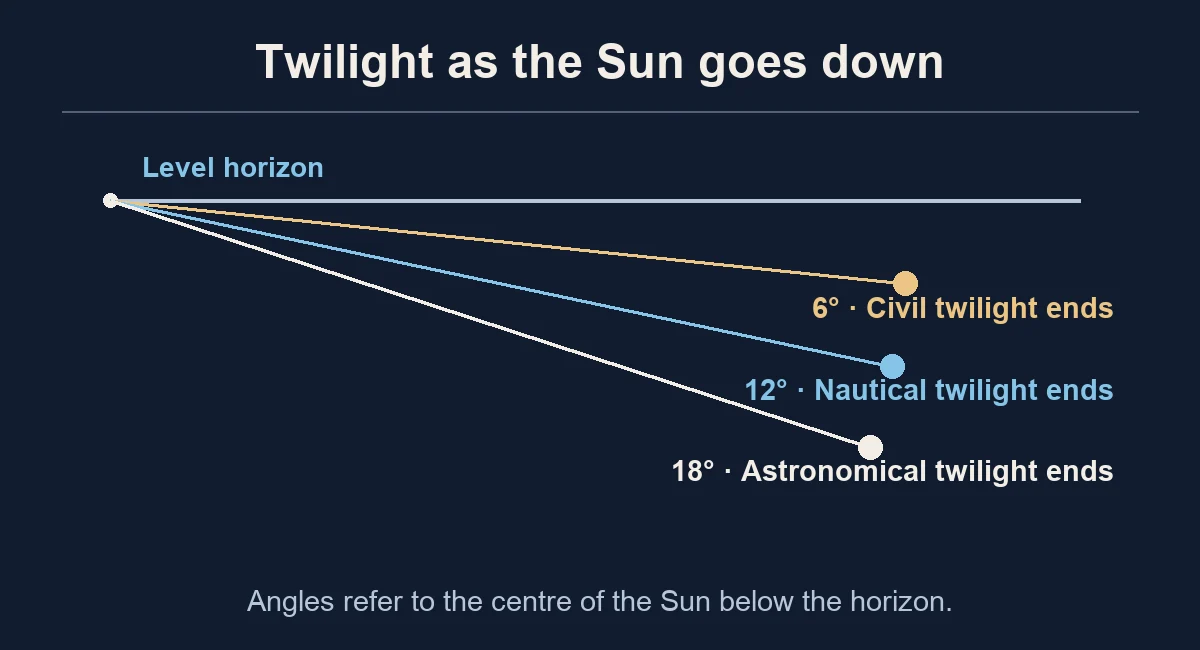
Venus, Jupiter or a bright star can appear before civil twilight ends if the object is well placed. More familiar star patterns become visible as the sky darkens. For faint targets such as the Milky Way, use the end of astronomical twilight as a starting point and also check the Moon, cloud and light pollution.
| Stage | Sun below horizon | What to look for |
|---|---|---|
| Civil | Sunset to 6° | The Moon and bright planets when visible. The ground is often still easy to see. |
| Nautical | 6° to 12° | Bright stars and larger patterns begin to stand out. |
| Astronomical | 12° to 18° | More faint stars emerge. After 18° the Sun’s twilight contributes little to the natural sky brightness. |
A worked example for Honavar
On 20 March 2027, HONTARA’s solar model places sunset near 18:42 IST. Civil twilight ends around 19:04, nautical twilight around 19:29 and astronomical twilight around 19:53. That is about 71 minutes from sunset to astronomical darkness. These are approximate times for a level horizon.
A hillside can block your view of the Sun earlier than the published sunset time. It does not switch off the sunlight still reaching the atmosphere above you. Twilight length also changes with latitude and season because the Sun crosses the horizon at different angles.
Choose your observing window
For the Moon or a bright planet, the early twilight window can be enough. If you want the Milky Way, wait until astronomical twilight ends and choose a date when bright moonlight will not wash it out. Check the local forecast before going out.
In the morning the sequence runs in reverse. Astronomical twilight starts first, followed by nautical twilight and then civil twilight before sunrise.