On this page
THE BIG IDEAS
- Describe motion and light behaviour before assigning an identity.
- A location-specific prediction can test a station-pass hypothesis.
- Steady or flashing light alone is not a universal classifier.
Begin with a neutral description
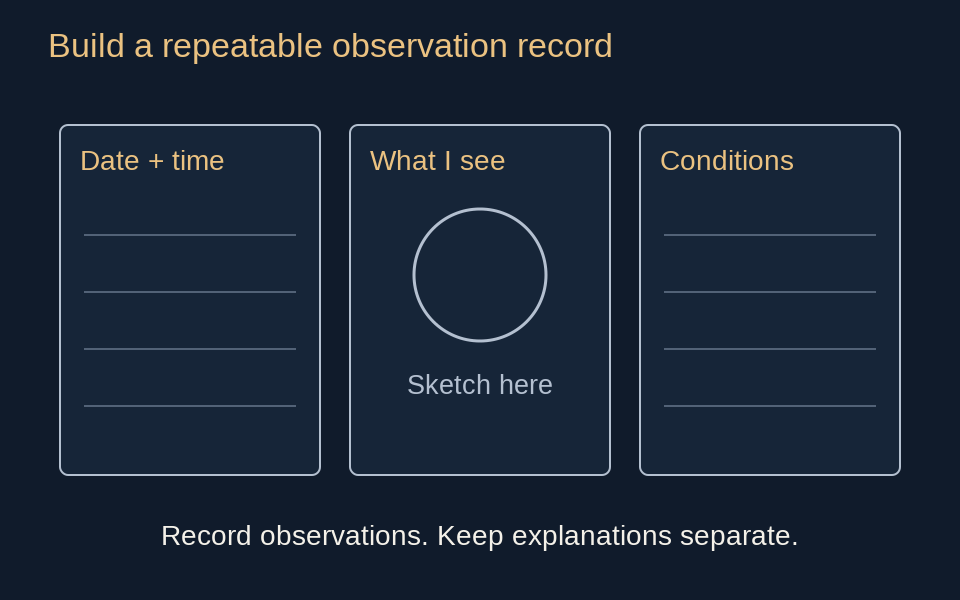
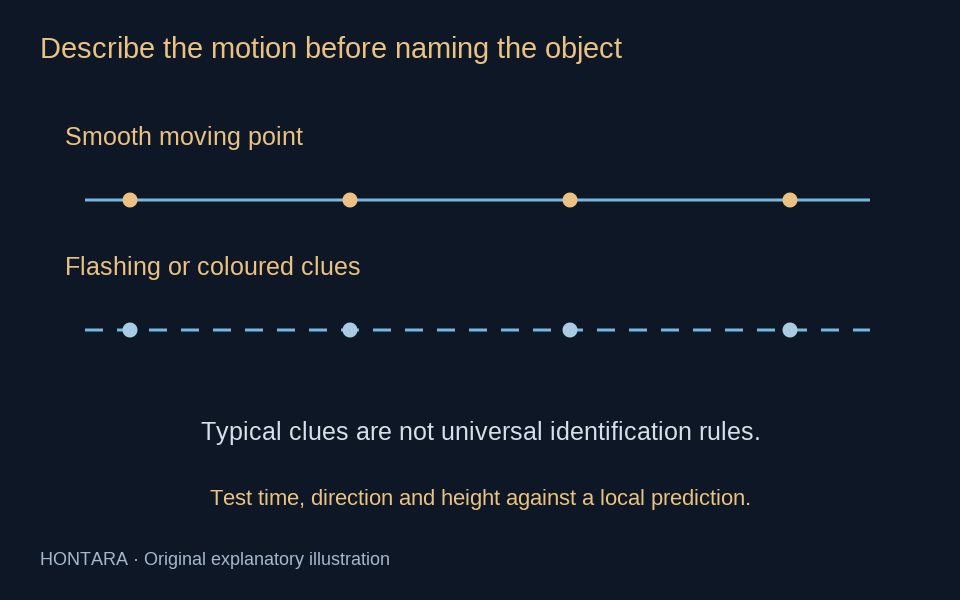
A moving point of light can be interesting without being identified immediately. Record what it does before naming it: apparent direction, approximate path, brightness changes, blinking and how long it remains visible. An unlabelled observation is more useful than a confident name based on one suggestive feature.
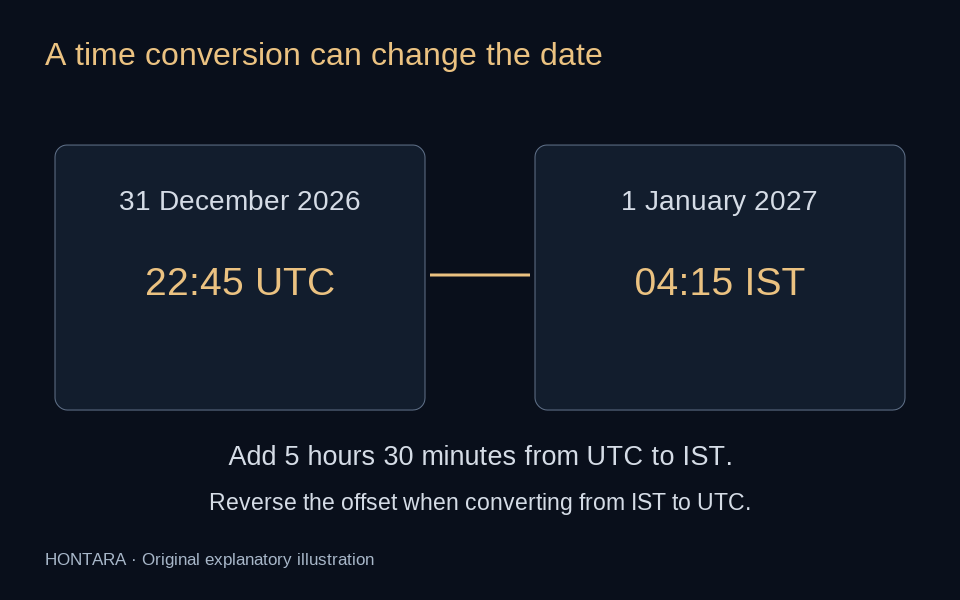
Keep the date and an accurate time with the record. Use an ordinary horizon or star reference if available, noting that memory of an angular path can be imperfect. No sudden chase with an optical instrument is needed to make a useful first description.
Compare familiar behaviours carefully
The International Space Station is visible because it reflects sunlight. A typical pass can look like a bright star moving smoothly across the sky, with its visibility changing as illumination and geometry change. The station is not a flashing beacon shining its own visible navigation lights toward the ground.
Aircraft often show flashing or coloured lights, but those details may be difficult to distinguish at a distance. Some satellites also vary in brightness because of their orientation or rotation. A simple rule that steady always means satellite and flashing always means aircraft would therefore be too strong.
Check a prediction for the right place and time
For a possible station pass, use NASA’s current Spot the Station information with the appropriate location and local time convention. Compare predicted direction, height and timing with the observation. A bright pass somewhere else in the country is not a match for your own sighting.
When comparing a satellite prediction, preserve its acquisition date because orbital forecasts can change. A match should use several features, not brightness alone. If the timing or path disagrees substantially, retain the object as uncertain rather than stretching the observation to fit the most famous candidate.
Distinguish other transient events
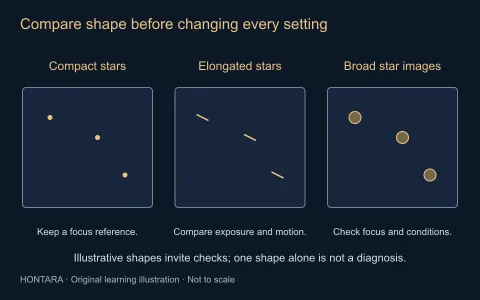
A meteor usually appears as a much briefer streak than a typical satellite crossing. A long-exposure photograph can turn different moving objects into trails that do not resemble their unaided-eye appearance. Camera processing or exposure gaps can also change a trail’s apparent pattern.
Write whether your evidence came from direct viewing, a single still frame or a sequence. Do not infer a constant physical speed from a short angular trail without knowing distance and geometry. Apparent motion in the sky is not the same quantity as velocity through space.
Report the conclusion at the supported level
A useful final note may read consistent with the predicted station pass, probable aircraft or unidentified from the available record. Those labels express different evidence levels. A missing explanation does not by itself establish an extraordinary object or justify inventing details about one.
For a repeatable exercise, prepare a prediction first and observe its stated time window from a comfortable position with a clear route. Then compare the actual record with the prediction while keeping missed detections and mismatches visible. The goal is a better identification process rather than collecting dramatic labels.
PAUSE AND THINK
Why is brightness alone a weak basis for identifying the International Space Station?
Explore the answer
Other objects can be bright and a station pass varies with geometry. Timing, direction, height and the appropriate local prediction provide much stronger combined evidence.