On this page
THE BIG IDEAS
- The pair is NGC 869 and NGC 884 in Perseus.
- Their centres are about 0.46° apart.
- They culminate only about 47° high from coastal Karnataka.
Begin with one hazy patch and resolve the pair
Caldwell 14 is the catalogue name for the two clusters together. You may also see the pair called h and chi Persei.
The pair is also known as Caldwell 14. Its two clusters are about 7,500 light-years away and contain hot young stars. Look for the glow with your eyes first. Try binoculars if moonlight or nearby lights make it hard to spot.
Account for the low observing latitude
The clusters lie far north on the celestial sphere. From coastal Karnataka near 14.3° north, their maximum geometric altitude is only about 47° above a level northern horizon. They do not pass near the zenith here, even though photographs or guides from farther north may describe them as high overhead.
Roughly November through January often offers convenient evening placement. The exact direction and altitude still depend on the chosen date and hour. Check a horizon chart and use an approved safe place with a clear northern view. The seasonal opportunity does not guarantee a clear coastal sky.
Confirm the Cassiopeia-to-Perseus region
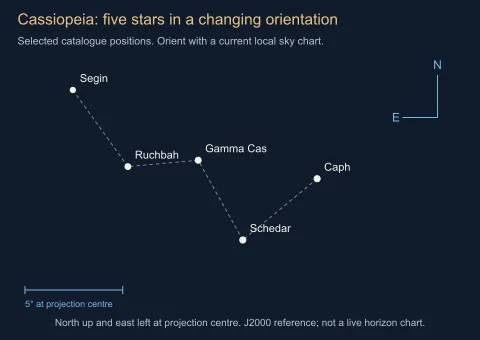
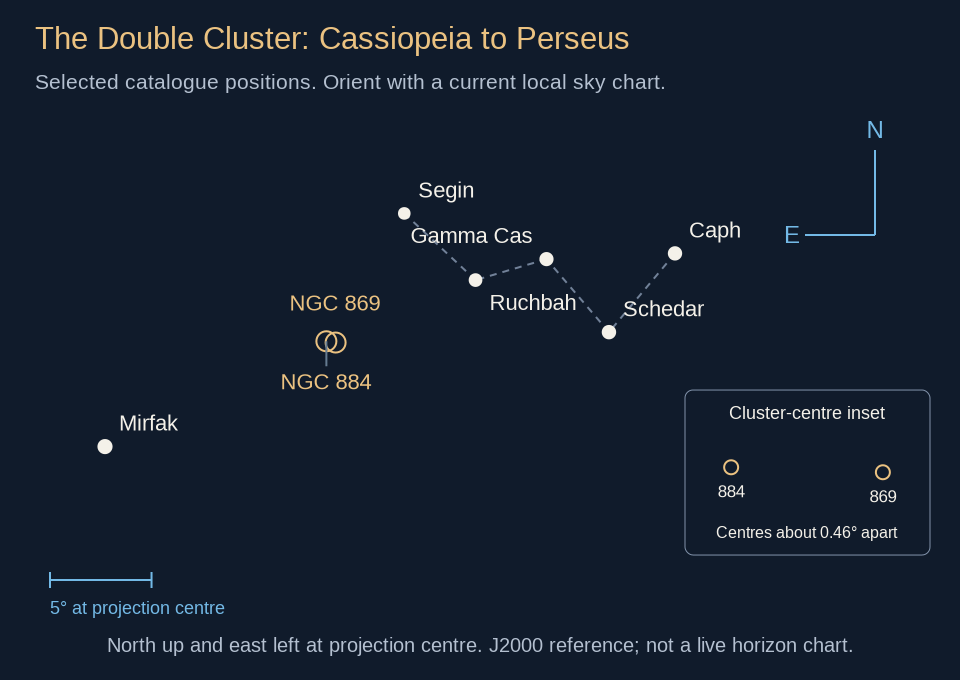
First identify the main Cassiopeia zigzag, then locate Mirfak in Perseus on a current chart. The reference diagram places the Double Cluster between these broader landmarks. NGC 869 is about 7.6° from Ruchbah and 12.1° from Mirfak, providing two independent scale checks.
The two catalogue cluster centres are about 0.46° apart, a little less than the Moon’s approximate apparent width. Their symbols are enlarged on the overview chart. The inset shows their relative centres at a separate scale; it is not a simulated eyepiece photograph. Use the labelled scale for the part of the diagram you are reading.
Choose a field that leaves room around both
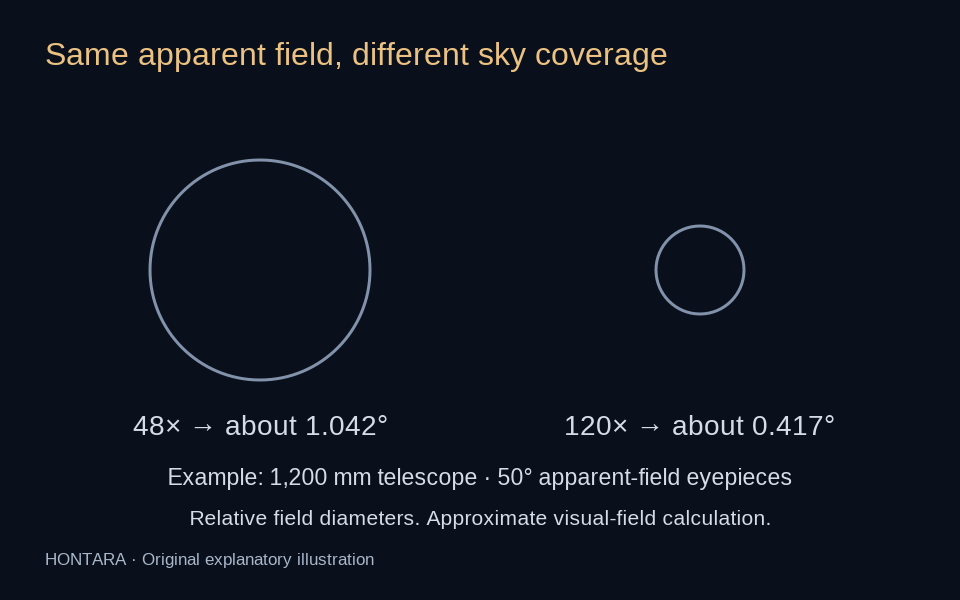
A field around a degree wide can contain the two centres and useful surrounding stars, while a somewhat wider field may make the pair easier to appreciate. The cluster edges are not hard circular boundaries. Begin with your longest appropriate focal-length eyepiece and inspect the whole scene before trying more power.
If changing eyepieces, keep the mount steady and note the calculated true field or a measured estimate. Two cluster centres fitting in a field does not mean every outer member fits. A tight view can be useful for detail while a wider view better shows the relationship between the concentrations.
Make a comparative sketch
Draw two labelled regions and record which appears more concentrated in your actual view. Add a few confident bright points to each region and indicate their relative orientation. Include time in IST, magnification and sky conditions. Do not copy a processed image’s colours into a visual record unless you actually perceive them.
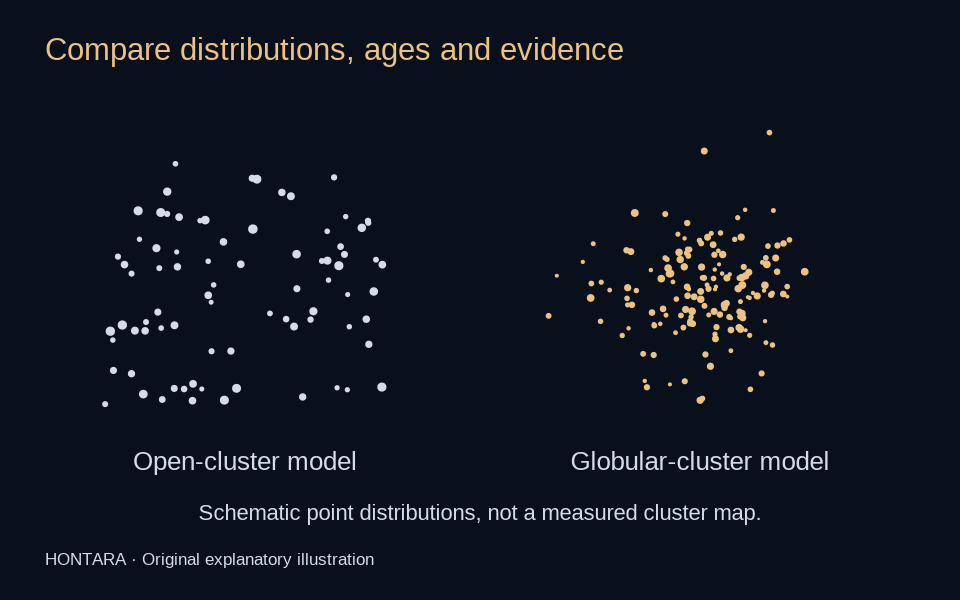
Compare your two regions using cautious language: “more visible points in this central area” is better evidence than “this cluster contains more stars”. Your instrument and sky select which stars you can detect. The clusters’ shared appearance on the sky is an invitation to investigate their physical properties, not a complete measurement of them.
PAUSE AND THINK
Why can a catalogue centre separation of 0.46° be insufficient for choosing a field only slightly wider than that?
Explore the answer
The clusters occupy extended areas around their centres. A field barely covering the centre-to-centre gap may cut off much of each group and leave little surrounding context.