On this page
Start with the tilted axis
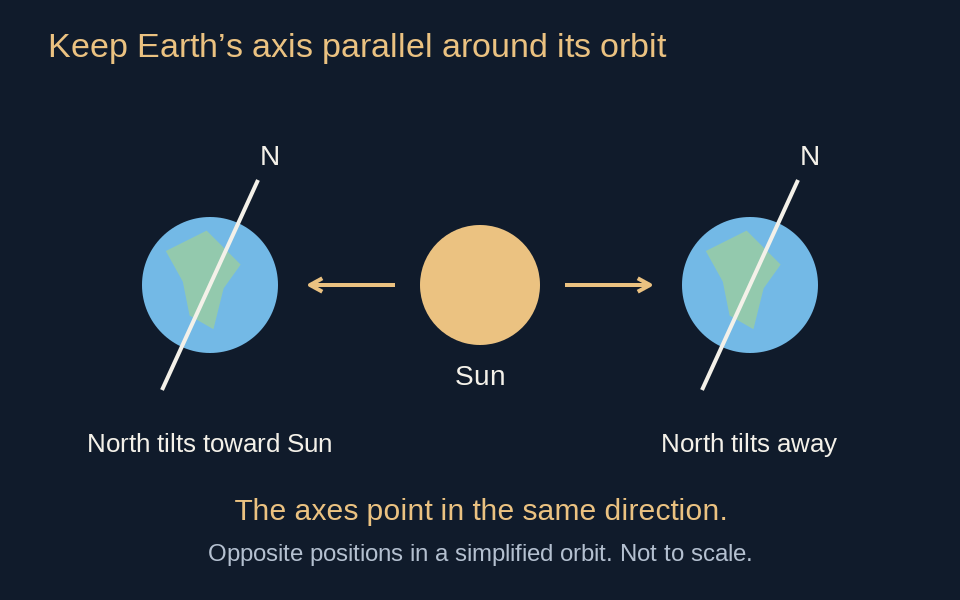
Earth’s axis is tilted by about 23.4 degrees relative to the direction perpendicular to its orbital plane. During a year the axis keeps pointing approximately the same way in space. That means one hemisphere leans toward the Sun during part of the orbit and away during another part. This tilt changes both the angle of sunlight and the length of daylight. Together they produce the main seasonal cycle.
THE BIG IDEAS
- Axial tilt is the main cause of astronomical seasons.
- Sun angle and daylight duration change together.
- Local climate adds patterns that a simple orbit diagram cannot explain.
Direct and slanting sunlight
When sunlight strikes the ground more directly, the same incoming energy is concentrated over a smaller area. When it arrives at a shallow angle, it spreads over a larger area. Longer summer days also allow more time for sunlight to warm the surface. Think of shining a torch squarely onto paper and then tilting the paper. The illuminated patch spreads out, even though the torch itself has not become weaker.
Opposite hemispheres
When the Northern Hemisphere is tilted toward the Sun, it has its summer while the Southern Hemisphere has its winter. Six months later the relationship reverses. If changing Earth–Sun distance were the main explanation, both hemispheres would have summer together. Earth’s orbit is slightly elliptical, but that small distance variation does not cause the opposite seasonal patterns. The tilt is the key geometry to keep in your explanation.
Solstices and equinoxes
A solstice marks one of the two times when the Sun’s apparent path reaches its greatest northern or southern extent. An equinox occurs when the Sun crosses the celestial equator. Around an equinox, day and night are approximately similar in length, though atmospheric refraction and the Sun’s apparent size complicate an exact twelve-hour rule. These terms describe astronomical geometry, not a guarantee that temperatures change suddenly on that date.
Connect the model to Karnataka
In coastal Karnataka, rainfall and monsoon patterns are central to the experience of seasons. Astronomical seasons alone do not describe local weather. Oceans, winds, terrain and heat storage all matter. A useful school investigation is to compare monthly daylight length with monthly rainfall, treating them as different measurements. A globe-and-lamp model explains the sunlight pattern; it does not simulate monsoon circulation or predict whether a particular night will be clear.
PAUSE AND THINK
Why is January summer in Australia but winter in northern India?
Explore the answer
The Southern Hemisphere tilts toward the Sun while the Northern Hemisphere tilts away during that part of Earth’s orbit.