On this page
THE BIG IDEAS
- Rotation changes the view during a night.
- Orbit changes the midnight direction across the year.
- The letter sectors are a model rather than a local finder chart.
Keep two motions separate
Stars appear to move through a night because Earth rotates. The night-time view also changes across the year as Earth orbits the Sun. This activity separates those motions instead of asking one spinning model to explain both at once.
The four lettered sky sectors are invented teaching labels, not constellations or a dated sky chart. A flat top-down orbit picture shows one plane and one representative midnight direction. It does not describe every star visible above a real observer’s horizon.
Build a paper orbit
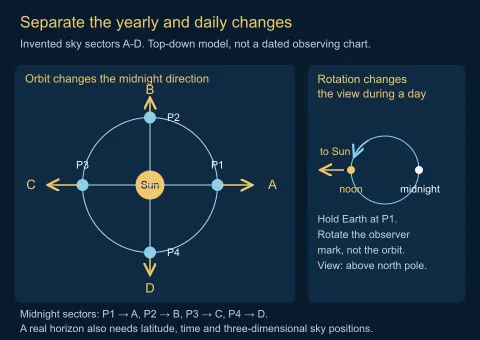
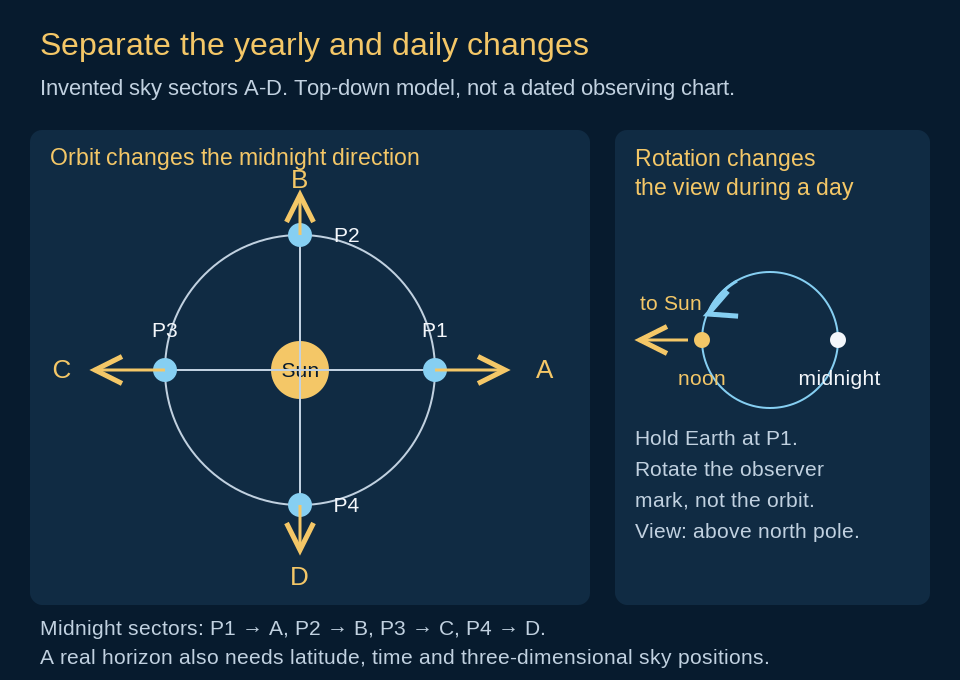
Use paper, pencil, ruler, four card slips, a round Earth token and removable tape. Draw a Sun at the centre of a sheet and a circle around it. Mark P1 on the right, P2 at the top, P3 on the left and P4 at the bottom. These represent four equally spaced orbital positions without named calendar dates.
Place sky cards beyond the orbit: A to the right, B above, C to the left and D below. Treat these directions as distant and fixed during the model year. Draw enough empty space between the orbit and cards for long sightline arrows. No lamp or direct viewing of a light is needed.
Compare midnight directions
Place Earth at P1. Draw a line from the Sun through Earth and continue it outward with an arrow. This anti-solar direction represents the outward-facing local-midnight direction in the simplified plane. It points to A. The opposite direction points toward the Sun and sector C.
Move Earth to P2 without moving the sky cards. Draw the new outward arrow to B. Repeat for P3 and P4, which point to C and D. Complete the worksheet before comparing answers. The midpoint of the night now faces a different broad direction because Earth occupies a different place around the Sun.
Model one day separately
Keep Earth’s orbital centre fixed at P1. Put a removable observer mark on its edge and turn the token anticlockwise as seen from above the north pole. When the mark faces the Sun it represents local noon; on the opposite side it represents local midnight.
Follow the mark through one full turn. This daily rotation changes the observer’s orientation and produces the day-night cycle. It does not move Earth from P1 to P2. In reality rotation and orbit occur together; pausing one here helps identify the role of the other.
Read the result cautiously
The midnight sectors are A, B, C and D at P1 through P4. Six months apart in this circular model, P1 and P3 face opposite sectors. Stars near the Sun’s direction are overwhelmed by daylight rather than physically removed from the sky.
Actual visibility depends on latitude, observing time, declination and horizon as well as orbital position. Some stars are circumpolar from a given latitude and remain visible throughout the year. Finish with one sentence about annual change and a separate sentence about motion during a single night.
PAUSE AND THINK
Does a different midnight sector mean every visible star has changed?
Explore the answer
No. The diagram tracks one representative direction. Real visible regions overlap and some stars remain above the horizon throughout the year from suitable latitudes.
RECORD YOUR OWN EVIDENCE
Your activity sheet
You need: Paper, pencil, ruler, four labelled card slips, round Earth token and removable tape.
Draw a central Sun and four Earth positions: P1 right, P2 top, P3 left and P4 bottom. Place invented distant sectors A right, B top, C left and D bottom. Point a midnight arrow away from the Sun at each position. Then hold Earth at P1 and rotate a separate observer mark to represent one day.
Name or group: Date:
| Earth position | Midnight sector | Sector toward Sun | Motion being tested |
|---|---|---|---|
| P1 right | |||
| P2 top | |||
| P3 left | |||
| P4 bottom |
What are the midnight sectors at P1 and P3 and why do they differ?
What changes during a rotation at fixed P1? Why does this not require completing an orbit?
Record what happened, including uncertain results. Use the answer guidance in this resource to discuss your explanation.